
Most Canadian families think of income tax as a single number: what’s my rate, what do I owe. In reality, provincial brackets, tax credits, CPP and EI deductions, and income-tested benefits like the Canada Child Benefit all move at once, and none of them work quite the way most people assume. A family earning $95,000 in Ontario and a family earning the same amount in Alberta can end up with meaningfully different tax bills and benefit payments, simply because of where they live.
This guide breaks down exactly how the system works for the 2026 tax year: what three Canadian families at different income levels actually owe once every bracket, credit, and benefit is factored in, and where the biggest opportunities to keep more of your income actually sit.
This article is educational and doesn’t recommend or link to any financial products. All figures are sourced from the CRA and cited inline.
 TAXES
TAXES
In This Article
- What Is Income Tax in Canada?
- How Canada’s Progressive Tax System Actually Works
- Federal Tax Brackets for 2026
- Why Your Province Changes Everything
- Three Families, Three Provinces: What They Owe
- Total Income vs. Taxable Income
- Tax Credits vs. Tax Deductions
- Why Your Paycheque Is Smaller Than Your Bracket Suggests
- Income the CRA Doesn’t Tax At All
- Government Benefits: The CCB and the New CGEB
- Not All Income Is Taxed the Same Way
- Registered Accounts: Your Biggest Lever
- Five Mistakes Canadian Families Make
- Tax Planning Is a Year-Round Job
- How Taxes Fit Into Your Bigger Picture
| Family | Province | Income | Fed + Prov Tax | Effective Rate | Annual CCB |
|---|---|---|---|---|---|
| Devon, single parent, 1 child | Alberta | $58,000 | $8,635 | 14.9% | $6,774 |
| Priya, 2 children | Ontario | $95,000 | $19,947 | 21.0% | $7,051 |
| Marcus, 1 child | British Columbia | $155,000 | $40,268 | 26.0% | $2,725 |
What three Canadian families owe for the 2026 tax year. Figures include the Ontario Health Premium where it applies, but otherwise assume standard employment income with only the basic personal amount claimed. Full breakdown below.
What Is Income Tax in Canada?
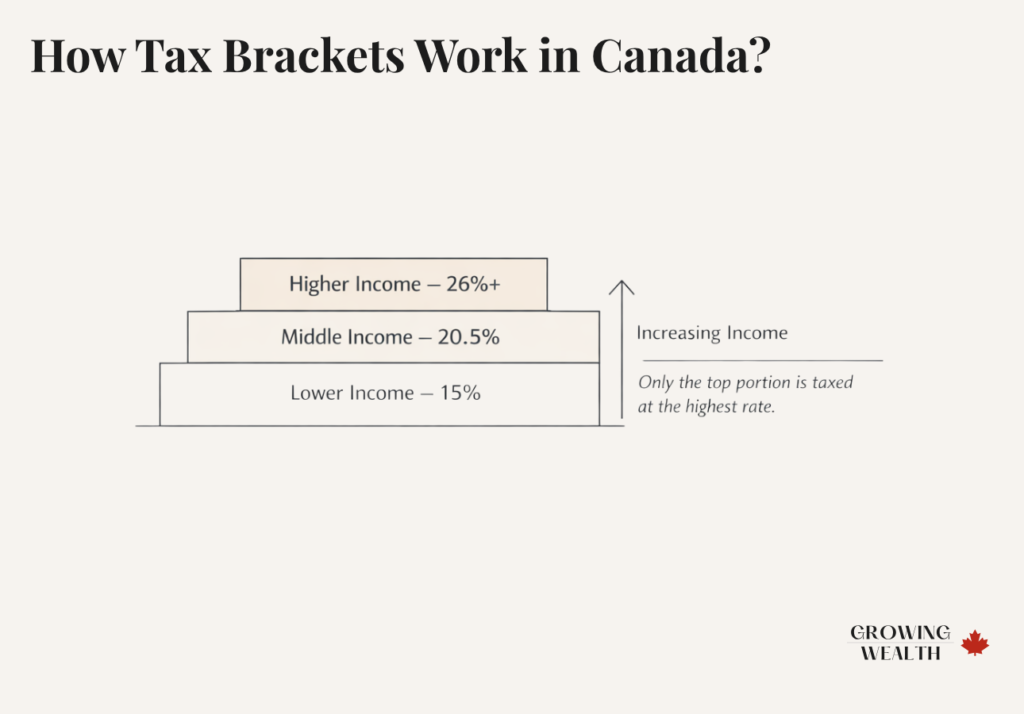
Income tax in Canada is progressive: income is taxed in layers, not at a single flat rate. As income rises, higher rates apply, but only to the portion of income inside each bracket, never to the whole amount.
Every working Canadian pays both federal tax and provincial or territorial tax, combined into a single return filed with the Canada Revenue Agency. The CRA administers the system nationally, while each province sets its own brackets and rates on top of the federal ones. You can review the CRA’s overview of income taxes in Canada.
This layered structure is the reason tax planning works at all. Because tax is not flat, reducing taxable income by even a small amount can remove that income from your highest bracket entirely.
How Canada’s Progressive Tax System Actually Works
The most common misunderstanding about Canadian tax is that moving into a higher bracket means your entire income gets taxed at that higher rate. It does not.
Take a straightforward example. For the 2026 tax year, if you earn $70,000, the first $58,523 is taxed at 14%, and only the remaining $11,477 is taxed at 20.5%.
This distinction between effective rate and marginal rate matters because it’s what determines whether a raise, a bonus, or a side income stream is actually worth pursuing. Nobody loses money by earning more in Canada. The higher rate only ever applies to the new income, never the income you already had.
Federal Tax Brackets for 2026
These are the federal brackets that apply to every Canadian, regardless of province:
| Taxable Income | Federal Rate |
|---|---|
| $0 – $58,523 | 14% |
| $58,523 – $117,045 | 20.5% |
| $117,045 – $181,440 | 26% |
| $181,440 – $258,482 | 29% |
| Over $258,482 | 33% |
Source: CRA, confirmed for 2026. Thresholds are indexed to inflation and adjust every January — the lowest rate itself was cut from 14.5% to 14% partway through 2025, so it’s worth a quick check each year.
You can always check the CRA’s current tax rates page directly for the latest confirmed figures. For a deeper look at exactly how income moves through each bracket, How Tax Brackets Work in Canada covers the mechanics in more detail.
Why Your Province Changes Everything
Federal brackets are the same for every Canadian. Provincial brackets are not, and the difference is bigger than most people expect.
| Ontario | Alberta | British Columbia | |
|---|---|---|---|
| Lowest rate | 5.05% (to $53,891) | 8% (to $61,200) | 5.06% (to $50,363) |
| Top rate | 13.16% (over $220,000) | 15% (over $370,220) | 20.50% (over $265,545) |
| Basic personal amount | $12,989 | $22,769 | $13,216 |
| Notable feature | 20%/36% surtax, plus a Health Premium up to $750/year | Nearly double the BPA of most provinces | Most brackets of the three (7 total) |
Alberta’s basic personal amount ($22,769) is close to double Ontario’s ($12,989), which means an Alberta resident shields nearly twice as much income from provincial tax before paying a cent. Ontario, meanwhile, layers a surtax on top of its bracket rates once provincial tax owed crosses roughly $5,818, plus a separate Health Premium of up to $750 a year, which together push its effective top combined rate to 53.53%, among the highest in the country.
Sources: CRA Payroll Deductions Tables (T4032), Ontario, Alberta, and British Columbia editions, effective January 2026.
Three Families, Three Provinces: What They Owe for the 2026 Tax Year
Bracket tables only tell part of the story. Here’s what three income levels actually owe for the 2026 tax year, once federal tax, provincial tax, and the Canada Child Benefit are all factored in.
Devon’s entire income falls inside the first federal and Alberta brackets. Alberta’s basic personal amount is $22,769, nearly double most provinces, which does most of the work keeping this bill low.
As a single parent, Devon’s CCB is based on personal income alone. At $58,000, that’s inside the first reduction band (7% on income over $38,237 for one child) — a $1,383 reduction from the $8,157 maximum.
Priya’s income crosses into Ontario’s second bracket, and lands her right at the edge of a surtax most people never see coming.
Ontario’s surtax kicks in once provincial tax exceeds $5,818. Priya’s net Ontario tax is just $9 over that line — a token $1.81 in surtax. Ontario also charges a separate Health Premium, capped at $750 for anyone earning over $72,000. Ten thousand dollars less in income and Priya would have avoided the surtax entirely, though the Health Premium would still apply.
Priya’s two children are both in the 6–17 age bracket, so her maximum CCB is $13,766. At $95,000 in family income, she’s in the second CCB reduction zone: a $6,022 fixed reduction plus 5.7% of income over $82,847.
Marcus is the sole earner in his household. His income spans four federal brackets and reaches BC’s fifth bracket.
Marcus’s effective rate is 26.0%, but his marginal rate on his next dollar earned is 40.70%. That gap is the single most misunderstood number in Canadian tax.
With one child under six and family income of $155,000, Marcus’s household is well into the second CCB reduction zone: a $3,123 fixed reduction plus 3.2% of income over $82,847. The benefit doesn’t disappear entirely until family income climbs much further.
These figures include the Ontario Health Premium where it applies, but otherwise assume standard employment income with only the basic personal amount claimed. CPP and EI premiums, additional credits (childcare, medical, donations), and RRSP contributions would change every one of these numbers, in some cases significantly. What to do with your tax refund covers what to do once you know where you land.
Total Income vs. Taxable Income
Total income is everything earned in a year: employment income, side income, rental income, investment income. Taxable income is what’s left after deductions are applied, and it’s the number that actually determines your tax bill.
Deductions like RRSP contributions, childcare expenses, and eligible employment costs reduce taxable income directly. For families near a bracket threshold or a benefit phase-out zone, like Priya just above Ontario’s surtax line, a deduction doesn’t just lower this year’s tax bill; it can also change what benefit tier the family lands in.
Getting organized before filing season matters more than most people think. A Tax Filing Checklist for Canadians is worth working through before documents start arriving in the new year.
Tax Credits vs. Tax Deductions
These two terms get used interchangeably, and they shouldn’t be.
Reduces taxable income before tax is calculated.
Example: RRSP contributions. Contribute $5,000, and $5,000 less income gets taxed — at whatever your marginal rate happens to be.
Worth more to someone in a higher bracket, since it removes income taxed at a higher rate.
Reduces tax owed after it’s already been calculated.
Example: the basic personal amount. Applied at the lowest tax rate, regardless of what bracket you’re in. Most non-refundable credits work this way: donations, medical expenses, tuition.
Worth the same dollar amount to almost everyone, since it’s calculated at a fixed rate.
Why Your Paycheque Is Smaller Than Your Bracket Suggests
Income tax isn’t the only thing coming off a Canadian paycheque. CPP (Canada Pension Plan) and EI (Employment Insurance) are separate, mandatory deductions, and they’re a common source of confusion when someone tries to reconcile their bracket rate with what actually lands in their bank account.
Neither CPP nor EI is income tax. Both are contributions to programs that pay out later: CPP as retirement income, EI as short-term replacement income. Employers match the CPP rate; self-employed Canadians pay both sides, up to $8,460.90 a year. They still reduce take-home pay today, which is why a $70,000 salary and a 15% effective tax rate don’t fully explain a given paycheque.
Income the CRA Doesn’t Tax At All
Not everything that lands in a bank account is taxable. Some of the most common tax-free sources for Canadian families:
Knowing what’s exempt matters just as much as knowing what’s taxed. It’s a common source of unnecessary worry at filing time.
Government Benefits: The CCB and the New CGEB
Government benefits are closely tied to a family’s tax return, and two of the biggest for families with children are the Canada Child Benefit and what used to be the GST/HST credit.
The Canada Child Benefit (CCB) is a tax-free monthly payment for families with children under 18, based on adjusted family net income (AFNI). The figures above reflect the July 2026 reset. The benefit begins reducing once AFNI passes $38,237, and reduces further above $82,847. Review how the Canada Child Benefit works directly on the CRA site, or estimate your own payment using the CRA’s Canada Child Benefit calculator.
As of the July 2026 payment, it’s officially the Canada Groceries and Essentials Benefit (CGEB) — the same quarterly, tax-free, income-tested structure Canadians have always known as the GST/HST credit, but with a 25% increase in payment amounts, locked in through 2031. Full details are on the CRA’s Canada Groceries and Essentials Benefit page.
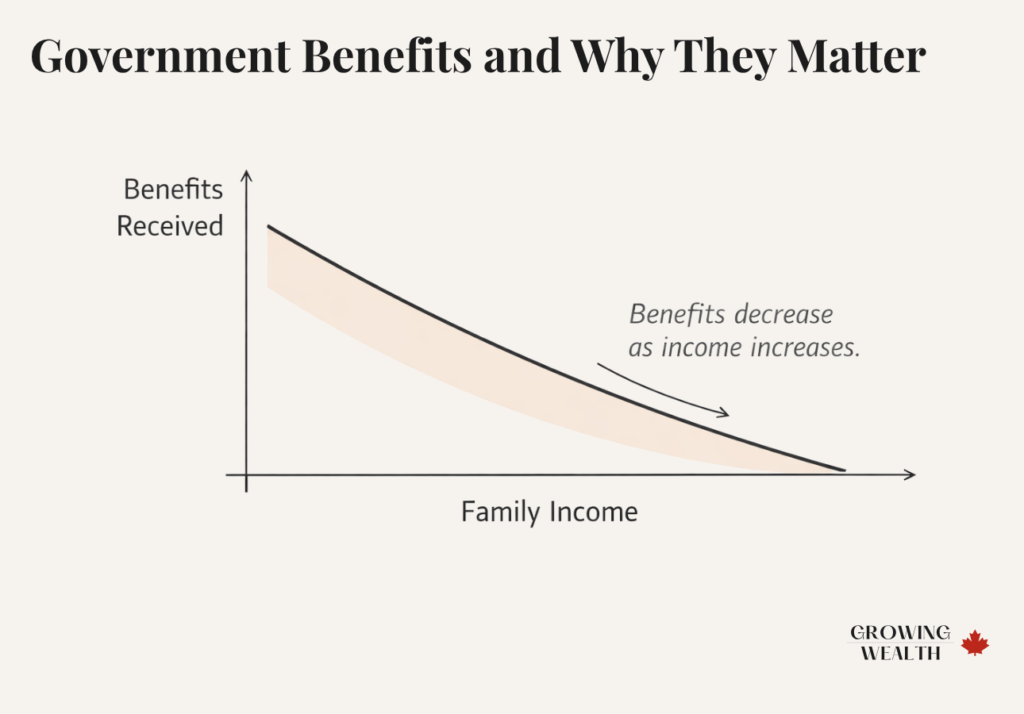
Because both benefits are income-tested, an increase in family income can mean a real reduction in what a family receives, sometimes enough to offset a raise almost entirely once the tax owed on that raise is factored in too. This is one reason many families look at tips to reduce your Canadian tax bill as a genuine household strategy, not just a tax-season exercise.
Not All Income Is Taxed the Same Way
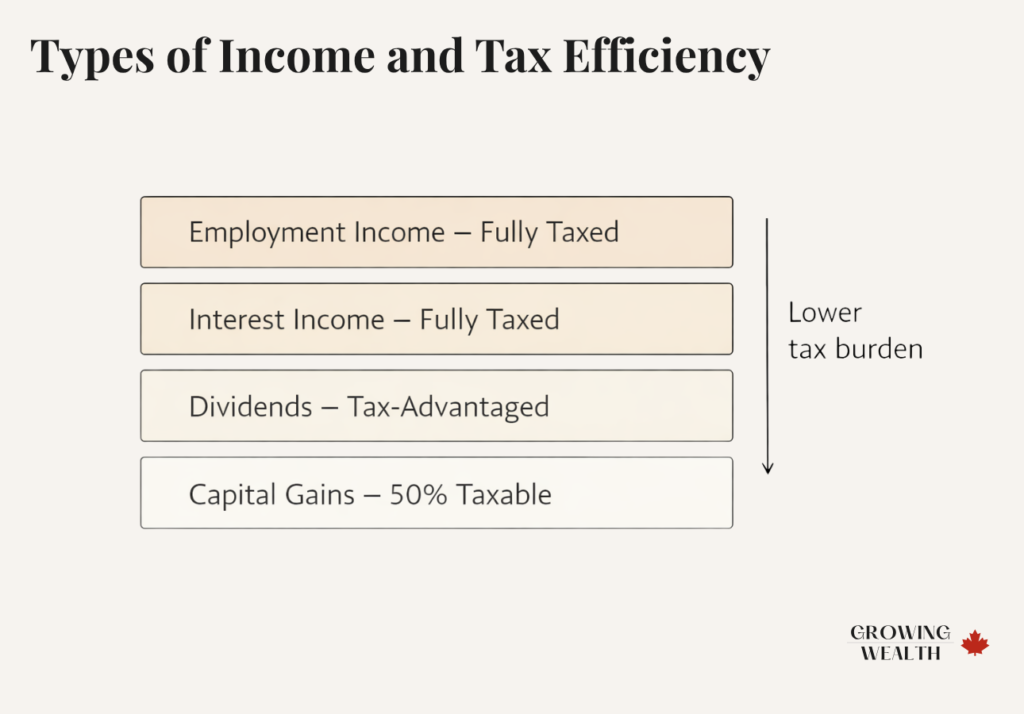
How income is earned matters just as much as how much is earned.
For families building long-term wealth, this is where investment account structure starts to matter as much as the investments themselves. How to start investing in Canada is a reasonable next step once the basics of how income is taxed start to click.
Registered Accounts: Your Biggest Lever
Registered accounts are the single most effective tool most Canadian families have for managing what they owe and what they keep.
| RRSP | TFSA | FHSA | |
|---|---|---|---|
| Contribution deductible? | Yes | No | Yes |
| Growth | Tax-deferred | Tax-free | Tax-free |
| Withdrawal | Taxed as income | Tax-free | Tax-free (first home) |
| Counts toward AFNI? | Yes, on withdrawal | Never | No, if used for a home |
| Best for | Retirement, lower future bracket | Flexible savings, near benefit thresholds | First-time home buyers |
Because an RRSP contribution lowers AFNI, it can also increase CCB and CGEB payments in the same year, on top of the tax refund. Priya, from the example above, sitting just over Ontario’s surtax line, is a textbook case: a modest RRSP contribution would pull her taxable income back under $94,907, eliminate the surtax entirely, and raise her CCB at the same time.
A TFSA’s withdrawal flexibility makes it the better source to draw from in a year when a family is close to a benefit threshold — since nothing pulled from it ever counts toward AFNI, it can’t accidentally push a family into a lower CCB or CGEB tier.
Five Mistakes Canadian Families Make With Their Taxes
A $5,000 RRSP deduction and a $5,000 medical expense credit do not save the same amount of tax; conflating them leads to inaccurate expectations at filing time.
Families focus on the tax refund and miss that the same contribution can also increase CCB and CGEB payments by lowering AFNI.
A new job, a raise, or a second income source can shift a family into a new bracket or benefit tier mid-year; without adjusting, the surprise shows up at filing time instead.
A raise that looks identical on paper can land very differently after tax, depending on the province, as the Ontario/Alberta/BC comparison above shows.
Both the CCB and the CGEB require an up-to-date tax return to keep paying out, even in a year with no income to report. Missing a filing can pause benefits that have nothing to do with the reason they were skipped.
Tax Planning Is a Year-Round Job
Tax planning shaped entirely by decisions made in April is planning after the fact. The moves that actually change an outcome, RRSP timing, benefit-threshold awareness, income splitting where available, happen throughout the year, not in the weeks before the filing deadline.
Even small, deliberate adjustments, timed correctly, compound into a meaningfully different outcome by the time a return is actually filed.
How Taxes Fit Into Your Bigger Financial Picture
Taxes touch savings, investing, and every other financial decision a family makes; treating them as a once-a-year task rather than part of an ongoing system is where most of the missed opportunity above actually comes from.
A structured approach, like a simple family finance system for Canadians, brings tax, savings, and investing decisions into one system instead of three separate ones. Consistency matters just as much as any single strategy; the power of financial habits is what turns a good plan into money actually kept.
The Bottom Line
The Canadian tax system runs on a small number of consistent rules: brackets apply in layers, provinces add their own on top, and benefits like the CCB and CGEB respond to income the same way tax does.
Most families don’t need advanced strategies. They need to understand how their specific income, in their specific province, moves through this system, and where an RRSP contribution, a filing deadline, or a provincial difference actually changes the outcome.
Once taxes are treated as one connected system rather than a once-a-year task, the numbers above stop being abstract, and start being a plan.
Frequently Asked Questions
It depends heavily on province. For the 2026 tax year, a $100,000 earner in Alberta owes meaningfully less combined tax than the same earner in Ontario or BC, largely due to Alberta’s high basic personal amount and lower top rates. Most Canadians land in a 20–28% effective tax range at this income level, even though marginal rates are higher.
It’s a federal tax credit, $16,452 for most Canadians for the 2026 tax year, that shields a portion of income from tax entirely. Every province also has its own BPA on top of the federal one, and these vary significantly: Alberta’s is nearly double Ontario’s.
No. The CCB is completely tax-free and isn’t reported as income. Household income still determines how much a family receives, but the payment itself is never taxed.
It’s the new name for the GST/HST credit, effective the July 2026 payment. Same quarterly, tax-free, income-tested structure Canadians already know, but with a 25% increase in payment amounts, in place through 2031.
Common methods include RRSP contributions, childcare expense deductions, and claiming eligible expenses. Because Canada’s system is progressive, reducing taxable income lowers the portion of income exposed to the highest bracket a family reaches.
For most Canadians, the filing deadline is April 30. Self-employed individuals, and their spouse or common-law partner, have until June 15 to file, though any tax owed is still due April 30 to avoid interest.
Yes, if you want to keep receiving benefits. The CRA uses your tax return to calculate the Canada Child Benefit, the CGEB, and provincial credits, so skipping a return in a no-income year can pause payments that have nothing to do with why you didn’t file.
About two weeks if you file online with direct deposit. Paper returns typically take around eight weeks. Filing early in the season generally means faster processing either way.
Want to turn what you’ve just learned into a concrete plan? Read FHSA vs TFSA vs RRSP: Which Should You Use? — the natural next decision once you understand how your tax picture works.