
If you’re still paying $15–$20 a month just to have a chequing account, you’re leaving real money on the table. A family paying $180–$240 a year in banking fees — for the exact same services available for free elsewhere — is one of the most common and most fixable money leaks in Canada.
The good news: Canada’s digital banking landscape has matured significantly, and switching has never been easier. Whether you’re looking for a no-fee chequing account, a savings account that actually pays you something, or a bank that does both well, there are solid options across every category.
One note before we get into it: deposit insurance matters. All of the accounts in this article are protected by the Canada Deposit Insurance Corporation (CDIC), which covers eligible deposits up to $100,000 per depositor, per insured category. It’s worth understanding before you move money anywhere new.
This article contains affiliate links. We may earn a commission if you open an account — at no cost to you. We only recommend products we’ve researched and trust.
 Banking
In This Article
- Why Most Canadian Families Are Overpaying
- Quick Comparison: Best Bank Accounts in Canada
- Best No-Fee Chequing Accounts (Simplii, Tangerine & Neo Chequing)
- Best High-Interest Savings Accounts (EQ Bank & Neo Savings)
- Best for Investing + Banking Together
- How Traditional Banks Compare
- How to Choose the Right Account for Your Family
- Switching Banks: What It Actually Looks Like
- The Bottom Line
- Frequently Asked Questions
Why Most Canadian Families Are Overpaying
Before getting into the best options, it’s worth understanding what most families are comparing against.
A standard TD Everyday Chequing account costs $10.95/month — $131.40/year — for 25 transactions. TD’s Every Day Savings account earns 0.01% interest. On a $10,000 balance, that’s about $1 in interest for the entire year.
Compare that to EQ Bank: $0/month, 2.75% everyday interest. On that same $10,000, you’d earn $275/year — and keep the $131 you were paying in fees. That’s a $405 swing for the same core banking services: deposits, bill payments, and transfers.
The trade-off is real: digital banks don’t have physical branches. But for most Canadian families who already handle the vast majority of their banking through an app, this is a trade-off worth making — especially when you can keep a small amount at your existing bank for the rare times you need in-person service.
To compare accounts on your own terms, the Financial Consumer Agency of Canada (FCAC) offers an independent bank account comparison tool that isn’t affiliated with any bank.
Quick Comparison: Best Bank Accounts in Canada
| Bank | Account Type | Monthly Fee | Savings Rate | Best For |
|---|---|---|---|---|
| EQ Bank | Personal Account (hybrid) | $0 | Up to 2.75% | High everyday interest, no games |
| Neo | Neo Chequing account | $0 | 1–3% cashback on gas & groceries | Cashback everyday chequing |
| Neo | Neo Savings account | $0 | 2.00–2.75% (tiered by balance) | Goal-based tiered savings |
| Simplii Financial | Chequing + HISA | $0 | 4.5% promo / 1.00% base | No-fee chequing with ATM access |
| Tangerine | Chequing + Savings | $0 | 4.5% promo / 0.30% base | Full-service no-fee banking |
| Wealthsimple Cash | Cash Account | $0 | Up to 2.25% | Investing + banking in one app |
| TD Bank | Everyday Chequing | $10.95/mo | 0.01% | Traditional banking, branch access |
All rates are variable and subject to change. Promotional rates apply to new customers for a limited time — base rates apply after the promotional period ends.
Best No-Fee Chequing Accounts in Canada
All three of these accounts charge nothing — no monthly fee, no minimum balance. The differences come down to what you value most: ATM access, budgeting tools, or cashback on everyday spending.
Simplii Financial is CIBC’s digital banking arm, which means two things that matter: your money is CDIC-insured, and you get access to 3,400+ CIBC ATMs across Canada — a significant practical advantage over most digital banks.
Chequing Account
- $0 monthly fee, unlimited transactions
- No minimum balance required
- Access to 3,400+ CIBC ATMs fee-free
- Free Interac e-Transfers
- Overdraft protection available
- Earns 0.01% interest
High-Interest Savings Account (HISA)
- Promotional rate: ~4.5% for new customers (limited time)
- Base rate: up to 1.00% after the promo ends
- No monthly fee, no minimum balance
The 4.5% savings rate is genuinely attractive for a few months, but 1.00% is the rate you’ll live with long-term. If savings growth is your priority, EQ Bank’s everyday 2.75% beats it without any promotional games.
- Unlimited transactions — no counting your purchases
- CIBC ATM network is a real-world advantage most digital banks can’t match
- Familiar experience for families coming from a big bank
- Strong mobile app
- CDIC insured
- Base savings rate (1.00%) is well below EQ Bank’s 2.75% once the promo expires
- No physical Simplii branches
- Customer service wait times can be long
Tangerine is one of Canada’s original digital banks — now owned by Scotiabank — and it remains one of the most complete no-fee banking options available. With over two million customers and more than a decade of operation, it’s as close to a traditional bank experience as you’ll get without the fees.
Chequing Account
- $0 monthly fee, unlimited transactions
- Earns up to 0.10% interest on your balance
- Access to 3,500+ Scotiabank ATMs fee-free
- Free Interac e-Transfers and mobile cheque deposit
- Automatic savings features built into the app
High-Interest Savings Account (HISA)
- Promotional rate: ~4.5% for new customers (typically 5 months)
- Base rate: up to 0.30% after the promo ends
A 0.30% base savings rate isn’t competitive. If you’re drawn to Tangerine primarily for the savings rate, understand that the promotional period ends — and at 0.30%, you’d earn $30/year on $10,000. EQ Bank at 2.75% earns $275 on the same balance, no promo required. Tangerine’s strength is the chequing experience and budgeting tools, not the long-term savings rate.
- Most established digital bank in Canada — reliable, well-run
- Scotiabank ATM network is extensive
- Best-in-class budgeting tools: goal-based savings buckets, automatic savings rules, spending categorization
- Mobile cheque deposit
- CDIC insured
- Base savings rate (0.30%) is the lowest on this list after promos end
- No access to Scotiabank branches for in-person service
- Promo rates are heavily marketed but short-lived
The Neo Chequing account is a full-service, no-fee chequing account that does something most chequing accounts don’t: it pays you cashback just for spending on essentials. Earn 1% on gas and groceries via the Neo Money™ Card, with rates that increase automatically as your balance grows — no action required.
Neo Chequing Account at a Glance
- $0 monthly fee, $0 NSF fees
- 1% cashback on gas and groceries via the Neo Money™ Card (base rate)
- Average 5% cashback (up to 15%) at 10,000+ Neo partner locations
- Free Interac e-Transfers (send, receive, and scheduled)
- Free ATM withdrawals at any Canadian ATM
- Real-time spend tracking and smart budgeting tools
- Joint account available — both co-owners earn cashback independently
- Funds held in trust at one or more CDIC member institutions, eligible for CDIC protection up to $100,000
Cashback Reward Levels
Your cashback rate on gas and groceries increases automatically based on your Neo Chequing balance:
| Level | Balance Required | Gas & Groceries | Everything Else |
|---|---|---|---|
| Level 1 | $0 | 1% | 0% |
| Level 2 | $5,000 | 2% | 0.5% |
| Level 3 | $10,000 | 3% | 1% |
Membership Tiers
Neo Chequing includes optional membership tiers that unlock additional benefits — and both can be accessed for free based on your balance:
- Build membership ($7.99/month, free with $5,000+ in any Neo account) — credit score monitoring, credit builder tools, and ATM fee reimbursements
- Grow membership ($12.99/month, free with $20,000+ across Neo Chequing and Neo Savings) — all Build benefits plus no foreign transaction fees (up to $10,000/month in foreign spend) and 2.75% interest on Neo Savings
- Cashback on gas and groceries from day one — no credit card required
- $0 NSF fees is a genuine differentiator vs. traditional banks
- Reward levels increase automatically as your balance grows
- Smart budgeting tools and real-time spend tracking built in
- Build and Grow memberships can both be accessed for free
- Cashback subject to monthly spend limits — rates may reduce once limits are reached
- No physical branches or CIBC/Scotiabank ATM network
- Neo is not a CDIC member — funds are held in trust at CDIC member institutions
- Newer platform with less established history than Tangerine or Simplii
Neo Chequing account is offered by Neo Financial Technologies Inc. Funds are held in trust at one or more CDIC member institutions. Neo is not a CDIC member institution. Eligible funds may be protected by CDIC up to applicable limits. Cashback earned via the Neo Money™ Card; subject to monthly spend limits. Partner cashback subject to availability and may vary. See Neo’s terms for complete details.
Best High-Interest Savings Accounts in Canada
Both EQ Bank and Neo offer competitive everyday savings rates with no fees and no promotional tricks. The key difference: EQ Bank earns 2.75% on every dollar from the first dollar, while the Neo Savings account starts at 2.00% and scales up to 2.75% at $20,000+. The right choice depends on your balance and whether you’re already in the Neo ecosystem.

EQ Bank is our top pick for savings — not because of a promotional rate, but because their everyday rate is consistently among the highest in Canada without any time limits or conditions. Their Personal Account works as a hybrid chequing-and-savings account: you can pay bills, send e-Transfers, and earn 2.75% on every dollar at the same time.
There’s no promotional period to track, no base rate to fall back to. What you see is what you get — and that consistency is exactly why we recommend it.
The Personal Account
- $0 monthly fee
- Up to 2.75% interest on your full balance, every day
- Free Interac e-Transfers (unlimited)
- Free bill payments
- No minimum balance
- CDIC insured up to $100,000
- Debit card available
- No promotional tricks — the everyday rate is the rate
- Hybrid chequing/savings: earn interest while still doing daily banking
- Clean, simple app
- No minimum balance, no monthly fee
- CDIC insured
- Limited physical ATM access — not ideal if you regularly need cash
- No Scotiabank or CIBC ATM network to fall back on
- No budgeting tools or spending insights
- Works best for families comfortable doing all banking digitally
The Neo Savings account is a separate product from the Neo Chequing account — a straightforward high-interest savings account with tiered rates based on your Neo membership. No promotional period, no switching required: just a competitive everyday rate with no fees.
Neo Savings Account at a Glance
- $0 monthly fee, no minimum deposit
- Tiered interest rates — based on your Neo membership tier
- Open up to 10 savings accounts to organize by goal (vacation, down payment, emergency fund)
- Joint account available
- Instant access — move money anytime, no lock-in periods
- $0 transaction fees
- CDIC-eligible deposit protection
Interest Rate Tiers
Rates as of September 2026, per Neo’s official interest rates page:
| Neo Membership Tier | Interest Rate |
|---|---|
| Base account | 2.00% |
| Build membership | 2.50% |
| Grow membership | 2.75% |
Boosted rates require an active Build or Grow membership. All rates are variable and subject to change.
- Rates are tied to your membership tier — no chasing promos or switching accounts
- Up to 10 goal-based accounts in one app — useful for families tracking multiple savings targets
- Joint account available
- No lock-in periods — access your money anytime at no cost
- Pairs naturally with the Neo Chequing account in a single app
- Base rate (2.00%) is lower than EQ Bank’s everyday 2.75% at any balance
- Boosted rates depend on your Neo membership tier (Build or Grow), not just this account’s balance
- No registered account options (TFSA, RRSP) — savings are not sheltered from tax
The Neo Savings account is offered by Neo Financial Technologies Inc. Funds are held in trust at one or more CDIC member institutions. Neo is not a CDIC member institution. Eligible funds may be protected by CDIC up to applicable limits. Rates are variable and subject to change. See Neo’s terms for complete details.
Best for Investing + Banking Together
If your family invests through Wealthsimple — or is planning to — the Wealthsimple Cash account is the most convenient way to connect your everyday banking to your investment accounts. Everything lives in one app: your TFSA, RRSP, non-registered accounts, and your day-to-day spending account.
The interest rate (up to 2.25%) is lower than EQ Bank’s everyday 2.75%, and that’s worth acknowledging. But the integration value is real, particularly for families who want one place for all their money rather than logging into three different apps.
Wealthsimple Cash Account
- $0 monthly fee
- Up to 2.25% interest on deposits
- Visa debit card — works anywhere Visa is accepted
- Free Interac e-Transfers and bill payments
- Seamless transfers to/from Wealthsimple TFSA, RRSP, and investment accounts
- No minimum balance
- CDIC insured
- One-app experience for banking + investing is genuinely useful for busy families
- Visa debit card is a practical advantage — not all digital banks offer one
- Seamless transfers between Cash and investment accounts
- Strong mobile experience
- CDIC insured
- 2.25% interest rate is the lowest of the savings-focused accounts on this list
- Best value if you’re already using Wealthsimple for investing — less compelling standalone
- No dedicated ATM network (you can use any ATM but may pay fees)
How Traditional Banks Compare: The TD Example
We’re including TD not because it’s one of the best options for most families — it isn’t — but because it’s where a lot of Canadian families currently bank, and understanding the comparison makes the decision clearer.
| Feature | TD Everyday Chequing | TD Every Day Savings |
|---|---|---|
| Monthly fee | $10.95/mo ($131.40/yr) | $0 |
| Fee waiver | Maintain $4,000 balance at all times | N/A |
| Transactions | 25 included (extras cost extra) | — |
| Interest rate | 0.00% | 0.01% |
| Interest on $10,000 | $0/year | ~$1/year |
| Branch access | 1,100+ locations | 1,100+ locations |
| CDIC insured | ✓ | ✓ |
When does a big bank still make sense? When you regularly need in-person branch services, have an existing mortgage or credit relationship you genuinely benefit from consolidating, run a small business that needs features digital banks don’t offer, or have elderly family members who rely on in-branch banking. For most families handling day-to-day banking digitally, the $131/year in fees and near-zero savings interest are hard to justify. The FCAC’s switching bank accounts guide outlines your rights and the process if you decide to make a move.
How to Choose the Right Bank Account for Your Family
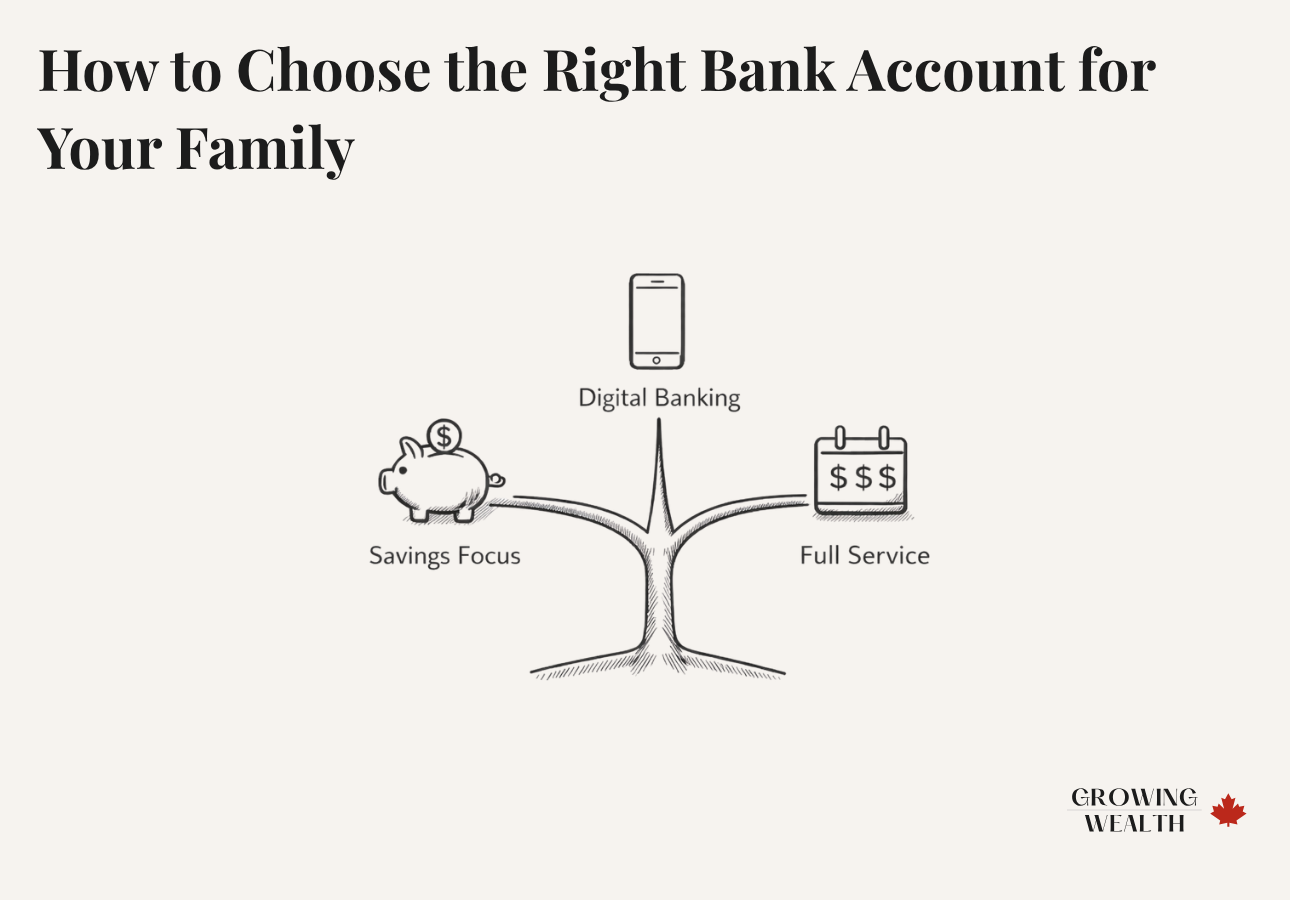
There’s no single right answer — the best account depends on how your family actually uses your money. Here’s a direct decision guide:
Two Accounts, Zero Fees
A no-fee chequing account at Simplii or Tangerine for everyday spending and ATM access, plus EQ Bank for savings. Or use Neo Chequing for cashback on essentials and Neo Savings for your savings goals — everything in one app. Either way, you’re paying nothing in fees.
Money flows in on payday, gets sorted automatically, and you’re not thinking about it every month. This pairs naturally with a simple automated family finance system — and once it’s set up, it runs itself.
Switching Banks: What It Actually Looks Like

Switching your main bank account sounds complicated. It usually isn’t. Most families complete the full switch in under a month and spend less than two hours on the whole process.
Takes 5–10 minutes online. You’ll need your Social Insurance Number and a piece of government-issued ID. Most accounts are approved and usable the same day.
Contact your employer’s payroll department with your new account details. Allow one full pay cycle for the change to take effect. Keep your old account active until at least one deposit lands in the new one.
Pull up your last 2–3 months of bank statements and list every automatic payment — insurance, utilities, gym, streaming, phone. Update each one with your new banking info. This is the most time-consuming step: budget 30–45 minutes.
Keep it active with a small balance for 30–60 days to catch anything you missed. Then close it. The FCAC’s step-by-step switching guide explains what consumer protections apply during this process.
The Bottom Line
The best bank account for your family isn’t necessarily the one with the highest promotional rate — it’s the one that fits how you actually bank, charges you nothing to do it, and grows your savings in the background without requiring constant attention.
For most Canadian families, that means at least one no-fee digital account. If you’re paying monthly fees right now, Simplii or Tangerine is the easiest first move. If growing your savings is the goal, EQ Bank or Neo offer the strongest everyday rates without any promotional fine print. If budgeting and spending tools matter, Tangerine is in a class of its own. And if you’re in the Wealthsimple ecosystem, adding the Cash account makes everything simpler.
The average family that makes this kind of switch saves $300–$400 in the first year through eliminated fees and better savings interest. That’s money that stays with your family — and it compounds from there.
All rates listed are current as of publication but are variable and subject to change. Confirm current rates directly with each institution before opening an account.The right bank account is only one piece of the puzzle. Read How to Automate Your Family Finances — it shows exactly how to connect the right accounts so your money moves where it needs to go without constant attention.
Frequently Asked Questions
Several banks offer genuinely no-fee chequing accounts: Simplii Financial, Tangerine, and the Neo Chequing account all charge $0/month with no minimum balance required. EQ Bank’s Personal Account also has no monthly fee and earns 2.75% interest on top of that. All of these are solid alternatives to a traditional big bank account that charges $10–$16/month.
Yes. Every account in this article is covered by CDIC deposit insurance, which protects eligible deposits up to $100,000 per depositor, per insured category — the same protection your money gets at RBC or TD. Canada hasn’t had a major bank failure in decades, and our banking system is consistently ranked among the safest in the world. Digital banks also tend to invest heavily in cybersecurity — end-to-end encryption, two-factor authentication, and real-time fraud alerts are standard. You can verify any institution’s CDIC membership at cdic.ca.
As of July 2026, EQ Bank offers 2.75% as an everyday rate with no conditions — that’s the strongest flat rate on this list. The Neo Savings account reaches 2.75% with a Grow membership (2.00% on the base account, 2.50% with Build). Simplii and Tangerine offer promotional rates around 4.50–4.60% for new customers for the first 5 months, dropping to 1.00% and 0.30% respectively after that. If you want to set it and forget it, EQ Bank’s everyday rate requires no tracking. All rates are variable and subject to change.
Opening a new account takes 5–10 minutes online. The full switch — updating direct deposit and all pre-authorized debits — typically takes 2–4 weeks, depending on how quickly your employer processes payroll changes. Most people spend about 30–45 minutes of total active effort. The most common advice is to keep your old account open with a small balance for 30–60 days to catch any missed automatic payments before closing it.
For any of the digital banks in this article, you’ll typically need: a valid government-issued photo ID (driver’s licence or passport), your Social Insurance Number (SIN), and a Canadian residential address. Everything is done online — no branch visit required. Most accounts are approved and usable the same day. You must be the age of majority in your province (18 or 19 depending on where you live).
CDIC (Canada Deposit Insurance Corporation) is a federal Crown corporation that protects eligible deposits at member institutions if that institution fails. Coverage is up to $100,000 per depositor, per insured category — and the categories are separate. That means a $100,000 chequing account and a $100,000 TFSA at the same institution are each protected separately, for a combined $200,000 in coverage. Coverage is automatic — you don’t need to apply. Note that credit unions are not CDIC members; they’re covered by provincial deposit insurance programs instead.
It depends on the bank. EQ Bank offers TFSAs, RRSPs, FHSAs, and GICs — making it a genuine full-savings alternative to a big bank. Wealthsimple handles TFSAs, RRSPs, FHSAs, and a full investing platform. Tangerine offers TFSAs, RRSPs, and GICs as well. Simplii has a more limited registered account lineup. Neo Financial does not currently offer registered accounts — TFSA or RRSP savings held there aren’t sheltered from tax, which is a meaningful limitation for larger balances. For mortgages, most digital banks don’t offer them directly, though EQ Bank has a mortgage marketplace.
For most families, yes — and the math is usually straightforward. A standard TD or RBC chequing account costs $10.95–$16.95/month, or $131–$203/year. Switching to a no-fee account at Simplii or Tangerine costs nothing, with the same core features. Add in the difference in savings interest — a family with $15,000 in savings earns $413 more per year at EQ Bank’s 2.75% vs. TD’s 0.01% — and the total annual swing is often $400–$600. The switch takes a few hours of total effort and is a one-time task.
The digital banks in this article — Simplii, Tangerine, EQ Bank — are all open to Canadian residents regardless of how long they’ve been here, and don’t require a credit history to open. Simplii and Tangerine are the easiest starting points: no fees, ATM access, and a fast online application. For newcomers who want a more established bank experience with branch access and newcomer-specific programs (like pre-arrival account setup), RBC, Scotiabank, BMO, and CIBC all offer dedicated newcomer accounts worth comparing. We cover some of these in our student and newcomer account guide.