
 SAVING
This article contains affiliate links. We may earn a commission if you open an account — at no cost to you. We only recommend products we’ve researched and trust.
Most Canadians searching for emergency fund advice find the same answer: save three to six months of expenses. It’s not wrong. But it’s not useful either.
That rule doesn’t tell you which months to count, what qualifies as an expense, whether Employment Insurance changes your target, or how to actually build it when money is already tight. It gives you a number range and leaves you to figure out the rest.
What it also doesn’t account for: the gap between when income stops and when EI actually arrives, the difference between a dual-income household and a single-income one, or the fact that two families with the same monthly income can need very different buffers depending on how much of their spending is locked into fixed costs. The 3–6 month rule treats every household the same — and most Canadian households aren’t the same.
This guide helps with the rest.
In This Article
- What an Emergency Fund Is (and Is Not)
- Why the 3–6 Month Rule Isn’t the Right Starting Point
- How Much You Actually Need: A Canadian Framework
- What Counts as Monthly Expenses
- A Real Canadian Calculation
- How to Build Your Emergency Fund Step by Step
- Where to Keep It in Canada
- Common Mistakes to Avoid
- How It Fits Into Your Bigger Financial Picture
- The Bottom Line
- Frequently Asked Questions
At a Glance: What’s Your Target?
Before the full framework, here’s a quick read on where most Canadian households land:
| Your Situation | Target Range | Why |
|---|---|---|
| Dual income, stable salaried jobs, no kids | 2–3 months | Two income streams absorb one job loss; fixed costs are lower |
| Single income, kids, fixed childcare costs | 4–6 months | One disruption affects the whole household; fixed costs don’t pause |
| Self-employed or contract income | 6+ months | Income gaps are harder to predict; regular EI access is limited |
| Single adult, stable employment | 3 months | Lower fixed obligations; EI covers a larger share of baseline costs |
| Homeowner with older property | Add 1 month | Mechanical failures — furnace, roof, plumbing — create spikes that fall outside a regular monthly budget |
An emergency fund exists for one purpose: protecting you from financial shocks — events that disrupt income or force sudden, unavoidable expenses you weren’t expecting.
True emergencies include:
An emergency fund is about liquidity and stability, not growth. That distinction matters when you’re deciding where to keep it.
What It Is Not
An emergency fund is not for predictable expenses — summer camps, annual subscriptions, a vacation you’ve been planning, back-to-school shopping. Those aren’t emergencies. They’re known costs that belong in a separate short-term savings bucket.
Mixing the two creates confusion and guilt. Families that draw on their emergency fund for planned expenses then feel “behind” on their emergency target — when they were never behind at all. Keep the pools separate. If you’re unsure how to structure your spending and savings buckets, the How to Budget in Canada guide walks through exactly how to set that up.
Why the 3–6 Month Rule Isn’t the Right Starting Point
The three-to-six-month guideline is better than nothing. It’s simple, and it pushes people in the right direction. But it sidesteps every question that actually determines how exposed your household is.
The EI Gap — What Most Canadians Miss
Employment Insurance is not an immediate, full income replacement. In 2026, the maximum weekly EI benefit is $729/week, calculated at 55% of your average insurable weekly earnings, up to maximum insurable earnings of $68,900/year. See the full 2026 EI figures on the Government of Canada’s EI page.
What that means in practice: a Canadian earning $80,000/year is not receiving $80,000 worth of income coverage. They’re receiving $729/week — roughly $37,908 annualized — while they job search. A Canadian earning $55,000/year receives approximately $582/week.
Beyond the amount, there’s the timing. Under standard rules, there’s a one-week waiting period before benefits begin, and Service Canada targets processing within 28 days of filing. Average first payment times have been running around 16 days in 2025–26 — but in a real disruption, assume 2–4 weeks before your first cheque arrives.
EI replaces part of your income — typically 55 cents on the dollar, with a hard cap — and takes time to arrive. Your emergency fund bridges the gap between what EI pays and what your household actually needs.
Other Factors the Rule Ignores
A dual-income household absorbs one job loss without losing all income. A single-income household loses everything in the same scenario. The math on buffer size is completely different.
Self-employed Canadians generally cannot access regular EI benefits. Contract workers may qualify but often with limited insurable hours. When income stops, the floor disappears faster.
Two households with identical incomes can need very different buffers depending on how much spending is locked in — mortgage, childcare, car payments, insurance, minimum debt payments. Fixed costs don’t pause when income does.
The better question isn’t “how many months?” — it’s: how exposed is my household if income drops or expenses spike?
How Much You Actually Need: A Canadian Framework
Rather than targeting a generic month count, evaluate your household across five factors.
The higher your locked-in costs — mortgage or rent, childcare, car payments, insurance, minimum debt payments — the less flexibility you have during a disruption. High fixed obligations mean a larger cushion is needed, not smaller.
Ask three questions: Would you qualify for EI if income stopped tomorrow? How long until your first payment? How much of your actual monthly expenses would it replace? If EI covers only part of your costs — or takes three weeks to arrive — you need cash to bridge that gap.
Minimum debt payments don’t stop when income does. Households carrying higher fixed debt loads need more accessible cash, not less — every minimum payment that goes unpaid creates its own crisis.
| Risk Profile | Household Type | Target Range |
|---|---|---|
| Lower risk | Dual income, stable employment, manageable fixed costs | 2–3 months of core expenses |
| Moderate risk | Single income, or dependents, or mixed income stability | 4–6 months of core expenses |
| Higher risk | Self-employed, contract, single income with high obligations | 6+ months of core expenses |
This isn’t a moral target. It’s a risk buffer, calibrated to how exposed your household actually is — and it should be revisited when your situation changes.
What Counts as Monthly Expenses
Use your real, baseline monthly costs — not a best-case budget and not an artificially reduced austerity number. The goal is to know what you’d actually need to cover if income stopped.
Include in Your Baseline
Leave These Out
The number you arrive at is your monthly baseline — the floor of what it costs to keep your household running.
A Real Canadian Calculation
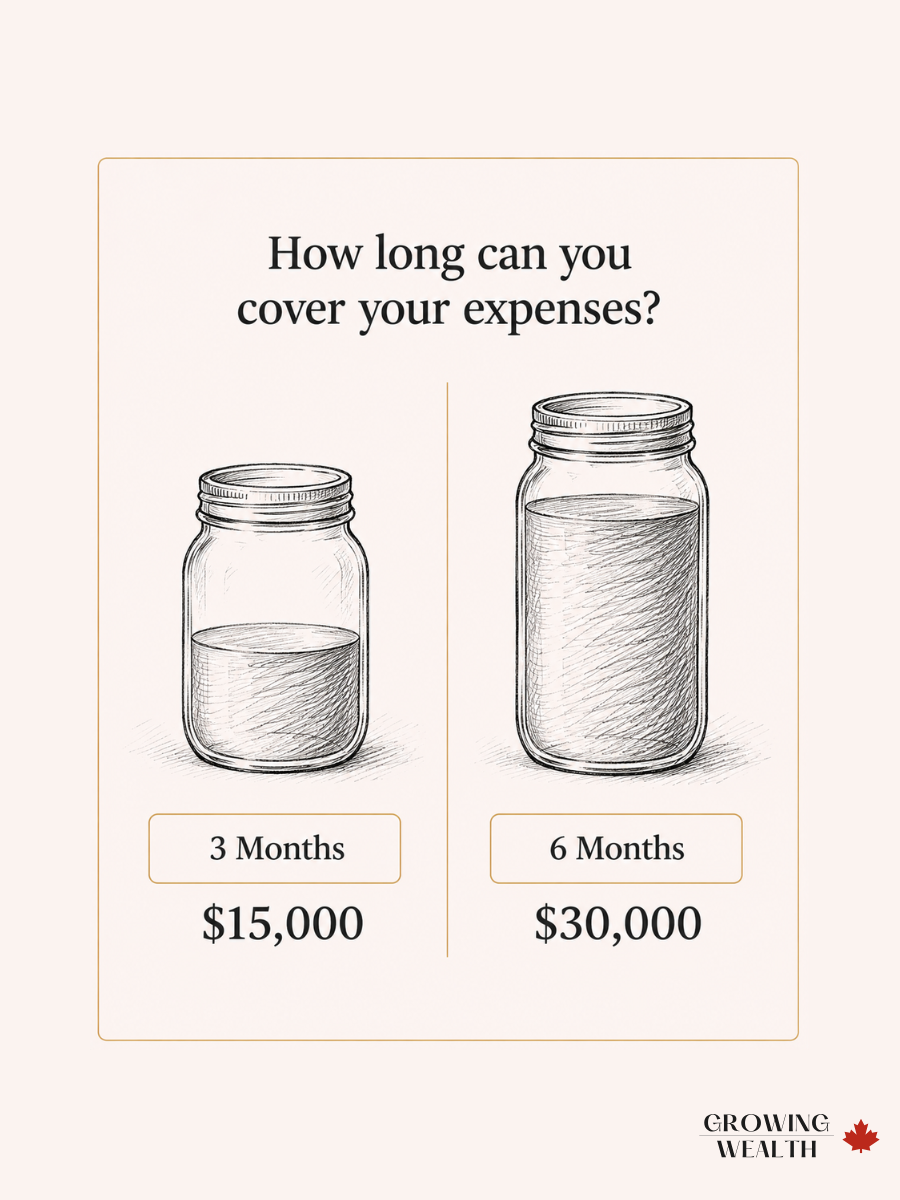
Take a family of four in Ontario: two earners — one full-time salary, one part-time income — with $5,000/month in core expenses (mortgage, childcare, two cars, utilities, groceries, insurance, minimum debt payments).
One full-time salary + one part-time income. Childcare and mortgage consume roughly 60% of the monthly budget. The salaried earner qualifies for EI; the part-time earner has limited insurable hours. Risk profile: moderate — one disruption puts real pressure on the household. Target: 4–6 months of core expenses, which equals $20,000–$30,000. Build toward the higher end given the childcare fixed cost.
The salaried earner at $75,000/year would receive approximately $729/week from EI — roughly $3,160/month. Their monthly baseline is $5,000. That’s a $1,840/month shortfall the emergency fund must cover, plus any gap before the first payment arrives.
How to Build Your Emergency Fund Step by Step
Most families cannot set $20,000 aside at once. That’s not the starting point.
This is your first goal, not your final one. A $1,000 buffer prevents small emergencies — a car repair, an unexpected dental bill — from becoming credit card debt. Get here first, before anything else.
Keep your emergency fund completely separate from your everyday chequing account. Out of sight, out of temptation. A high-interest savings account (HISA) at Neo or EQ Bank works well — no fees, immediate access, earns interest while it sits. You can also hold it inside a TFSA savings account if you have contribution room available — the interest is tax-free.
Set a fixed automatic transfer from your chequing account on payday — even $200/month builds to $2,400/year. Treat it like a bill. For help structuring automated savings, see A Simple Family Finance System for Canadians.
Tax refunds, work bonuses, and lump-sum payments are the fastest way to close the gap. Route them directly to the emergency fund before they dissolve into day-to-day spending.
The fund only works if you replenish it. After a genuine emergency draw, restart contributions immediately — even a small monthly amount restores the buffer over time. Don’t wait until finances feel “comfortable” to start contributing again.
Where to Keep It in Canada
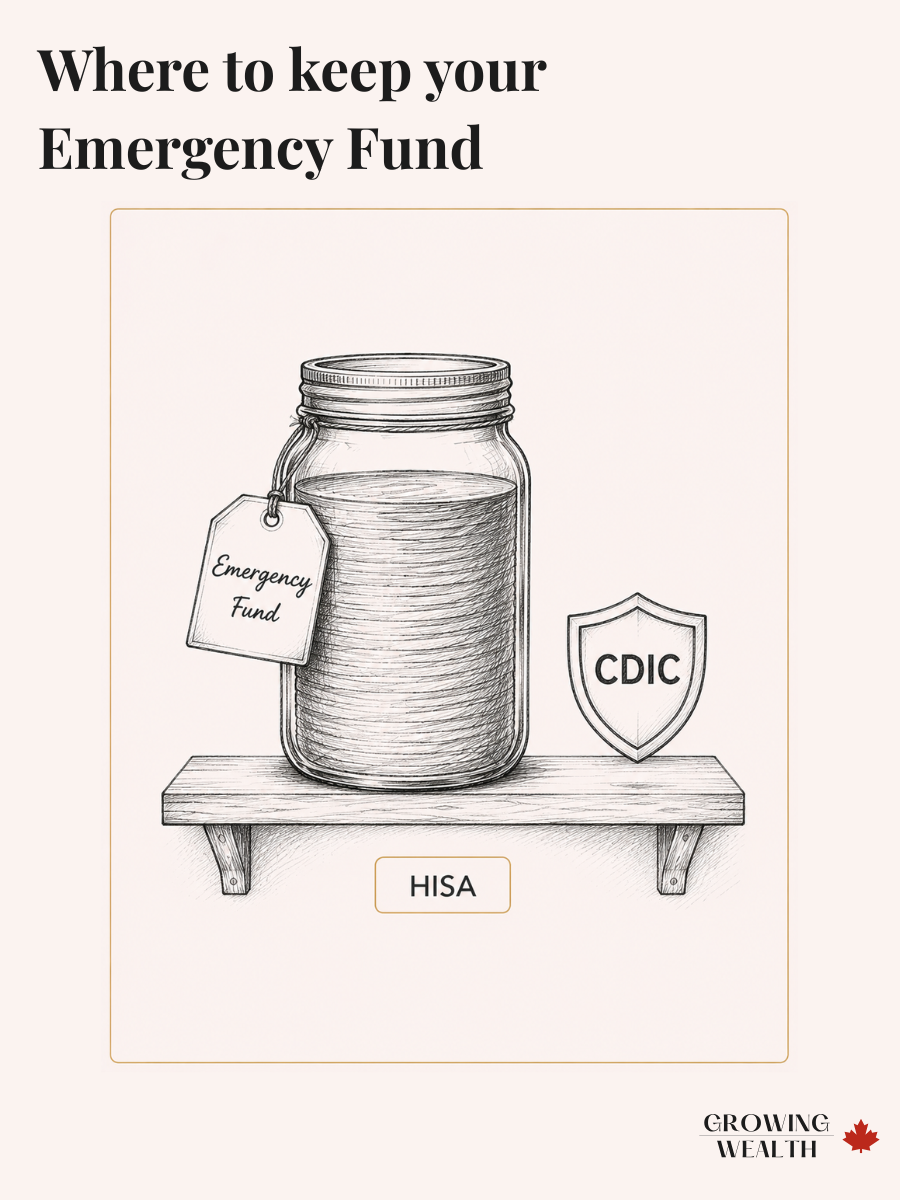
An emergency fund has one job: be there when you need it. That means three requirements — safe, liquid, and earning something while it waits.
This is not the place for stocks, ETFs, or locked-in GICs. Markets can drop 20–30% in a downturn — exactly when a job loss or emergency is most likely to occur. A locked-in product means a withdrawal penalty at the worst possible time. Both work against you.
For most Canadians, a high-interest savings account (HISA) is the right answer. For a full comparison of savings account options, see Where to Park Cash Safely in Canada and Best Bank Accounts in Canada.
Neo offers a straightforward tiered savings rate with no conditions, no monthly fees, and simple app-based access — earn 2% on the base account, 2.5% with Build membership, and 2.75% with Grow membership. No direct deposit required. Funds are held in trust at one or more CDIC member institutions.
Open a Neo Savings account →EQ Bank offers up to 2.75% p.a. on the Personal Account — but that rate requires a qualifying direct deposit of at least $2,000/month. Without it, the base rate is 1.00%. If you’re routing your paycheque through EQ Bank, it’s a strong option with no monthly fees and CDIC deposit insurance. If not, the no-condition rate at Neo may work better for a standalone emergency fund.
Open an EQ Bank account →What About a TFSA?
There’s a common mental model that a TFSA should only be used for investing — and for someone with accumulated wealth who is maximizing their registered accounts, that thinking makes sense. But it’s not the right frame for everyone.
If you’re just starting out, just finished building your emergency fund, or are genuinely risk-averse, holding your emergency savings inside a TFSA savings account is a smart move. Interest earned inside a TFSA is completely tax-free — you’re not paying tax on the interest income your emergency fund generates every year.
Someone in a 40% marginal tax bracket earning 2.75% on $20,000 in a regular HISA keeps about $330/year after tax. The same $20,000 in a TFSA savings account keeps the full $550. Over several years of building and holding an emergency fund, that gap adds up — with zero added risk.
For a full breakdown of TFSA rules, contribution room, and what to hold inside one, read the TFSAs in Canada Guide.
Common Mistakes to Avoid
ETFs and stocks are for long-term growth. A fund held in the market can drop 20–30% in a downturn — exactly when a job loss or emergency is most likely. Liquidity and stability come first, every time.
Summer camps, annual car insurance, holiday spending — these are knowable in advance. They belong in a separate sinking fund. Mixing the two drains the buffer without a real emergency occurring.
A line of credit is not an emergency fund. It’s debt that compounds at the worst possible moment. The emergency fund exists precisely so you don’t have to borrow under pressure.
A $500 buffer is more valuable than a $0 buffer. Start where you are. The perfect target is a destination, not a prerequisite for beginning.
A new child, a new mortgage, an income change, higher fixed costs — any of these shifts your exposure. Review your target annually and adjust when your household situation changes.
How It Fits Into Your Bigger Financial Picture
An emergency fund isn’t a standalone goal — it’s a prerequisite for everything else.
Without it, every financial decision becomes reactive. A job loss forces RRSP withdrawals at the worst possible tax moment. A car repair goes on a credit card at 19–22% interest. TFSA room gets used for the wrong reasons. Investments get liquidated during a market downturn because you need cash now.
With it, the rest of your plan runs on solid ground. RRSP and TFSA contributions are deliberate, not desperate. Investments can stay invested through market volatility because you don’t need the money. You navigate salary negotiations or career moves from a position of stability.
Build the emergency fund before aggressive investing — not because investing is wrong, but because the foundation has to come first. For a complete framework on how savings, investing, and registered accounts fit together, see A Simple Family Finance System for Canadians.
The Bottom Line
There is no universal emergency fund amount for every Canadian household. The 3–6 month rule is a starting point — not a verdict.
What actually determines your target: how stable your income is, how much of your budget is locked into fixed costs, whether you have dependents, and how much EI would actually cover if income stopped tomorrow. For a single-income family with kids, a mortgage, and childcare, 4–6 months of core expenses is the right range — typically $15,000–$30,000 depending on your cost structure. Dual-income households with stable employment and lower fixed costs can often function well at 2–3 months.
Start with $1,000. Automate contributions. Keep it in a HISA, separate from your spending accounts. Rebuild it after you use it. Review the target when your life changes.
The emergency fund doesn’t need to be exciting. It needs to be there.Once your emergency fund is in place, the next question is where everything else goes. Read The Power of Financial Habits — the mindset and system shifts that make saving automatic rather than effortful.
Frequently Asked Questions
It depends on your income stability, household structure, and fixed monthly obligations. A single salaried employee with low fixed costs can target 2–3 months of core expenses. A single-income family with children, a mortgage, and childcare costs should aim for 4–6 months. Self-employed and contract workers should target 6 months or more, since regular EI access is limited.
It reduces the gap — but doesn’t close it. In 2026, EI pays a maximum of $729/week, calculated at 55% of insurable earnings. For most Canadians, that covers roughly half to two-thirds of actual monthly expenses. It also takes 2–4 weeks after filing before the first payment arrives. Your emergency fund bridges that gap — both the shortfall in coverage and the delay before benefits begin.
A high-interest savings account (HISA) at a provider like Neo or EQ Bank is the standard answer — no fees, no lock-in, CDIC insured, and a competitive interest rate. Avoid keeping it in stocks or ETFs; you need it available immediately and at full value, regardless of what the market is doing.
Yes, with conditions. The money must be held in cash — not invested in ETFs or funds inside the TFSA. You also need to track your contribution room carefully, since withdrawals restore only in the following calendar year. For households already maximizing TFSA room for investments, a separate HISA is simpler and keeps your registered space available for growth.
Both, in sequence. Start by building a $1,000–$2,000 starter emergency fund. Then attack high-interest debt aggressively. Once high-interest debt is cleared, build the full emergency fund to your target range. Going straight to debt payoff with zero buffer means one small emergency goes back on the credit card — canceling your progress and starting the cycle over.
Job loss, income interruption, major home or vehicle repairs, unexpected medical or dental costs, and cash-flow gaps while waiting for government benefits. Planned predictable expenses — summer camps, annual car insurance, holidays — are not emergencies and should be funded from a separate savings bucket. The cleaner the separation, the more effectively each fund does its job.
At $300/month in contributions, a family with $5,000/month in core expenses (3-month target: $15,000) would take about 4 years at that pace alone. At $500/month, roughly 2.5 years. Tax refunds and year-end bonuses routed directly to the fund can shorten the timeline meaningfully. The key is starting and automating rather than waiting for conditions to feel right.
Yes. A new child, a new mortgage, an income change, or a new fixed obligation all shift your exposure. Review your target at least once a year and recalculate based on your current core monthly expenses and household risk profile. What was right at 28 may not be right at 38.