
Most Canadians don’t avoid investing because they don’t care about their future. They avoid it because it feels like three decisions at once: which account, which platform, which investments, and getting any one of them wrong feels expensive.
It isn’t three decisions. It’s one system, applied in order.
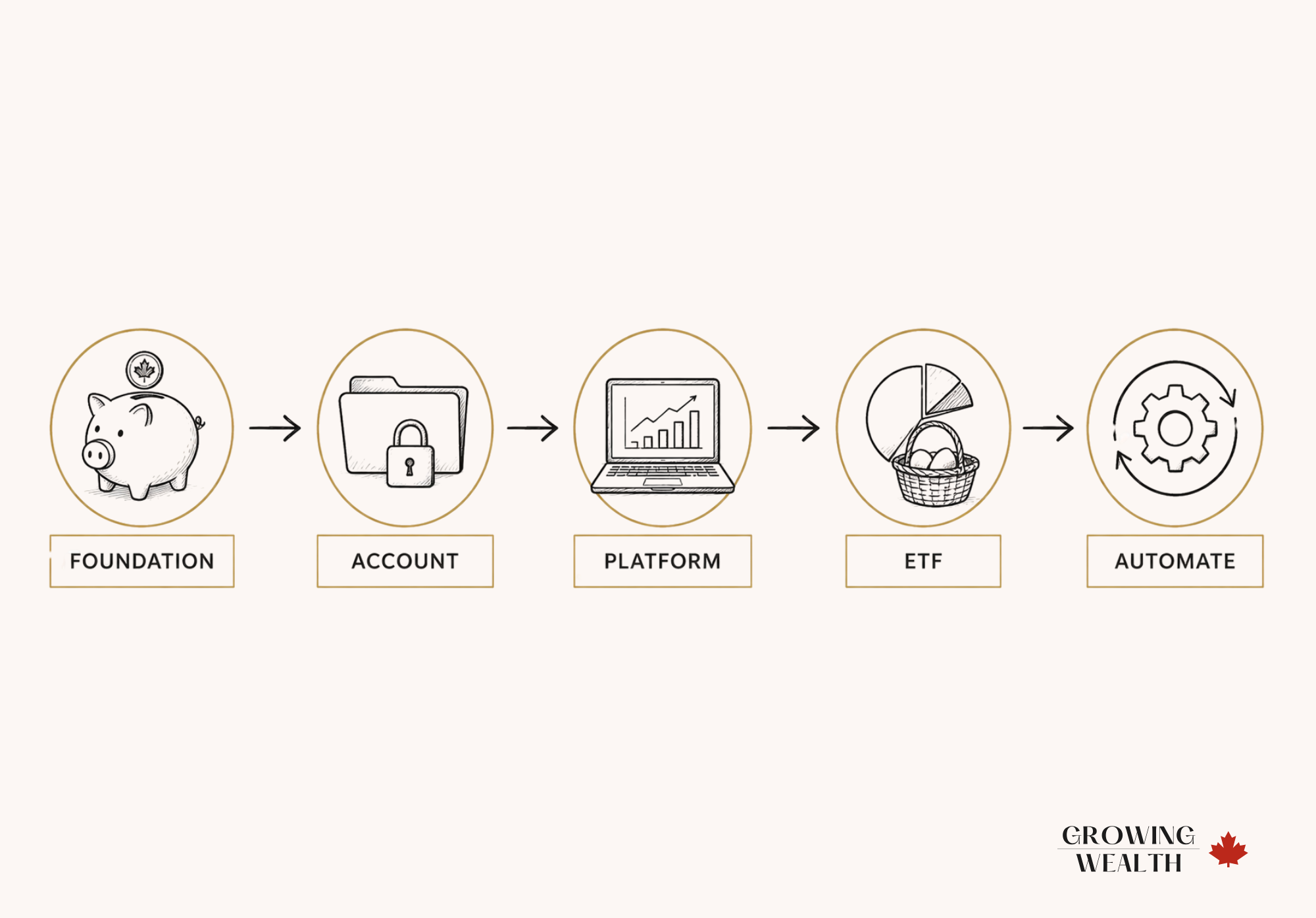
This guide walks through that system: how to get ready, which account to open first, where to hold it, what to buy, how much to contribute, and how to keep doing it without relying on willpower.
This article contains affiliate links. We may earn a commission if you open an account — at no cost to you. We only recommend products we’ve researched and trust.
 Investing
The full system: get ready, choose your account, choose your platform, invest, automate
In This Article
- Step 1 — Make Sure You’re Actually Ready to Invest
- Step 2 — Choose the Right Account: TFSA, RRSP, or FHSA
- Step 3 — Choose a Platform
- Step 4 — What Should You Actually Invest In?
- Step 5 — How Much Should You Invest?
- Step 6 — Invest Consistently
- Common Mistakes Beginners Make
- A Simple Beginner Setup
- Frequently Asked Questions
Step 1 — Make Sure You’re Actually Ready to Invest
Before any money goes into the market, two things need to be true: you’re not carrying high-interest debt, and you have a buffer so you’re never forced to sell at a loss to cover an emergency.
Carrying a credit card balance at 20%+ interest while investing is a losing trade. No diversified portfolio reliably returns more than that, so the math only works one way: pay down the high-interest debt first.
The second piece is a cash buffer. If your car needs a $1,800 repair and your only source of funds is your TFSA, you may end up selling investments during a down month just to cover it, and that’s how people lock in losses. A starting emergency fund, even $1,000–$2,000 while you build toward 3–6 months of expenses, keeps investing money from being pulled back out. Our emergency fund guide walks through how to build that buffer without stalling your other goals.
Once high-interest debt is gone and you have a starting buffer, the next decision is the account.
Step 2 — Choose the Right Account: TFSA, RRSP, or FHSA
This is the decision most beginners get wrong, not because they pick a bad account, but because they treat it as a two-way choice between TFSA and RRSP when for a lot of Canadians it’s actually a three-way one.
| Your Situation | Best First Account |
|---|---|
| Income under ~$60,000, no home purchase planned | TFSA |
| Income over ~$100,000 | RRSP |
| Planning to buy a first home in the next 1–15 years | FHSA |
| Saving for a first home AND want tax-deferred growth | FHSA, then RRSP |
TFSA — flexibility first. The TFSA dollar limit for 2026 is $7,000, and if you’ve been eligible since it launched in 2009 and never contributed, your total lifetime room is $109,000. Contributions aren’t deductible, but growth and withdrawals are completely tax-free, and withdrawn room comes back the following January. That flexibility is why it’s usually the right starting account for lower and middle incomes. Our TFSA guide breaks down contribution room and withdrawal rules in full.
RRSP — value scales with your tax bracket. The RRSP dollar limit for 2026 is $33,810, but your actual room is 18% of your 2025 earned income, up to that cap. The deduction is worth more the higher your marginal rate, which is why the RRSP tends to win for higher earners: a $10,000 contribution at a 43% marginal rate returns $4,300 back at tax time, versus $2,000 at a 20% rate. See our RRSP guide for how deduction room and carry-forward work.
FHSA — the one most people forget to weigh. If a first home is anywhere on your horizon, the FHSA lets you contribute up to $8,000/year (lifetime max $40,000), get the RRSP-style deduction, and withdraw tax-free for a qualifying home purchase. It’s the only account that gives you both benefits at once, which is why it usually outranks the other two if you qualify.
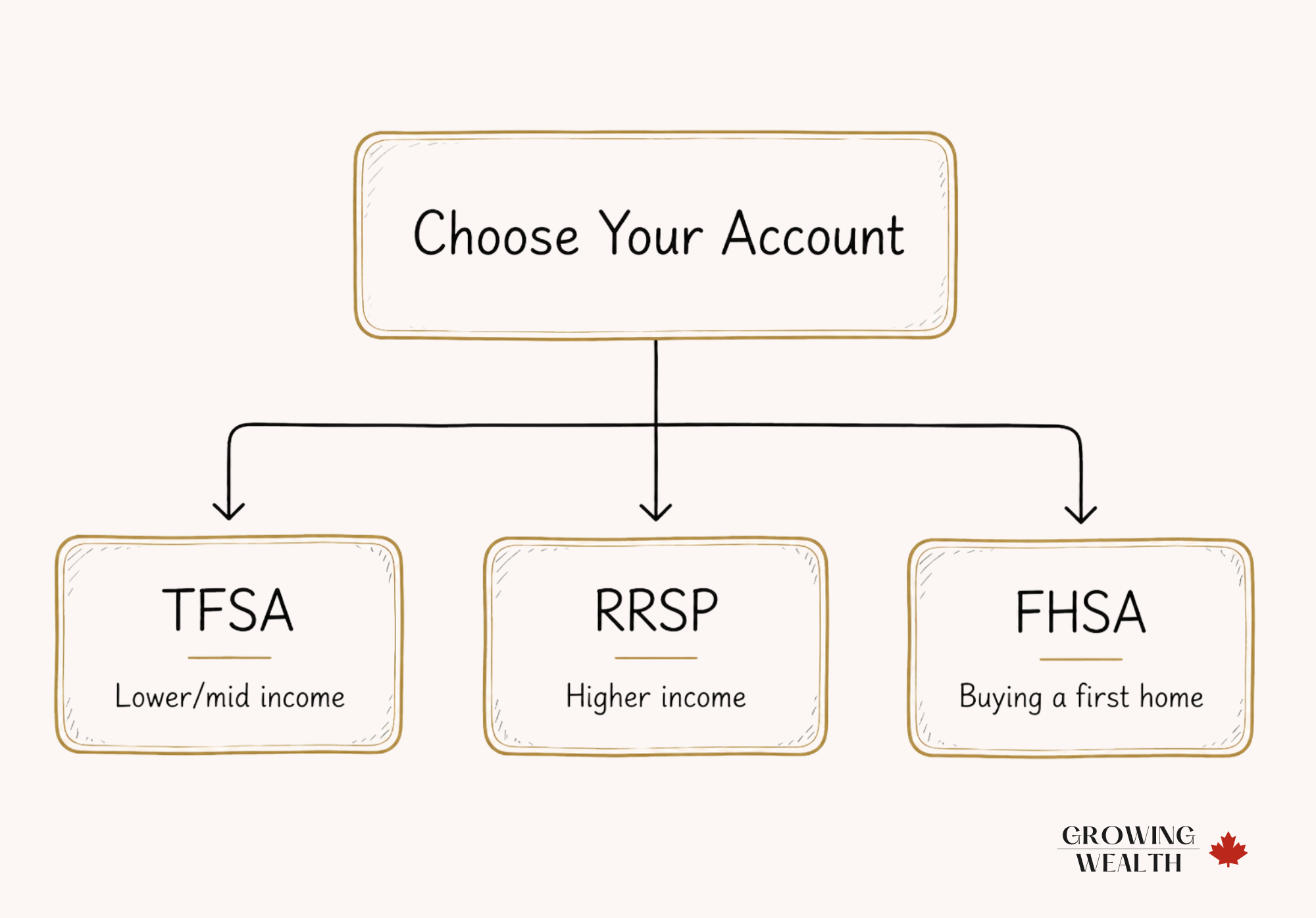
Choosing between TFSA, RRSP, and FHSA based on income and home-buying timeline
Amara is early in her career with a low marginal tax rate, so an RRSP deduction isn’t worth much yet, and she may need access to the money before retirement. The TFSA is the clear starting point for her.
At Derek’s marginal rate, RRSP contributions are worth significantly more in tax savings, and he’s not planning to touch the money for 25+ years. The RRSP is the stronger next account for him.
If you’re not sure which of these situations is closest to yours, our FHSA vs TFSA vs RRSP breakdown goes through more scenarios in detail.
Rather than guess, answer 7 quick questions and get your personalized priority order across TFSA, RRSP, FHSA, and RESP. Try the free tool →
Once you have the account open, the next decision is where to open it.
Step 3 — Choose a Platform
This used to be a harder decision than it is now. For years, self-directed investing meant real trading fees and a real learning curve, which is why robo-advisors and managed accounts carved out a place for beginners willing to pay a bit more for simplicity.
That gap has mostly closed. Commission-free trading, fractional shares, and all-in-one ETFs like XEQT and VEQT mean a self-directed investor can now build a fully diversified, one-ticket portfolio in a few clicks, without picking individual stocks and without paying a management fee on top of the fund’s own cost.
| Platform | Best For | Fee Structure | Effort |
|---|---|---|---|
| Wealthsimple | Hands-off beginners | Slightly higher MER on managed accounts; free self-directed trading | Lowest |
| Questrade | DIY investors comfortable picking their own ETF | Lower ongoing cost; no account fees on registered accounts | Moderate |
| Qtrade | DIY investors who want more research/analytics tools | $0 commission on stocks, ETFs, and mutual funds; no quarterly account fee | Moderate |
| Big 6 Banks | Investors who want everything under one login with their everyday banking | Typically $6.95–$9.95 per trade; most now offer a limited commission-free ETF list (CIBC is the one holdout) | Lowest to set up, highest ongoing cost |
The convenience gap has closed between Wealthsimple, Questrade, and Qtrade; the fee gap hasn’t, and the Big 6 brokerages are where that gap is widest. A managed robo-portfolio still typically costs more per year than buying the same underlying exposure yourself through a self-directed account, and a Big 6 brokerage still typically costs more per trade than any of the three DIY-focused platforms above it. What’s changed is that “self-directed” no longer means complicated, so paying the premium for a familiar bank login is a real trade-off, not a safety decision, since all of these platforms are CIPF-protected up to the same limits. Our Wealthsimple vs Questrade comparison breaks down the actual fee difference in dollar terms.
If you want the absolute simplest path and are comfortable paying slightly more for it, Wealthsimple’s managed option remains a reasonable choice. If you’re willing to spend 15 minutes understanding what an all-in-one ETF is, self-directed on any of the three DIY platforms now costs less for the same outcome.
The simplest way to open a TFSA, RRSP, or FHSA and start investing, with a managed option if you’d rather not choose the ETF yourself.
Apply for a Wealthsimple account →Full self-directed control over your ETF purchases with lower long-term fees, for investors who want to manage the details themselves.
Apply for a Questrade account →Zero-commission stocks, ETFs, and mutual funds, plus stronger research and portfolio analytics than Questrade, for self-directed investors who want more than the basics.
See Qtrade’s account options →Step 4 — What Should You Actually Invest In?
Once the account and platform are set, the temptation is to start researching individual stocks. Resist it. Stock-picking adds risk without reliably adding return, and it turns investing into a research project instead of a system.
The better starting point is a single all-in-one ETF, a fund that already holds a diversified mix of Canadian, U.S., and international equities (and sometimes bonds) in one ticker. XEQT and VEQT are the two most common examples Canadians use for this. Buying one of these is functionally the same as owning thousands of companies across multiple countries in a single purchase.
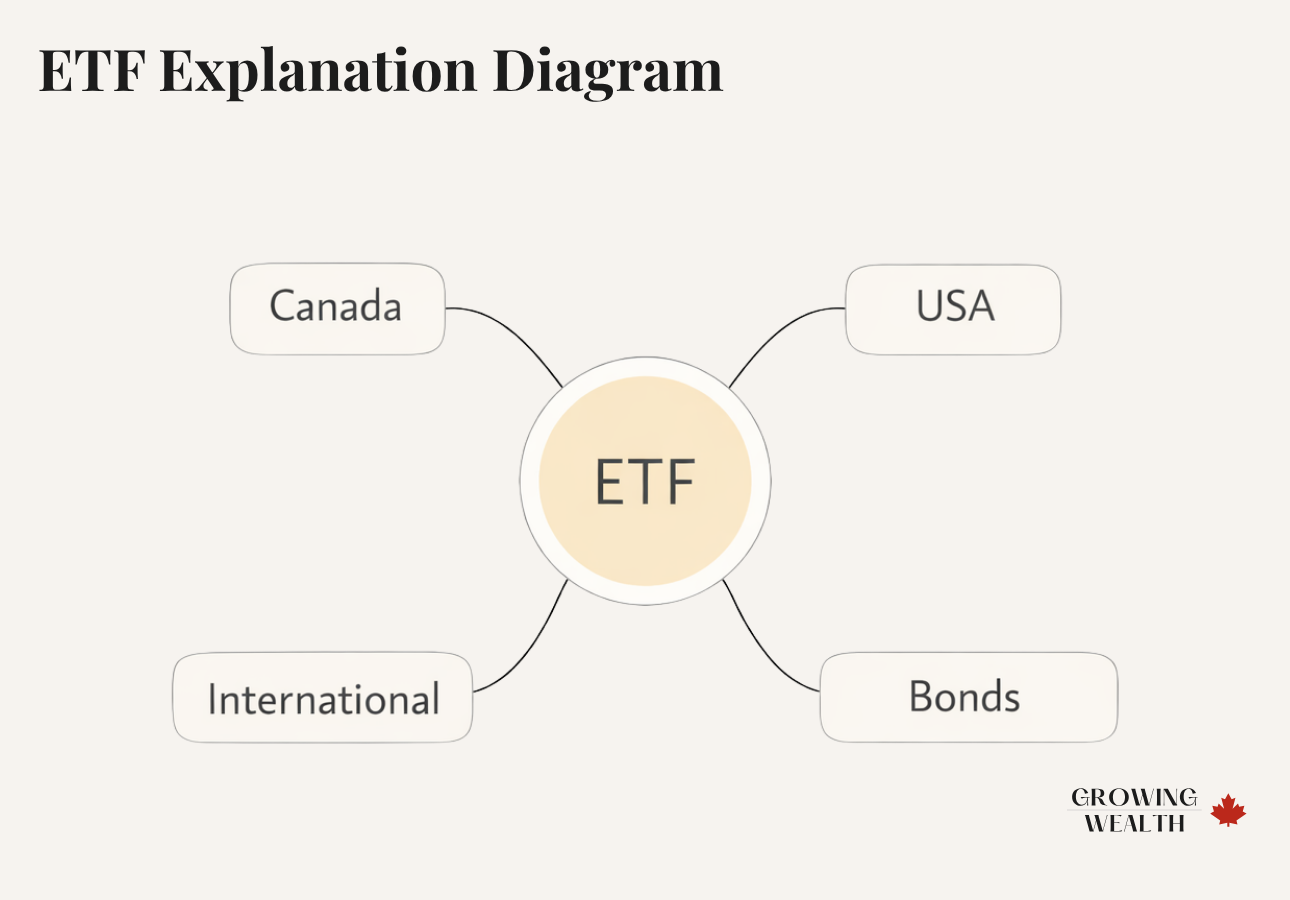
A single all-in-one ETF provides built-in diversification across multiple markets
This is index investing: you’re not trying to beat the market, you’re trying to capture its long-run return at the lowest possible cost. For a full breakdown of what belongs in a beginner portfolio and how to think about equity mix by age, see what you should actually invest in as a beginner in Canada.
Step 5 — How Much Should You Invest?
The dollar amount matters less than most people think. Consistency compounds; the size of any single contribution barely does.
A useful starting rule: aim for 10–15% of take-home pay once high-interest debt is cleared and your buffer exists, and adjust up as income grows. Our how much should you invest each month guide walks through this by income band.
Time matters more than amount. Money invested for 3 years carries meaningfully more risk of a bad exit point than money invested for 10+, which is why short-term savings goals don’t belong in this account at all.
Step 6 — Invest Consistently: Lump Sum, DCA, and Automation
If you’re contributing from income, dollar-cost averaging happens automatically: you’re investing a fixed amount on a fixed schedule regardless of what the market is doing that week. If you’re sitting on a lump sum, like an inheritance or a bonus, investing it all at once has historically outperformed spreading it out, since more of the money is exposed to market growth sooner. The exception is if the size of the lump sum would keep you up at night; in that case, a shorter phased approach trades some expected return for peace of mind. Our lump sum vs dollar-cost averaging guide covers both scenarios with real numbers.
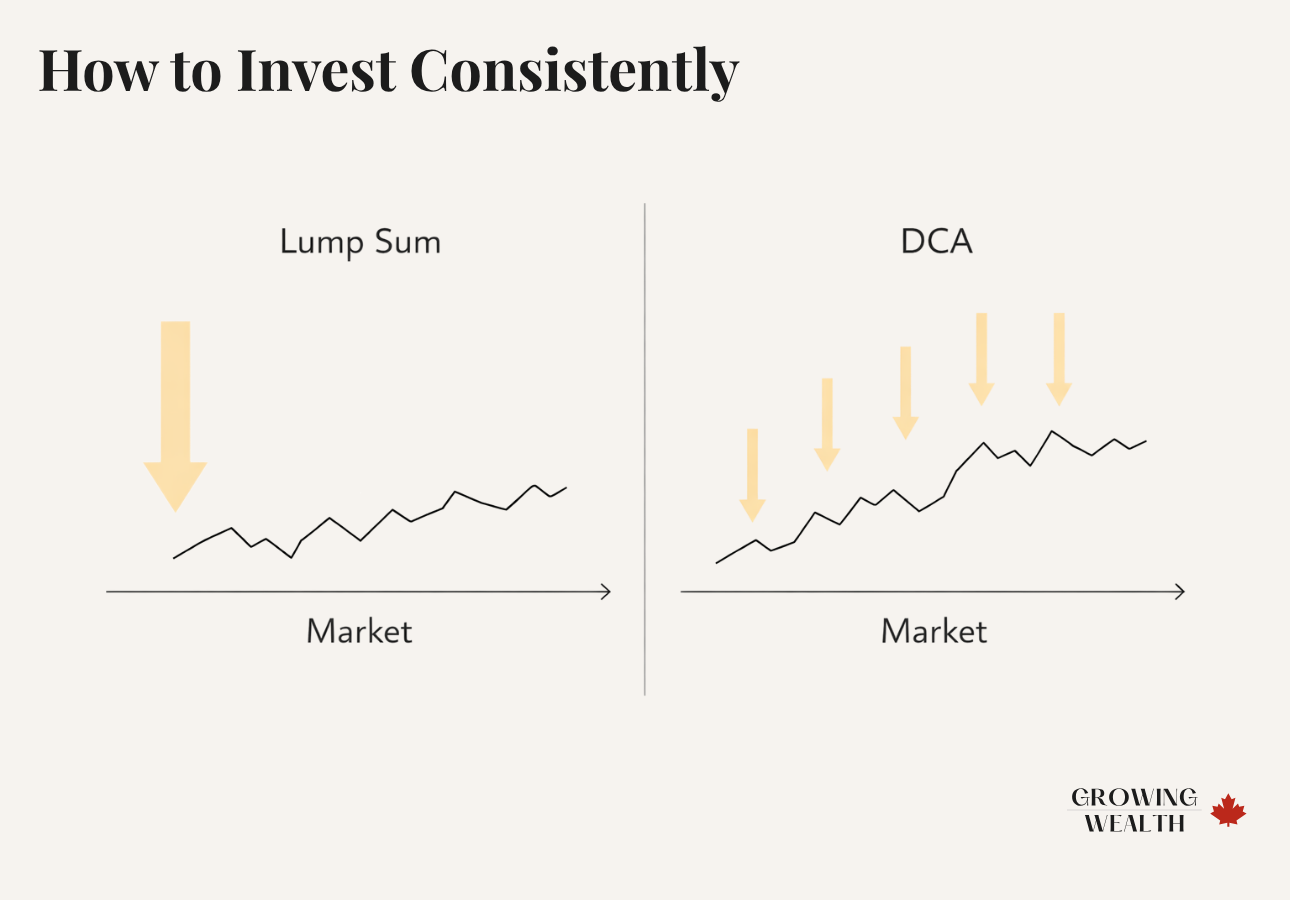
Lump sum investing puts money into the market at once, while dollar-cost averaging spreads investments over time to reduce timing risk
Neither approach matters much if it doesn’t happen consistently, and that’s the actual failure point for most beginners: not choosing the wrong account, not choosing the wrong platform, just stopping. Automated contributions remove the decision entirely, since money moves on payday before it has a chance to get spent elsewhere. Our family finance system shows how to build this into your broader monthly setup.
Common Mistakes Beginners Make
- Waiting for the “right time.” Time in the market matters more than timing the market. Every year delayed is a year of compounding you don’t get back.
- Treating TFSA vs RRSP as the only decision. Skipping the FHSA when a home purchase is realistic leaves real money on the table.
- Overpaying for simplicity that no longer requires a premium. A managed robo-portfolio isn’t wrong, but you’re paying an ongoing fee for something a self-directed all-in-one ETF now does almost as easily.
- Picking individual stocks as a first move. It adds risk and research burden without a reliable return advantage over a diversified fund.
- Letting automation lapse. A one-time contribution isn’t a system. If the transfer isn’t automated, it’s competing with every other thing your paycheque could go toward.
A Simple Beginner Setup, Example
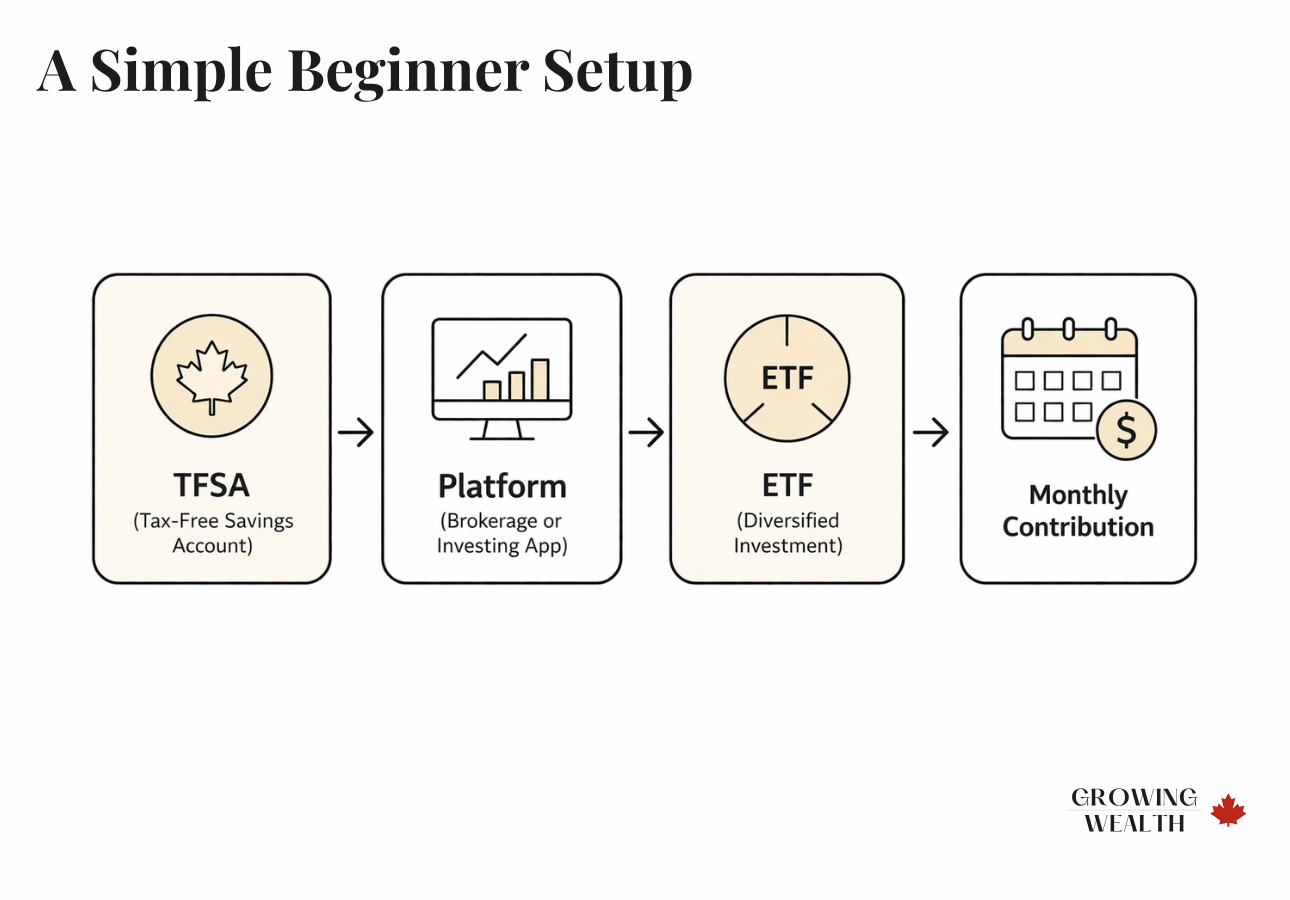
A simple investing system showing how to go from account setup to consistent monthly investing
This isn’t the only correct setup, but it removes every decision point that causes people to stall, and it costs less annually than the equivalent managed portfolio.
The Bottom Line
Investing in Canada isn’t complicated anymore; it’s mostly a sequencing problem. Get your foundation in place, pick the account that actually matches your income and timeline (not just TFSA vs RRSP, but FHSA too if a home is realistic), choose a low-cost platform, hold a single diversified ETF, and automate the contribution so it doesn’t depend on willpower.
Start with that. Everything else is optimization you can add later.
Frequently Asked Questions
As little as $100. Many platforms have no minimum for self-directed trading.
It depends on income. Lower and middle incomes usually start with the TFSA; higher earners often get more value from the RRSP deduction.
Yes, if a first home purchase is realistic in the next 15 years. It’s the only account offering both a tax deduction and tax-free withdrawal.
Wealthsimple is simplest for a fully hands-off start. Questrade and Qtrade both cost less for a self-directed all-in-one ETF portfolio, with Qtrade offering stronger research tools.
Both are all-in-one equity ETFs with similar global diversification. The differences are minor, mainly issuer and precise regional weighting, rather than fundamental.
High-interest debt, like credit cards and most personal loans, should be paid off first. Low-interest debt, like some mortgages, doesn’t need to block investing.
Yes, especially short-term. Diversification reduces single-company risk, not overall market risk.
Ideally 5+ years, and 10+ years for the money to reliably ride out a downturn.
Lump sum has historically outperformed on average. Dollar-cost averaging reduces regret risk if timing is a concern.
Monthly, automated, and tied to payday.
Want to turn what you’ve just learned into lasting results? Read The Power of Financial Habits — the small, repeatable habits that make your new investing system stick for good.