
 Banking
The average Canadian chequing account costs around $15 a month — or $180 a year. As a student, that’s a textbook, two months of groceries, or a weekend trip you didn’t have to skip. The good news: you don’t have to pay a cent.
In 2026, every major Canadian bank offers students a no-fee chequing account. But “no fee” is just the starting point. The real question is which account gives you the most back — whether that’s a cash welcome bonus, interest on your balance, rewards points, or better perks when you eventually graduate.
This guide breaks down the best student chequing accounts in Canada, including the Big Five banks and the digital challengers that are quietly outperforming them.
This article contains affiliate links. We may earn a commission if you open an account — at no cost to you. We only recommend products we’ve researched and trust.
In This Article
- Quick Answer: Best Student Chequing Accounts at a Glance
- What Is a Student Chequing Account?
- Why Your Choice Actually Matters
- How We Chose These Accounts
- The 5 Best Student Chequing Accounts in Canada
- Also Worth Considering
- The Smart Two-Account Strategy
- What Happens When You Graduate?
- Pair With a Student Credit Card
- Emergency Savings
- Frequently Asked Questions
Quick Answer: Best Student Chequing Accounts (2026)
| Account | Monthly Fee | Welcome Bonus | Best For |
|---|---|---|---|
| Simplii Financial No Fee Chequing | $0 | $300 + $50 Skip | Biggest bonus, CIBC ATM access, no-fee forever |
| TD Student Chequing | $0 | Up to $150 | Largest ATM network + overdraft protection |
| EQ Bank Personal Account | $0 | None | 2.75% interest — non-promotional |
| Neo Chequing Account | $0 | None | 1% cashback on gas & groceries + avg. 5% at partners |
| Wealthsimple Cash Account | $0 | None | Best if you’re already investing with Wealthsimple |
What Is a Student Chequing Account?
Chequing Account
Your everyday money hub — where your spending money lives. Used for rent, groceries, e-Transfers, and debit purchases. Unlimited deposits and withdrawals with no restrictions on how often you access it.
Student Chequing Account
A regular chequing account designed for high school and post-secondary students. Banks waive monthly fees and include student-friendly perks like welcome bonuses and discount programs.
Key Terms to Know
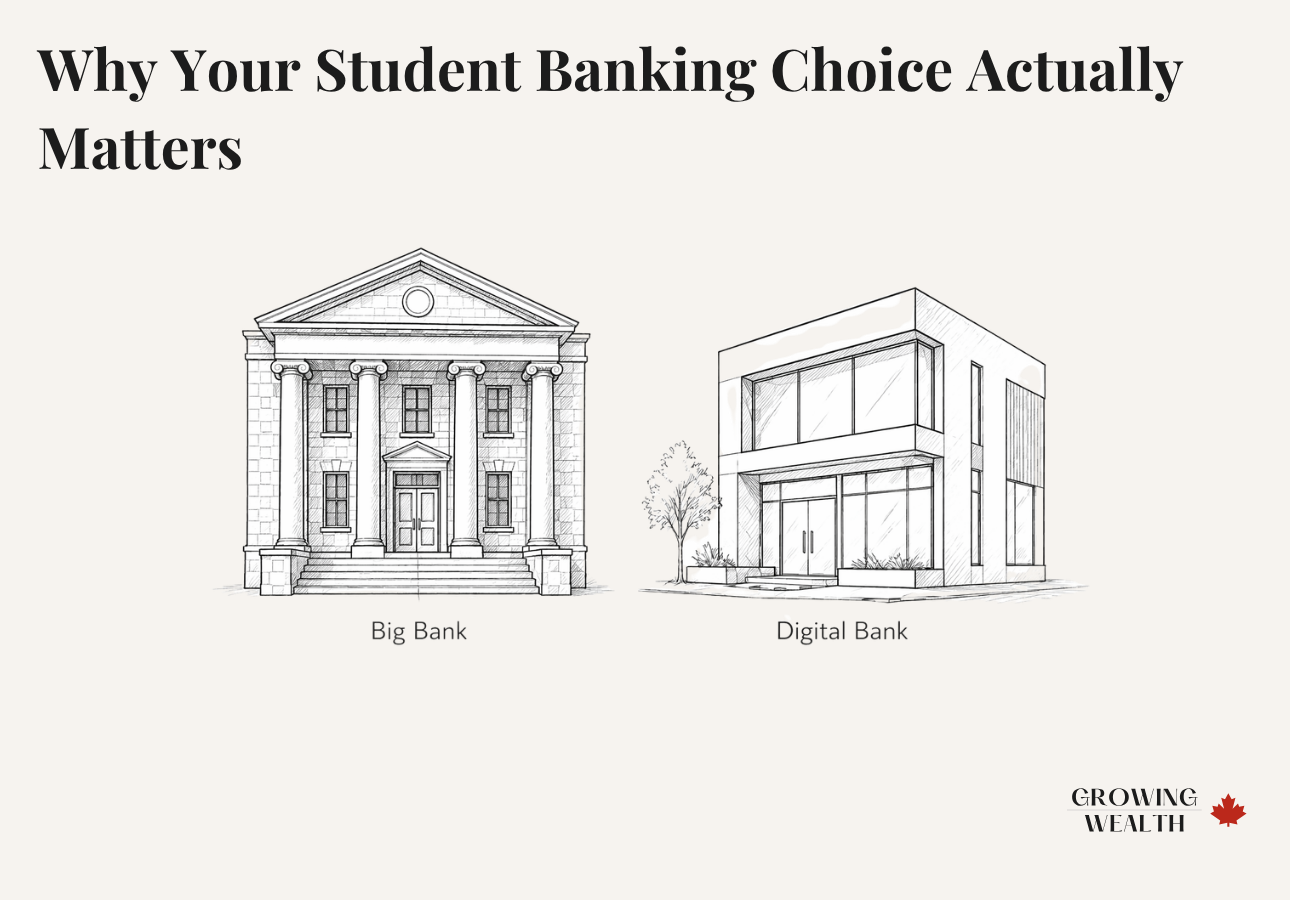
Why Your Student Banking Choice Actually Matters
Most students pick the bank their parents use. That’s understandable — it’s easy, and someone’s already helping you set it up. But it’s worth 20 minutes to compare, because the difference adds up fast.
Beyond the immediate savings, your student account is also where you establish your first banking relationship. That matters when you apply for a student credit card, a line of credit for tuition, or eventually a mortgage. Getting your foot in the door at a major bank as a student is easier than you might think — and the long-term value of that relationship compounds.
How We Chose These Accounts
We evaluated each account based on what actually matters to a student managing money for the first time:
- Monthly fees — must be $0
- Transaction limits — unlimited is standard
- Welcome bonus value and ease of qualifying
- Interest earned on chequing balances
- ATM network access
- Post-graduation account terms
- Rewards programs and student discounts
- App quality and digital experience
We focused on accounts available nationally. Credit union options vary by province and aren’t covered here.
The 5 Best Student Chequing Accounts in Canada
🏆 Simplii Financial No Fee Chequing Account
Best Welcome BonusSimplii Financial is owned by CIBC, which means you get CIBC’s massive ATM network without paying CIBC’s fees. That’s a genuinely useful combination — especially if you’re used to banking at a branch and want the flexibility of in-person ATM access.
The welcome bonus is the strongest in Canada right now for new clients: $300 deposited into your account after you set up three consecutive direct deposits of at least $100 each within 120 days. Add in a $50 Skip Delivery gift card, and you’re looking at $350 in your pocket just for banking somewhere you’d be banking anyway.
The account itself is exactly what it says — no fees, unlimited transactions, unlimited Interac e-Transfers, and no minimum balance. Unlike most big banks, the no-fee status doesn’t expire when you graduate or turn a certain age. That’s worth noting if you’re thinking long-term.

TD Student Chequing Account
Best for Overdraft ProtectionTD’s welcome offer — $125 for completing qualifying actions like setting up direct deposit or making online purchases — is solid. What sets TD apart is the largest ATM network in Canada combined with the option to add no-fee overdraft protection. For students managing tight cash flow between OSAP disbursements or paycheques, that overdraft buffer can be genuinely useful.
The TD Access Card comes with Visa Debit, so you can shop online anywhere Visa is accepted — helpful for paying tuition, subscription services, or international purchases.
EQ Bank Personal Account
Best Interest RateEQ Bank isn’t a student-specific account — it’s open to any Canadian. But it earns a spot on this list because of one thing: a 2.75% interest rate on your chequing balance that never expires and requires no promotional conditions.
Compare that to the 0.01% most big banks pay on chequing balances. If you’re keeping $2,000 in your account as a buffer, EQ Bank pays you about $55 a year. Your big bank pays you $0.20.
Neo Chequing Account
Best Cashback on Everyday SpendingNeo Chequing is a full-service, no-fee chequing account built around cashback. The Neo Money™ Card earns 1% cashback on gas and groceries at base — and that rate grows automatically as your balance increases, up to 3% on gas and groceries with $10,000 or more in your account. No action required; rates update in real time.
On top of that, you earn an average of 5% cashback (up to 15%) at 10,000+ Neo partner locations across Canada through the Neo app. For a student who’s already spending on gas, groceries, and everyday life, that cashback adds up without changing a single habit.
The account also comes with $0 NSF fees — unlike most traditional banks that charge $45 or more — free Interac e-Transfers, real-time spend tracking, and smart budgeting tools built into the app. CDIC-eligible deposit protection up to $100,000 is included.
Wealthsimple Cash Account
Best for Students Who InvestIf you’re already using — or planning to use — Wealthsimple for investing, the Cash account makes a lot of sense. Everything lives in one app: your chequing balance, your investment account, your TFSA. Moving money between them takes seconds.
The cashback on spending is a nice bonus, and the account has no fees and no minimum balance. It’s not the strongest standalone chequing account on this list, but as part of a broader Wealthsimple setup, it’s very convenient.
Open a Wealthsimple account →Also Worth Considering
If you’re already at one of the Big Five banks, or have a specific reason to stay, these accounts are all solid no-fee options. None of them edges out our top five picks on a standalone basis, but they’re far better than paying a monthly fee.
| Account | Best Feature | Bonus | Watch Out For |
|---|---|---|---|
| Scotiabank Preferred Package for Students | Scene+ rewards on every purchase | Up to $175 | Scene+ only valuable if you shop at partner brands |
| RBC Advantage Banking for Students | Avion points + Apple/Spotify/Amazon discounts | Varies | No guaranteed cash bonus currently |
| CIBC Smart for Students | Can apply before arriving in Canada | Varies | Smaller branch network than TD/RBC |
| BMO Performance Chequing for Students | Up to $175 bonus + free SPC+ | Up to $175 | Perks end at graduation; weaker app than competitors |
| Tangerine No-Fee Daily Chequing | Automatic savings rules built in | Promo interest rate | No branches; cash deposits difficult |
The Smart Two-Account Strategy
Most students open one account and leave it at that. The students who come out ahead financially run two — and it takes about 15 minutes to set up.
The Setup
Two Accounts. Zero Extra Cost. Real Results.
Account 1 — Day-to-Day
Big Bank
(RBC, TD, Scotiabank, Simplii, BMO)
- ATM withdrawals and cash access
- Direct deposit from employer or OSAP
- Interac e-Transfers with friends
- Claim your welcome bonus (up to $300)
- Build your first banking relationship
Account 2 — Savings Buffer
Digital Bank
(EQ Bank or Neo Chequing)
- Park your savings buffer here
- EQ Bank: 2.75% interest on every dollar
- Neo Chequing: cashback on gas & groceries
- Emergency fund lives here
- Free, no minimum balance
- Transfer to big-bank account as needed
Keep $500 in your big-bank account for daily use. Park $1,500 at EQ Bank and let it earn 2.75% interest — that’s ~$41/year on money that would otherwise earn $0.15 at a big bank. Or use Neo Chequing and earn cashback every time you buy gas or groceries. Both are free. Takes 15 minutes to set up.
For more on building smart financial systems from the start, see our guide on how to automate your family finances — many of the same principles apply even as a student with a simpler setup.
What Happens When You Graduate?
This is the question most comparison guides skip — and it’s one of the most important ones. Every student account has terms around how long the no-fee status lasts. Here’s the general breakdown:
Age-based cutoffs: TD’s account is free until age 23 — then requires annual proof of full-time enrollment. Scotiabank’s is free if you’re under 25 or enrolled. Graduation triggers: Many accounts automatically convert to a paid product when you graduate or can no longer provide proof of enrollment. Grace periods: Some banks give 3–6 months after graduation. Use that time to compare no-fee adult accounts. Digital-first options: EQ Bank, Neo Chequing, Tangerine, and Simplii have no student-specific accounts — no conversion to worry about.
When you’re in your final year of school, start researching no-fee adult chequing accounts. You shouldn’t be paying $15/month after graduation any more than you should during school. See our guide to the best bank accounts in Canada for the full picture on what to switch to.
Pair Your Chequing Account With a Student Credit Card
Opening a student chequing account is step one. Step two — once you have a stable income or direct deposit history — is getting a no-fee credit card to start building your credit score.
Your credit history starts the moment you open your first credit product. Students who start at 18–19 will have a 6–8 year head start over those who wait until their mid-20s. That head start translates directly into better mortgage rates, lower insurance premiums, and easier approval on rental applications. You don’t need to carry a balance — use the card for one or two regular purchases a month, pay it in full, and let the history build automatically.
See our guide to the best no-fee credit cards in Canada for options that won’t cost a dollar in annual fees. And if you want to understand how your credit score is actually calculated, how to improve your credit score in Canada is worth reading before you apply.
Don’t Skip the Emergency Fund
One thing students often skip: keeping a small emergency fund separate from their day-to-day chequing account. Even $500–$1,000 set aside for unexpected expenses — a dropped phone, a car repair, a medical co-pay — means you don’t have to reach for a credit card or call your parents. A high-interest account at EQ Bank is the right home for this money. See how much you really need in an emergency fund for a simple framework to build yours from scratch.

The Bottom Line
Every student chequing account on this list costs $0 a month. The differences are in the bonuses, the interest rates, and what happens when you graduate — and those differences add up to real money.
For most students, Simplii Financial is the answer: $300 in cash, $50 in gift cards, CIBC’s full ATM network, and no-fee status that never expires. If you want the full big-bank experience with the largest ATM network and overdraft protection, TD is the strongest pick. If you’re already investing with Wealthsimple, the Wealthsimple Cash account makes everything seamless in one app.
And whatever big-bank account you choose, pair it with EQ Bank for interest on your savings, or Neo Chequing for cashback on gas and groceries. Your money shouldn’t be sitting idle when better options are available with no extra effort.
Banking is one of the first real financial decisions you’ll make as a student. Getting it right doesn’t take much time — but it pays off for years.Frequently Asked Questions
For most Canadian students, Simplii Financial is the strongest choice — $0 fees that never expire, a $300 cash bonus plus $50 Skip gift card, and access to CIBC’s full ATM network. If you want a full big-bank experience with the largest branch network in Canada, TD is the best pick. If you’re already using Wealthsimple to invest, its Cash account keeps everything in one app. For earning interest on your savings balance, EQ Bank at 2.75% non-promotional beats every big bank by a wide margin.
Most student accounts can be opened online in about 10 minutes. You’ll typically need: government-issued photo ID (driver’s licence or passport), your Social Insurance Number, proof of enrollment (student ID, acceptance letter, or transcript), and your home address. Some banks — like CIBC — also allow international students to apply before arriving in Canada. Digital-first accounts like Simplii, EQ Bank, and Neo Chequing are entirely online with no branch visit required. Big banks like TD and RBC also offer online applications, though some bonuses require a branch visit to complete verification.
Most student chequing accounts require you to be the age of majority in your province — 18 in most provinces, 19 in British Columbia, New Brunswick, Newfoundland, Nova Scotia, Northwest Territories, Nunavut, and Yukon. RBC’s Advantage Banking for Students is available from age 13 with a parent or guardian. Some accounts like TD’s are free until age 23, then require annual proof of full-time enrollment. There’s no upper age limit for being a student — as long as you’re enrolled in a recognized post-secondary institution, you generally qualify.
Not always — it depends on the bank. Scotiabank’s Preferred Package for Students and Youth accepts anyone under 25 regardless of enrollment status, and some part-time students qualify for other banks’ accounts too. However, certain welcome bonuses do require full-time enrollment to be eligible. CIBC, RBC, and TD all accept part-time students for the account itself, but you may need to check the fine print on any bonus offer separately. When in doubt, call the bank or check their eligibility page before applying.
Yes. Several Canadian banks specifically accommodate international students. CIBC’s Smart for Students account can be opened before you arrive in Canada — useful for setting up housing payments or tuition transfers in advance. RBC also has an international student banking program. You’ll typically need your passport, study permit, and proof of enrollment. Simplii Financial also has an International Student GIC Program designed to help students meet visa deposit requirements. EQ Bank is another strong option for international students thanks to its free international money transfers via Wise.
Most student accounts automatically convert to a standard paid chequing account when you graduate or can no longer prove enrollment. The timing varies — TD’s account is free until age 23 (then requires annual proof of enrollment); Scotiabank converts you when you turn 25 or leave school. Banks usually send notice before this happens, but it’s worth planning ahead in your final year. The exception is accounts like Simplii Financial, EQ Bank, and Neo Chequing, which aren’t student-specific — they stay no-fee permanently with no conversion to worry about.
Yes, and many financially savvy students do. The most effective setup is a big-bank account for day-to-day spending, ATM access, and direct deposit — combined with a digital account like EQ Bank for earning 2.75% interest on your savings buffer. Both are free. Both take minutes to open. There’s no rule limiting how many accounts you can hold, and having two doesn’t hurt your credit score. This two-account strategy is one of the simplest ways to make your money work harder without changing your spending habits.
No. Opening a chequing account does not affect your credit score. Banks don’t run a credit check when you open a standard chequing account, and chequing accounts aren’t reported to credit bureaus. Your credit score is only affected when you open a credit product — a credit card, line of credit, or loan. That said, if you apply for overdraft protection, the bank may do a soft credit check in some cases. Opening a bank account is always credit-neutral.
Ready to build on your banking foundation? Read our guide to the best bank accounts in Canada — so you know exactly where to go when your student account terms change after graduation.