
By:
Growing Wealth
Published:
Buying a home is one of the biggest financial decisions Canadian families make.
Many people start with the same question:
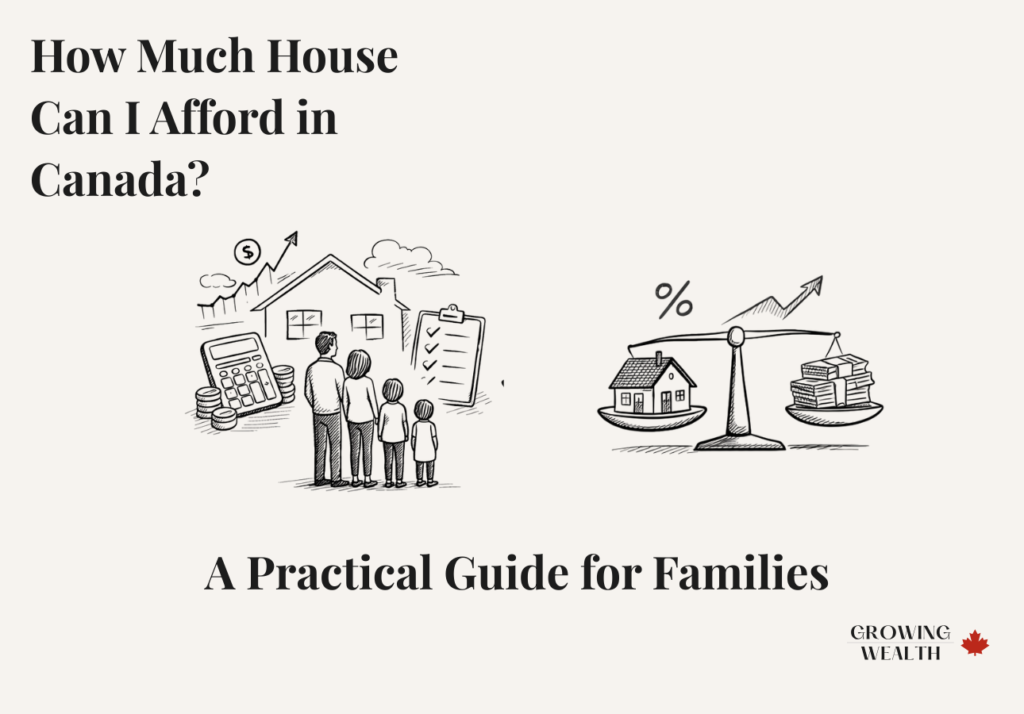
How much house can I afford in Canada?
Mortgage lenders may approve you for a certain amount, but that number doesn’t always reflect what’s comfortable for your household budget or long-term financial goals.
A home purchase affects nearly every part of family finances — from monthly cash flow and savings to childcare costs, retirement contributions, and lifestyle spending.
This guide explains:
- How mortgage affordability is calculated in Canada
- The debt ratios lenders use
- How interest rates impact affordability
- The role of the mortgage stress test
- Realistic budgeting considerations for families
By the end, you’ll have a clear framework to estimate a home price that works for your financial situation.
A Quick Formula to Estimate How Much House You Can Afford
A simple rule of thumb used by many financial planners is:
Home price ≈ 3–4× your gross household income
Example:
| Household Income | Estimated Affordable Home Price |
|---|---|
| $90,000 | $270,000 – $360,000 |
| $120,000 | $360,000 – $480,000 |
| $150,000 | $450,000 – $600,000 |
| $200,000 | $600,000 – $800,000 |
This rule provides a quick estimate but doesn’t account for:
- Down payment size
- Existing debts
- Interest rates
- Property taxes
- Mortgage stress test rules
For families managing childcare costs, car payments, and savings goals, staying closer to 3× income is often more comfortable.
Before you can think about affordability, you need to know how much you’ve saved. Our guide to closing costs in Canada shows what else comes due on possession day (typically $8,000–$15,000 in cash), and our guide to saving for a down payment in Canada walks through the FHSA and Home Buyers’ Plan to get you there faster.
How Mortgage Affordability Is Calculated in Canada
Before diving into affordability calculations, it helps to understand how mortgages work in Canada. Our guide on How Mortgages Work in Canada covers the fundamentals of mortgage terms, amortization, and how lenders structure loans.
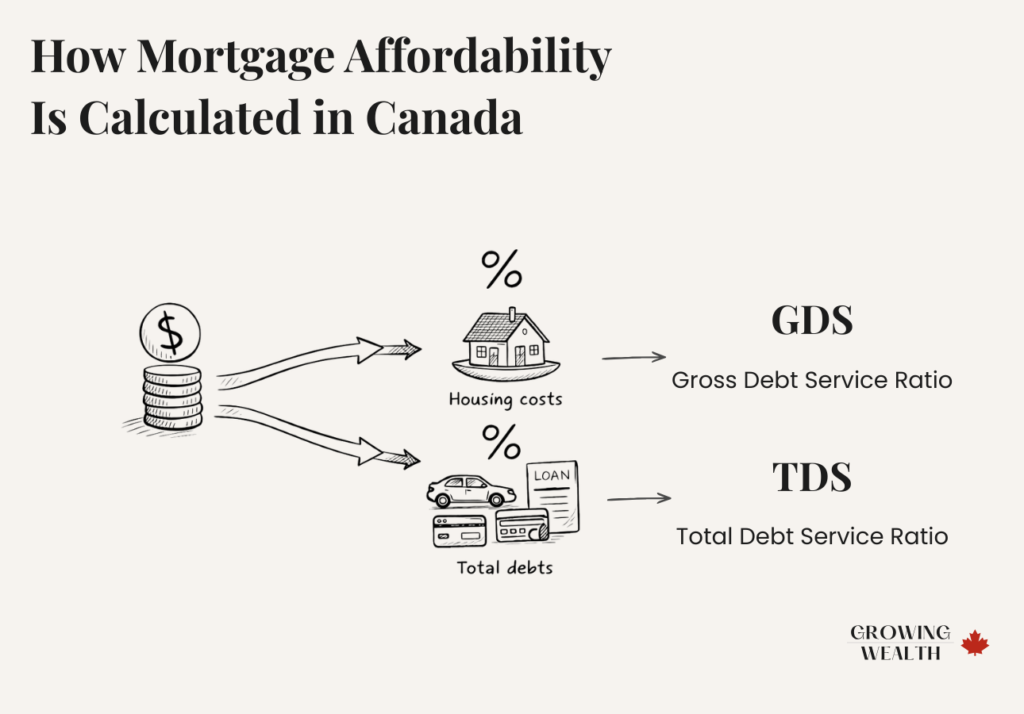
Mortgage lenders primarily evaluate affordability using two financial ratios.
- Gross Debt Service Ratio (GDS)
- Total Debt Service Ratio (TDS)
These ratios determine how much of your income can go toward housing and debt payments.
Gross Debt Service Ratio (GDS)
The Gross Debt Service ratio measures how much of your gross income is used for housing costs.
Housing costs include:
- Mortgage payments
- Property taxes
- Heating costs
- Condo fees (if applicable)
Most Canadian lenders require:
GDS ≤ 39% of gross household income
Example:
Household income: $120,000
Monthly income: $10,000
Maximum housing costs allowed:
$3,900 per month
This helps ensure homeowners still have room in their budgets for other living expenses.
Guidelines like these are outlined by the Financial Consumer Agency of Canada.
Total Debt Service Ratio (TDS)
The Total Debt Service ratio includes all debt obligations.
This includes:
- Mortgage payments
- Car loans
- Credit cards
- Student loans
- Lines of credit
Most lenders require:
TDS ≤ 44% of gross household income
Example:
Monthly income: $10,000
Maximum total debt payments allowed:
$4,400 per month
If you already have $700/month in other debts, your maximum housing costs may drop to around $3,700 per month.
Reducing debt before applying for a mortgage can significantly increase affordability.
How Much Mortgage Can You Afford in Canada?
Mortgage affordability ultimately depends on five main factors:
- Household income
- Existing debts
- Down payment
- Interest rates
- Stress test qualification
Even if a lender approves a large mortgage, that doesn’t mean it fits comfortably in your family budget.
A good approach is to calculate the maximum mortgage you qualify for, then decide whether a lower amount makes more sense for your long-term financial goals.
The Canadian Mortgage Stress Test
All federally regulated lenders must apply the mortgage stress test.
This rule ensures borrowers could still afford payments if interest rates rise.
Under rules set by the Office of the Superintendent of Financial Institutions, borrowers must qualify at the higher of:
- The mortgage contract rate + 2%
- The benchmark qualifying rate set by regulators
Example:
Actual mortgage rate: 5.5%
Stress test rate used for qualification: 7.5%
Because of the stress test, the amount you qualify for is often significantly lower than expected.
Beyond the stress test, lenders also evaluate your credit profile when approving a mortgage. A strong credit score improves your chances of approval and can help you secure better rates. Our guide on What Is a Good Credit Score in Canada? explains what lenders look for and where you stand.
You can learn more about mortgage rules from the Canada Mortgage and Housing Corporation.
The Role of Your Down Payment
Your down payment significantly affects how much home you can afford.
Minimum down payments in Canada are:
| Home Price | Minimum Down Payment |
|---|---|
| Up to $500,000 | 5% |
| $500,000–$999,999 | 5% on first $500k + 10% on remainder |
| $1M+ | 20% |
If your down payment is less than 20%, you must pay mortgage default insurance.
Mortgage insurance is provided by:
How to Save for Your Down Payment
Building a down payment is one of the biggest hurdles in home buying. If you’re a first-time buyer in Canada, the First Home Savings Account (FHSA) offers tax-deductible contributions and tax-free growth—making it one of the fastest ways to accumulate your down payment savings.
A larger down payment reduces:
- Total mortgage interest
- Monthly payments
- Insurance costs
Housing Affordability Varies Across Canada
Where you live dramatically affects affordability.
Typical home prices in major markets:
| City | Typical Home Prices |
|---|---|
| Toronto | Often $1M+ |
| Vancouver | Often $1.2M+ |
| Calgary | ~$550k |
| Ottawa | ~$650k |
| Halifax | ~$500k |
The same household income may buy a very different home depending on location.
National housing market trends can be tracked through the Canadian Real Estate Association.
Example: What a Canadian Family Might Afford
Consider a household earning $150,000 annually.
Assumptions:
- 20% down payment
- 5.5% mortgage rate
- Property taxes of $4,000 per year
- No other debt
Maximum housing budget:
Approximately $4,800 per month
Estimated mortgage amount:
$700,000 – $750,000
Estimated home price:
$875,000 – $940,000
However, many families choose to buy below their maximum qualification to maintain flexibility.
Why Mortgage Approval Is Not the Same as Affordability
Banks calculate how much risk they are willing to take.
They do not necessarily evaluate whether a mortgage leaves room for:
- Family savings
- Emergencies
- Vacations
- Children’s activities
- Retirement investing
Many homeowners discover that stretching to the maximum mortgage creates financial stress.
Before committing to a home price, it’s worth running through a full budget to see exactly what a mortgage payment would leave for everything else — our step-by-step budgeting guide for Canadian families walks you through that process.
Costs Many Buyers Forget to Budget For
Homeownership costs go beyond the mortgage.
These expenses often surprise first-time buyers.
Before committing to a mortgage, ensure you have a solid Emergency Fund in place. Unexpected repairs, job loss, or other disruptions can devastate your finances if you’re already stretched on your mortgage payment.
Closing Costs
Closing costs usually range from 1.5–4% of the purchase price.
These may include:
- Legal fees
- Land transfer tax
- Title insurance
- Appraisals
- Home inspections
In Ontario, land transfer taxes alone can be substantial.
Property Taxes
Property taxes vary significantly by municipality.
They may range from a few thousand dollars annually to much higher in major cities.
These costs must always be included when calculating affordability.
Maintenance and Repairs
A common rule of thumb is to budget 1–3% of the home value per year for maintenance.
Example:
$800,000 home
Annual maintenance estimate:
$8,000–$24,000
Utilities
Utility costs depend on:
- Home size
- Heating system
- Energy efficiency
- Climate
These costs can add several hundred dollars per month.
How Interest Rates Affect Affordability
Interest rates have a major impact on affordability.
Example: $600,000 mortgage
| Interest Rate | Monthly Payment |
|---|---|
| 3% | $2,840 |
| 5% | $3,480 |
| 6% | $3,850 |
Even small rate increases can significantly reduce buying power.
Many Canadians experienced this when rates rose sharply after the pandemic, especially those with variable-rate mortgages.
You can learn more about this in our guide to Fixed vs Variable Mortgages in Canada.
Should You Buy the Most Expensive Home You Qualify For?
For many families, the safest strategy is buying below the maximum approval amount.
This leaves room for:
- Retirement savings
- Emergency funds
- Investing
- Lifestyle spending
Financial flexibility is often more valuable than owning a larger home.
Financial flexibility is often more valuable than owning a larger home.
As you save toward your down payment, annual tax refunds can accelerate your timeline. Rather than spending this money, consider redirecting it to your down payment fund.
Key Takeaways
- Most lenders limit housing costs to 39% of gross income
- Total debt payments must stay below 44% of income
- Mortgage stress tests reduce maximum borrowing
- A typical affordability range is 3–4× household income
- Buying below your maximum mortgage can improve financial stability
Final Thoughts
Determining how much house you can afford in Canada involves more than just mortgage approval.
Interest rates, family expenses, debt levels, and financial goals all play a role.
For many families, the smartest decision isn’t buying the most expensive home possible — it’s choosing a home that allows room for saving, investing, and maintaining financial stability.
A home should support your financial life, not dominate it.
Once you have your affordability number, the next step is making it official — our mortgage pre-approval guide walks through the full process, documents needed, and how the stress test affects your maximum.
For the full picture — from pre-approval and closing costs through to mortgage renewal — our complete guide to buying a home in Canada covers every stage.
Frequently Asked Questions
How much income do I need to buy a $500,000 home in Canada?
With a 20% down payment and mortgage rates around 5–6%, a household income of roughly $90,000–$110,000 is often required.
Actual affordability depends on debts, property taxes, and interest rates.
How much income do I need to buy a $700,000 home in Canada?
With a 20% down payment and typical mortgage rates, households often need $130,000–$150,000 in income to comfortably afford a $700,000 home.
What credit score is required to get a mortgage in Canada?
Most lenders require a minimum credit score between 600 and 680.
However, borrowers with scores above 720 typically receive the best mortgage rates.
You can learn more in our guide to What Is a Good Credit Score in Canada?
What is the minimum down payment in Canada?
Minimum down payments are:
- 5% for homes up to $500,000
- 5% + 10% for homes between $500k and $999k
- 20% for homes above $1 million
Down payments under 20% require mortgage insurance.
How much should I save for closing costs?
Closing costs typically range from 1.5–4% of the home price.
For a $700,000 home, this could mean $10,000–$28,000.
Affiliate Disclosure
💡 GrowingWealth.ca is supported by readers. Some of the links in this article are affiliate links, which means we may earn a small commission if you open an account or make a purchase — at no extra cost to you. We only recommend products and services we personally use, trust, or believe provide genuine value to Canadians. Our reviews and comparisons are always independent and objective.