
 Registered Accounts
Every year, Canadians face the same question: RRSP or TFSA?
And every year, most articles give the same vague answer: “It depends on your situation.” That’s true — but it’s not helpful. Here’s what actually determines which account wins for you: your marginal tax rate today versus what you expect to pay in retirement. Get that comparison right, and the decision becomes clear.
Quick Decision Guide
| Earning under $55,000 | TFSA first |
| Earning $55,000–$100,000 | TFSA first, add RRSP as income grows |
| Earning over $100,000 | RRSP first, TFSA with the refund |
| Variable or unpredictable income | TFSA first |
| Saving for a home (within 5 years) | FHSA first, then TFSA |
| Need flexibility or may need the money | TFSA first |
| Already maxed RRSP | TFSA |
If you’re also a first-time buyer, there’s a third account in the mix — see our FHSA vs TFSA vs RRSP comparison for the full three-way breakdown.
How Each Account Works
RRSP — Registered Retirement Savings Plan
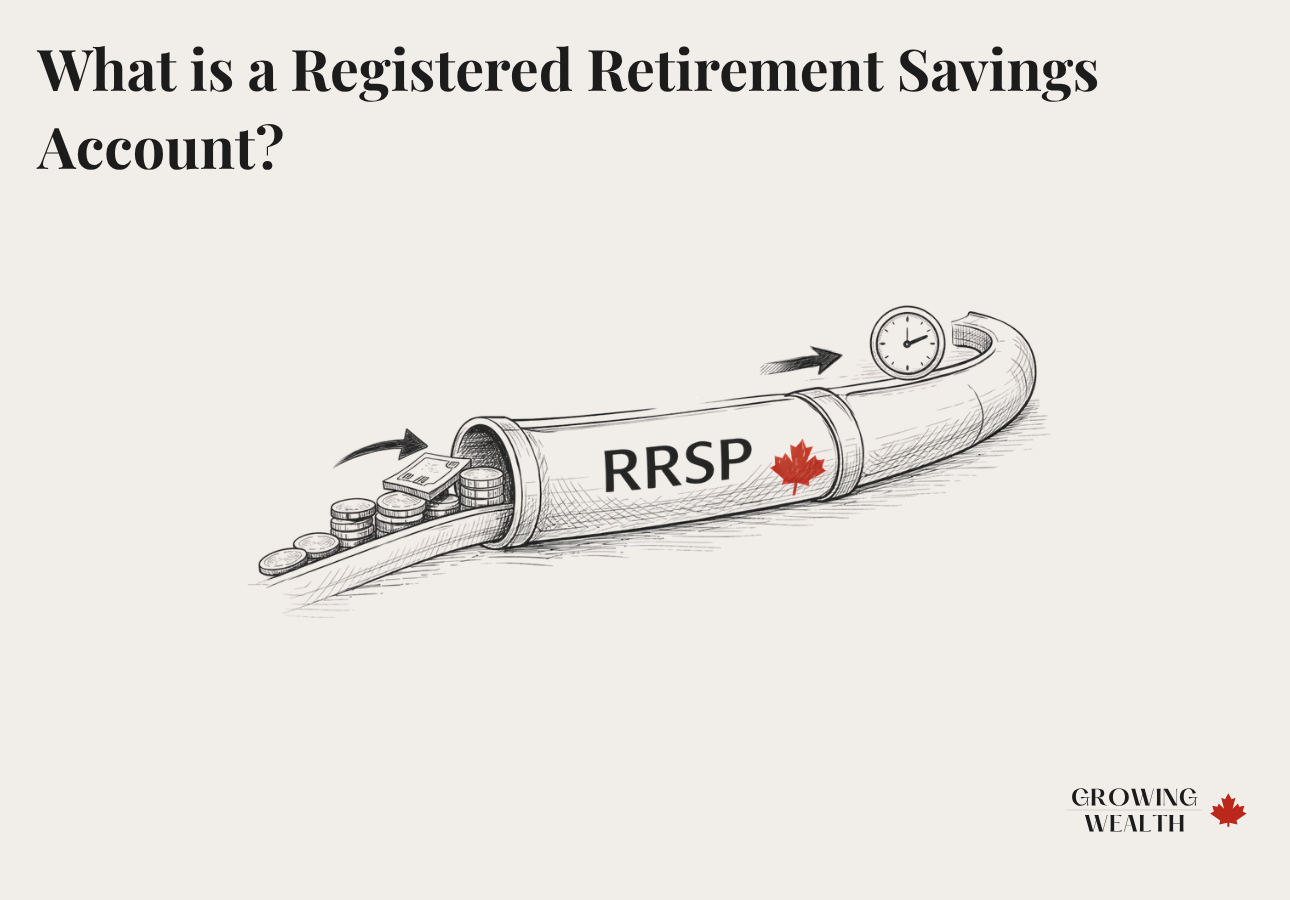
The RRSP is built around a tax deferral trade. You contribute money today, deduct it from your taxable income, and pay the tax later when you withdraw — ideally in retirement when your income and tax rate are lower.
The RRSP also doubles as a tool for first-time buyers through the Home Buyers’ Plan — you can withdraw up to $60,000 tax-free toward a first home, then repay it over 15 years. For the full breakdown, see our complete RRSP guide or the CRA’s official RRSP rules.
TFSA — Tax-Free Savings Account
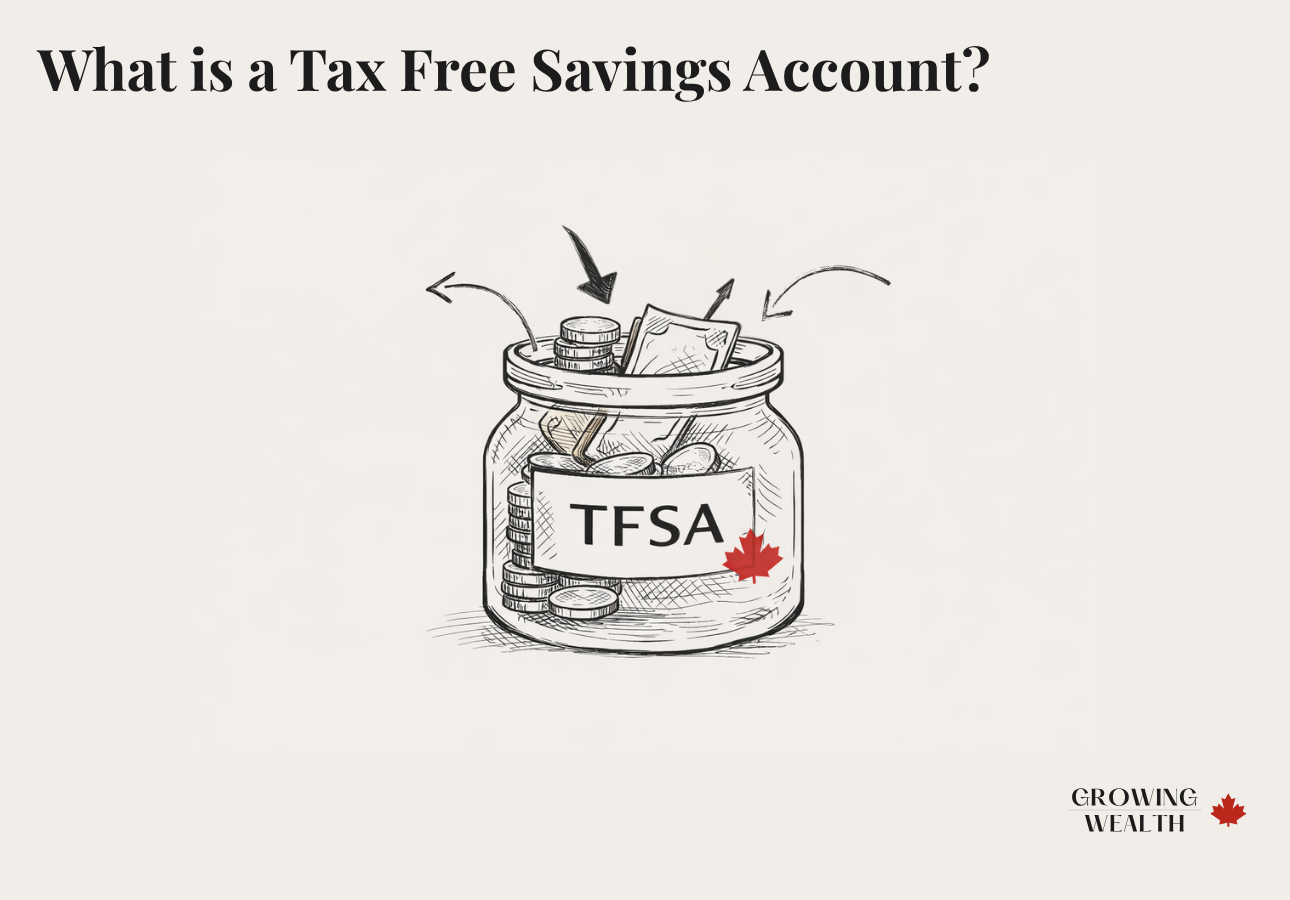
The TFSA flips the equation. You contribute after-tax dollars, get no deduction today, but every dollar of growth and every withdrawal is completely tax-free — forever.
For the full breakdown, see our TFSA guide for Canadians or the CRA’s TFSA rules.
Key Differences That Actually Matter
| Feature | RRSP | TFSA |
|---|---|---|
| 2026 Contribution Limit | 18% of income, max $33,810 | $7,000 annual |
| Tax Deduction on Contribution | ✓ Yes — reduces taxable income | ✗ No deduction |
| Tax on Growth | Tax-deferred until withdrawal | Tax-free forever |
| Tax on Withdrawal | Taxed as income | Never taxed |
| Room After Withdrawal | Lost permanently | Restored January 1 |
| Impact on Government Benefits | Counts as income — affects OAS, GIS | No impact on benefits |
| Age Restriction | Converts to RRIF at 71 | None |
| Spousal Option | ✓ Spousal RRSP available | ✗ No spousal TFSA |
The Real Math: Why Your Tax Bracket Decides This
The RRSP vs TFSA decision is fundamentally a tax bracket arbitrage question: do you pay tax now (TFSA) or later (RRSP)? The RRSP wins when your tax rate at withdrawal is lower than your rate at contribution. The TFSA wins when it’s the same or higher.
Priya earns $120,000 in Ontario. Her marginal tax rate is approximately 43%. She contributes $15,000 to her RRSP — saving roughly $6,450 in tax immediately. She invests that refund straight into her TFSA (the double-dip). In retirement at 65, she expects income around $60,000. Her RRSP withdrawal rate: approximately 29%.
She deducted at 43%, pays back at 29% — a meaningful long-term gain the TFSA alone couldn’t capture.
Marcus earns $48,000 in Alberta. His combined marginal rate is approximately 25%. A $5,000 RRSP contribution saves him just ~$1,250 in tax. In retirement, his income from CPP, OAS, and part-time work lands around $42,000 — a similar marginal rate. The math doesn’t work in his favour.
The TFSA is a better fit: growth and withdrawal are tax-free regardless of future income, and he keeps full flexibility.
Sarah and James earn $85,000 combined with two young kids. Income fluctuates based on contract work. In higher-income years, RRSP contributions capture the deduction. In lower-income or mat-leave years, TFSA is better. The answer isn’t one or the other — it’s sequencing them correctly based on where income sits each year.
The Double-Dip Strategy
The most powerful RRSP move isn’t just contributing — it’s what you do with the refund. Most families miss this entirely.
The OAS Factor: Why High Earners Need Both
This is the part most articles gloss over — and it matters enormously for long-term planning.
Old Age Security is clawed back once your income exceeds $90,997. For every dollar above that threshold, you repay 15 cents of OAS.
RRSP/RRIF withdrawals count as income. TFSA withdrawals do not.
A retiree with $800,000 in RRSPs converting to a RRIF at 71 may be forced into mandatory minimum withdrawals that push them well above the clawback threshold — losing thousands per year in benefits they’d otherwise keep.
Building a significant TFSA alongside your RRSP gives you withdrawal flexibility in retirement. Draw from the TFSA in years when RRIF withdrawals would trigger clawback; draw from the RRIF in lower-income years. This is why “use both” isn’t just a hedge — it’s an active tax-minimization strategy.
For Common Canadian Family Situations

Young family, moderate income ($70,000–$90,000 combined)
Goal: Save for a home in 3–5 years, build an emergency fund, start investing. Approach: TFSA first for flexibility and the home down payment goal. Once household income grows past $80,000–$90,000, begin layering in RRSP contributions.
Mid-career, higher income ($110,000–$160,000 combined)
Goal: Retirement savings, tax reduction now. Approach: RRSP first to capture deductions at a high marginal rate. Reinvest every refund into TFSA. By mid-career with stable income, you’re in the bracket where the RRSP advantage is most pronounced.
One income, one parent home ($75,000–$100,000)
Goal: Build savings while managing tight cash flow. Approach: TFSA during the stay-at-home period — flexibility matters more. Consider a Spousal RRSP so the working partner contributes and splits future retirement income across two tax returns.
Near retirement (55+, higher accumulated assets)
Goal: Minimize taxes on withdrawals, protect OAS. Approach: Start intentional RRSP/RRIF drawdown planning now. Contribute aggressively to unused TFSA room — those assets will never be taxed on withdrawal. Consider partial RRSP drawdowns before mandatory RRIF conversion at 71.
Answer 7 questions and get your personalized priority order with plain-English reasoning for your specific situation.
Pros and Cons
RRSP
- Immediate tax deduction reduces your bill today
- Higher contribution limits for higher earners
- Spousal RRSP allows income-splitting in retirement
- Home Buyers’ Plan and Lifelong Learning Plan available
- Withdrawals fully taxed as income
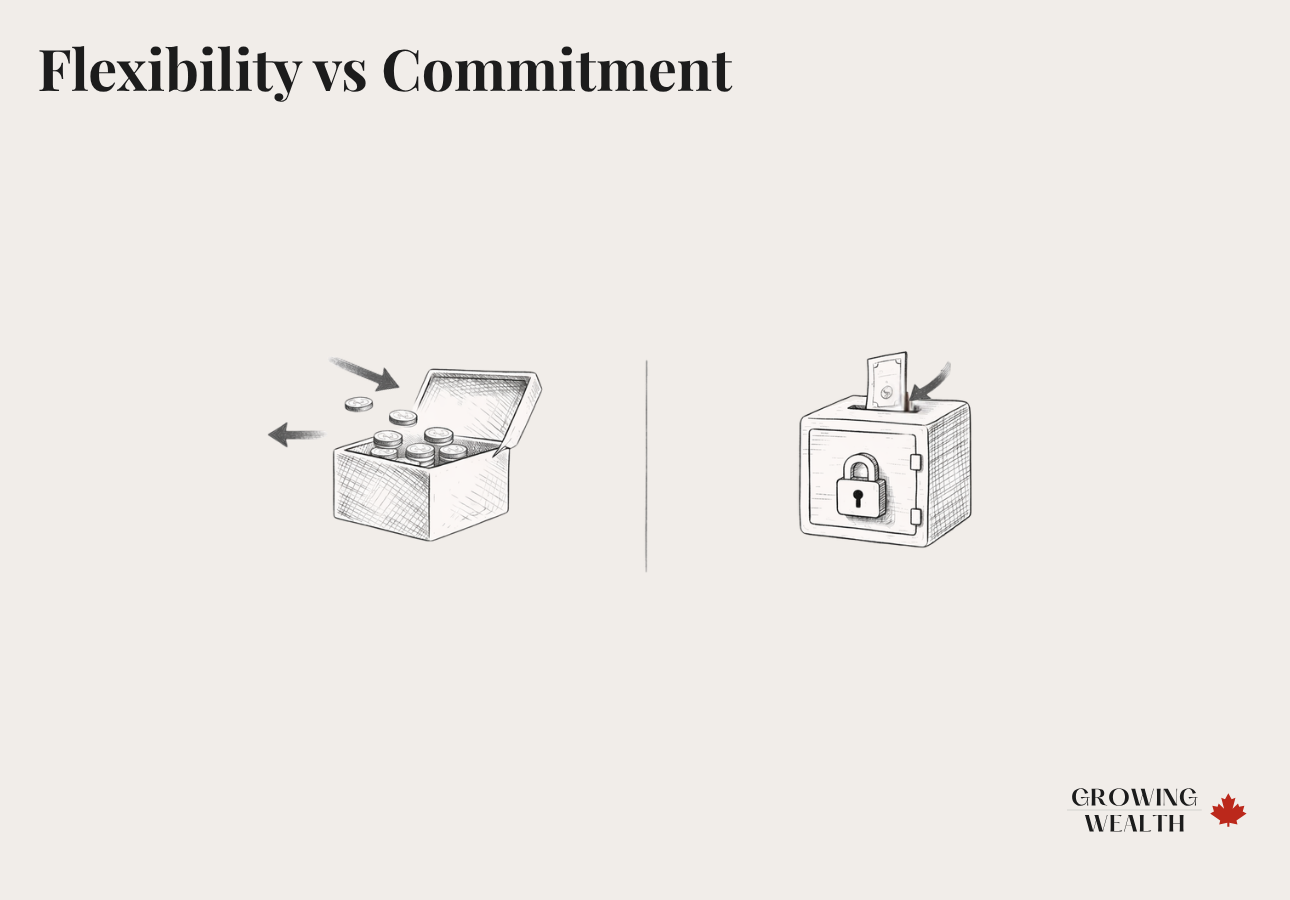
- Contribution room permanently lost on withdrawal
- Mandatory RRIF conversion at 71
- Can trigger OAS clawback and affect income-tested benefits
TFSA
- Withdraw anytime, tax-free, for any reason
- Growth never taxed — not even capital gains
- Doesn’t affect OAS, GIS, or government benefits
- Contribution room restored January 1 after withdrawal
- Lower annual limit ($7,000 vs up to $33,810)
- No immediate tax deduction
- Over-contributions carry a 1% monthly penalty
- Withdrawn room comes back January 1, not immediately
Best Accounts to Open

For more options, see our guide to high-interest savings accounts in Canada.
Bottom Line
For a strong foundation before investing, see A Simple Family Finance System for Canadians — it covers the sequencing of savings before registered accounts become the priority.
Frequently Asked Questions
Most Canadians benefit from using both. The RRSP provides a tax deduction during your working years at a higher marginal rate, while the TFSA gives you tax-free income in retirement that doesn’t push you into OAS clawback territory. The goal isn’t to pick one — it’s to sequence them correctly based on your income each year.
As a rough rule: once your combined marginal tax rate exceeds 30%, the RRSP deduction becomes meaningfully valuable. In most provinces, that happens around $55,000–$60,000 in income. Below that, the immediate tax savings are modest and the TFSA’s flexibility often wins.
Yes — and most long-term savings strategies rely on both. There are no restrictions on holding both simultaneously. The question is which one to prioritize with your next available dollar, which depends on your income level and goals.
Withdrawals are taxed as income in the year you take them. The financial institution will withhold tax at source (10% on amounts up to $5,000, 20% up to $15,000, 30% above that in most provinces), but you may owe more depending on your total income. Critically, the contribution room is permanently lost — unlike a TFSA, it does not come back.
Generally yes. If you’re earning under $50,000–$55,000, your marginal tax rate is low enough that the RRSP deduction doesn’t save much today. If your income rises in retirement, you could end up paying a similar or higher rate on withdrawals. The TFSA avoids that risk: growth and withdrawals are always tax-free.
RRSP withdrawals and mandatory RRIF withdrawals after age 71 count as taxable income. If your total retirement income exceeds the OAS clawback threshold (~$91,000 in 2026), you’ll repay 15 cents of OAS for every dollar above it. Building a large TFSA alongside your RRSP gives you the flexibility to draw from the TFSA in years when RRIF withdrawals would push you into clawback territory.
Yes. Contributing to your RRSP doesn’t affect your TFSA room, and vice versa. Many Canadians do both in the same tax year — RRSP to capture the deduction, then TFSA with whatever’s left (or with the RRSP refund using the double-dip strategy).
The deadline for contributions to count toward your 2025 taxes is March 2, 2026. Since March 1 falls on a Sunday in 2026, the deadline shifts to the next business day.
A Spousal RRSP allows the higher-earning partner to contribute to an RRSP in the lower-earning partner’s name. You get the deduction at your higher tax rate, but future withdrawals come out at your spouse’s lower rate. This can meaningfully reduce a couple’s combined tax burden in retirement. There are no Spousal TFSAs — each partner contributes to their own.
The CRA charges 1% per month on over-contributions. Before contributing, check your available room through CRA My Account or your Notice of Assessment. If you withdrew from your TFSA in 2025, that room doesn’t come back until January 1, 2026 — contributing it back sooner creates an over-contribution.
Want to turn what you’ve just learned into lasting results? Read our cornerstone guide — The Power of Financial Habits: How to Build Lasting Wealth — and learn how small, consistent actions create real financial freedom.