
Most Canadians misunderstand the TFSA, treating it like a savings account—a place to park cash, something “safe.”
That’s not what it’s for.
A Tax-Free Savings Account is one of the most powerful tools available to Canadian families—not because it’s safe, but because everything that grows inside it is never taxed again.
The Canadian government makes it clear that a TFSA allows your investments to grow completely tax-free—including interest, dividends, and capital gains. According to the official guidance from the Government of Canada, any income earned inside a TFSA is not taxed, even when withdrawn.
Used properly, your TFSA can compound into a six-figure (or higher) tax-free portfolio; used poorly, it barely keeps up with inflation.
If you’re still building your foundation, start with how to start investing in Canada.
This article contains affiliate links. We may earn a commission if you open an account — at no cost to you. We only recommend products we’ve researched and trust.
 Registered Accounts
Most Canadians treat their TFSA like savings—but it’s designed for long-term growth.
In This Article
- Quick Answer: What Should You Hold in a TFSA?
- The Core Rule: Use Your TFSA for Growth
- Broad Market ETFs (Your Default Choice)
- U.S. and Global Equity Exposure
- Individual Stocks (Use Carefully)
- What You Should NOT Hold in a TFSA
- Why Using Your TFSA for Savings Feels Right (But Isn’t)
- TFSA vs RRSP: Asset Location Strategy
- Where Your TFSA Fits in a Family Finance System
- TFSA Growth vs Savings: Real 10-Year Comparison
- A Simple TFSA Portfolio (That Actually Works)
- Where Lump Sum vs DCA Fits In
- Common TFSA Mistakes
- Frequently Asked Questions
The best investments to hold in a TFSA in Canada are high-growth assets like ETFs and global stocks, not low-return options like savings accounts or GICs. Your TFSA should be used for long-term tax-free growth, not short-term cash.
The Core Rule: Use Your TFSA for Growth
Don’t waste your TFSA room on low-return investments.
Your TFSA eliminates tax on capital gains, dividends, and withdrawals. That’s what makes it so powerful—especially when paired with long-term growth.
Historically, equity markets have returned roughly 7–10% annually over the long term, while savings accounts typically sit closer to 2–4%. That gap compounds over time—and the TFSA lets you keep all of it.
Consider Meera, 34, in Alberta, earning $58,000. She keeps $12,000 split evenly between her TFSA and a joint savings account—$6,000 in each. If she moved the savings-account portion into a broad ETF inside her TFSA instead, she’d keep the exact same tax-free treatment on both halves, but the growth half would likely be worth two to three times more after 15 years.
That’s why your TFSA should be your growth engine, not your safety bucket.
Broad Market ETFs (Your Default Choice)
If you’re asking what should I put in my TFSA, this is your answer.
Broad market ETFs give you diversification, low fees, and long-term growth—all in a single investment. Instead of trying to pick individual winners, you own the market.
For most Canadian families, this is the simplest and most effective TFSA strategy. The two most common one-ticket options are XEQT (iShares Core Equity ETF Portfolio) and VEQT (Vanguard All-Equity ETF Portfolio) — both hold thousands of stocks spread across Canada, the US, and international markets, rebalance automatically, and charge around 0.20% a year. They’re close to interchangeable; picking one and starting matters more than which one you pick.
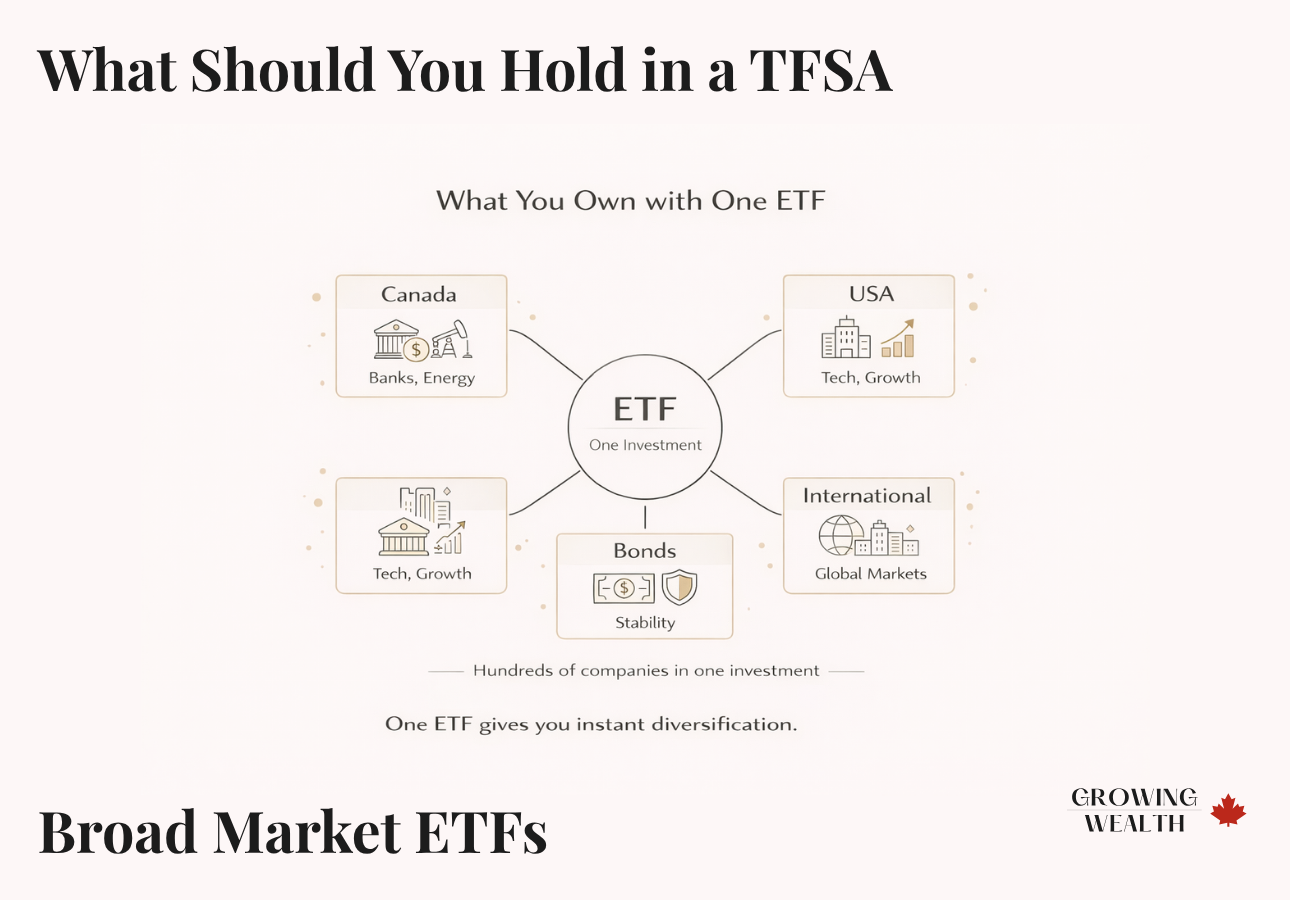
One ETF gives you instant diversification across multiple markets.
If you want a straightforward way to get started:
This allows you to invest in diversified ETF portfolios with minimal setup and ongoing management.
Open an account with Wealthsimple →U.S. and Global Equity Exposure
Canada makes up a small portion of the global market, so if your TFSA is heavily concentrated there, you’re limiting your long-term potential.
A stronger approach includes exposure to:
This gives you access to global growth, innovation, and a broader range of industries.
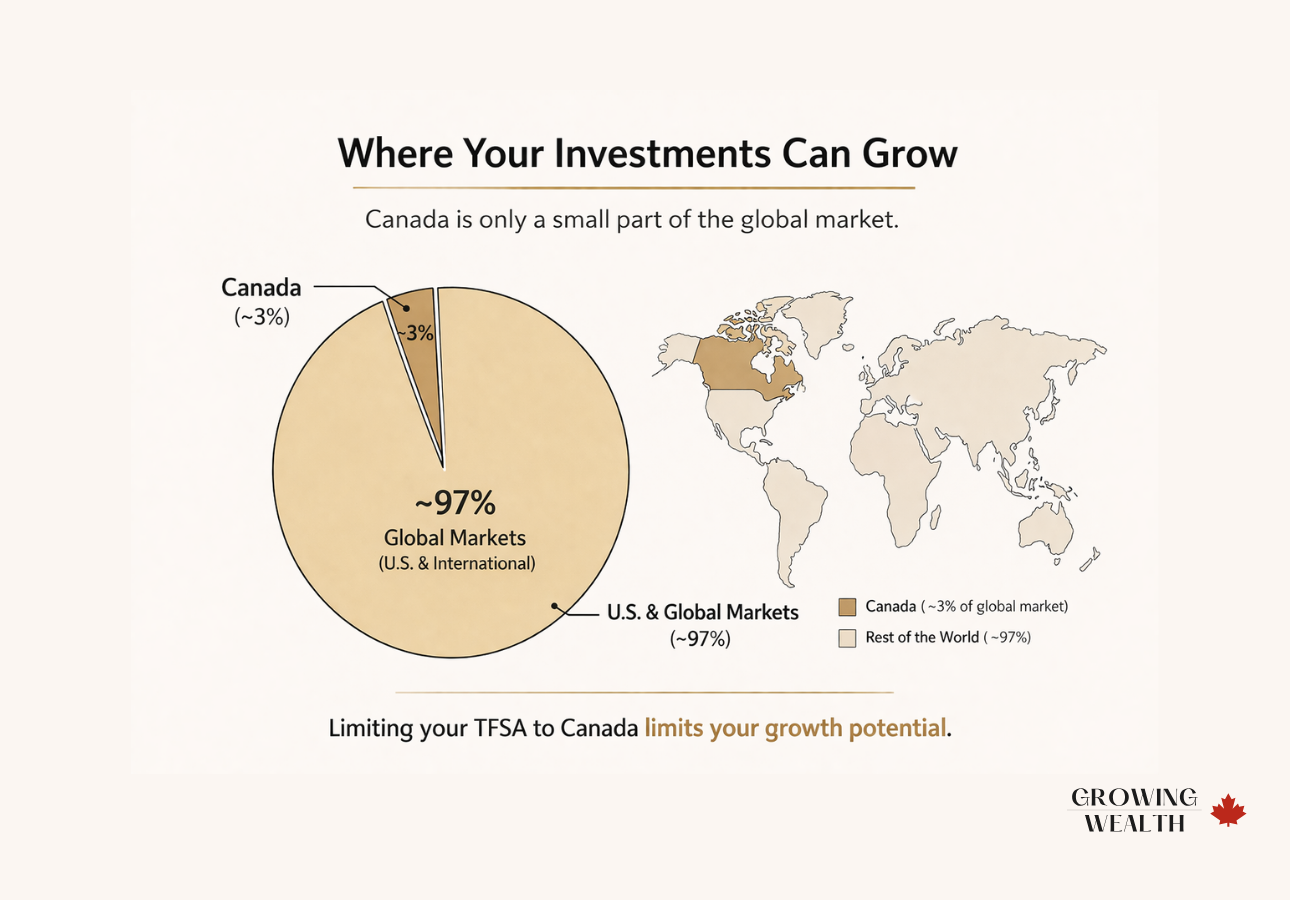
Canada represents only a small portion of global investment opportunities.
You may hear about a U.S. withholding tax inside a TFSA. Here’s the short version: the U.S. government keeps 15% of any dividend paid by an American company, even inside your TFSA — and there’s no way around it, whether you hold a Canadian-listed fund like VFV or a U.S.-listed one. The amount is small, though, and shouldn’t stop you from investing in U.S. or global markets. Growth matters more.
Individual Stocks (Use Carefully)
Holding individual stocks in a TFSA can be powerful—but it’s not where most people should focus.
- If a stock performs well, all gains are tax-free.
- If your investment drops significantly, that loss permanently reduces your TFSA contribution room. You don’t get it back.
For that reason, individual stocks should be used carefully and kept as a smaller portion of your overall TFSA.
What You Should NOT Hold in a TFSA
Three come up again and again:
This is the most common mistake. It feels safe, but it limits what the account can actually do — savings accounts generate relatively low returns, which means you’re using tax-free space for minimal growth. If your goal is to earn interest on short-term cash, keep that outside your TFSA.
GICs offer fixed returns and capital protection—but they also limit your upside. Inside a TFSA, that creates opportunity cost: valuable tax-free space used on investments that don’t grow much over time. They can still serve a purpose for short-term needs, but shouldn’t be the core of your TFSA.
If your TFSA is heavily weighted toward bonds, cash, or low-risk funds, you’re underusing it. The TFSA works best paired with time and growth — that doesn’t mean taking unnecessary risk, it means aligning your investments with a long-term horizon.
If you’re comparing savings options, see high-interest savings accounts in Canada. Or use a dedicated account like:
This keeps your TFSA available for higher-growth investments.
Open an EQ Bank account →There are exceptions. A TFSA can still make sense for:
But beyond that, it’s not the best use.
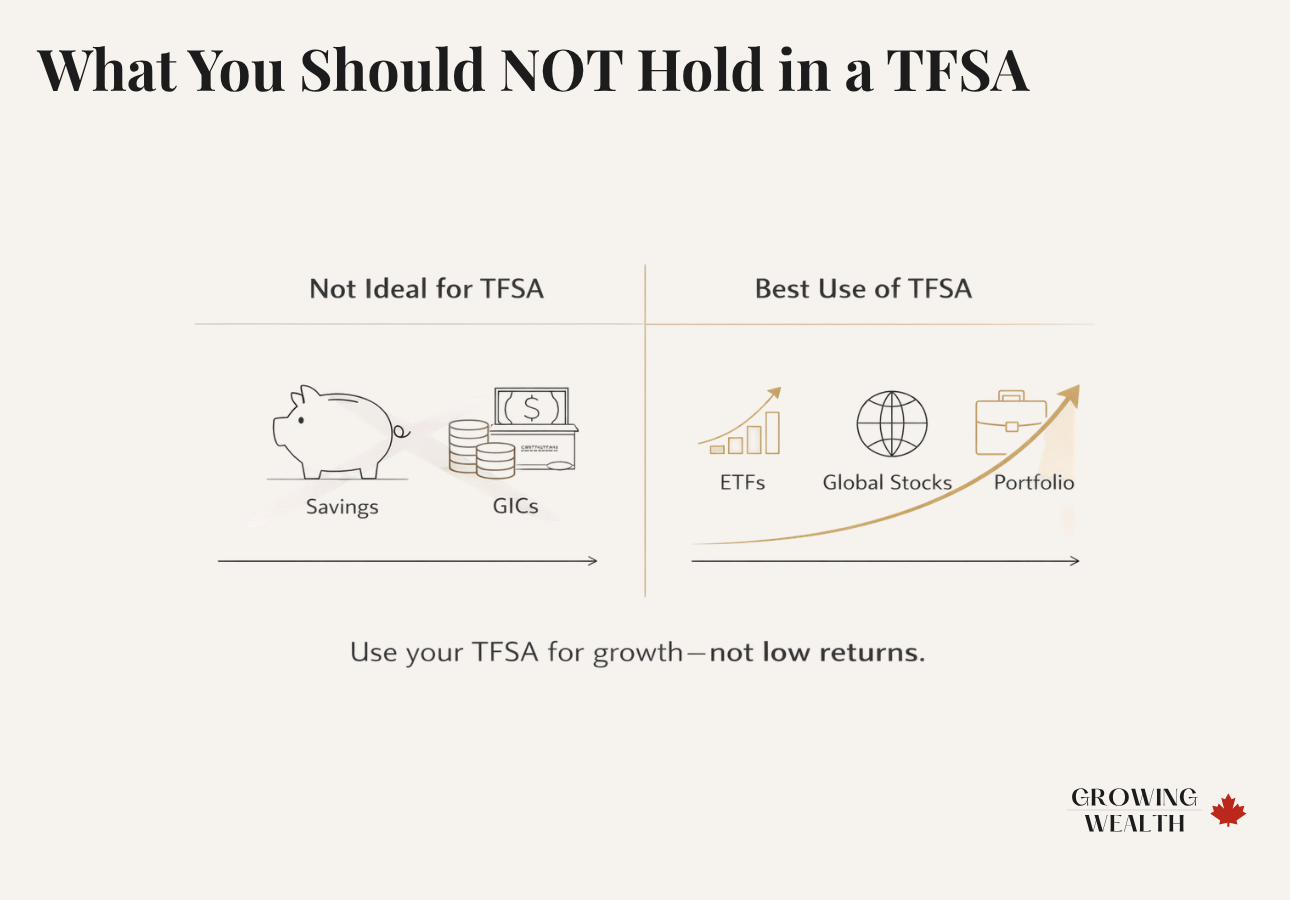
Using your TFSA for savings or GICs limits growth—investing in ETFs and global stocks makes better use of tax-free compounding.
Why Using Your TFSA for Savings Feels Right (But Isn’t)
Part of the confusion comes from the name—“Tax-Free Savings Account” makes it sound like a place for cash, but it’s not.
Banks reinforce this by promoting TFSAs as savings products, which leads many people to default to low-return options.
Psychologically, it feels safer—but financially, it’s inefficient. The TFSA isn’t about protecting money; it’s about growing it efficiently.
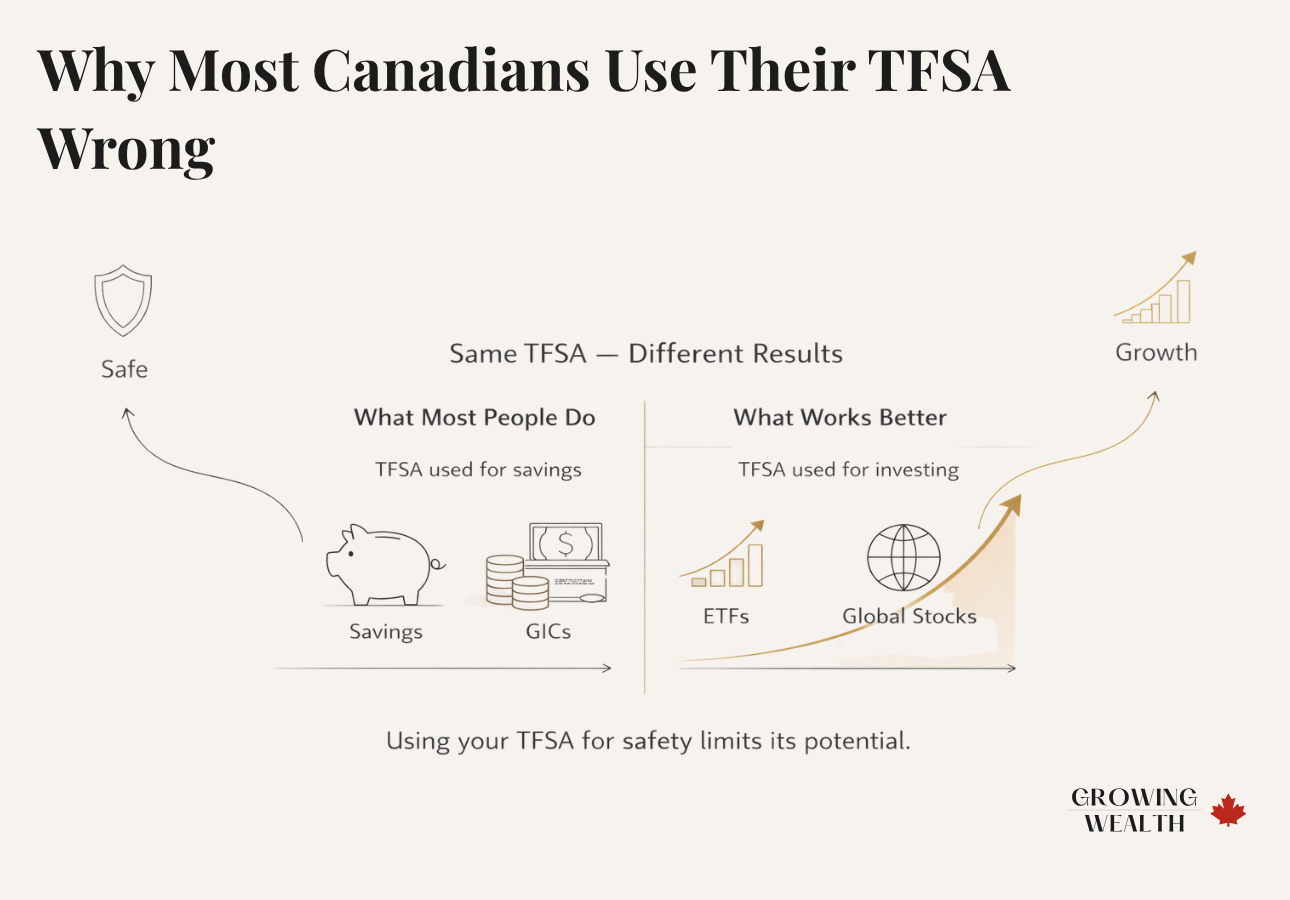
Many Canadians use their TFSA for safety instead of growth—this limits long-term tax-free potential.
TFSA vs RRSP: Asset Location Strategy
Not all investments belong in the same account.
| Investment Type | Best Account |
|---|---|
| High-growth ETFs | TFSA |
| U.S. dividend stocks | RRSP |
| Bonds / fixed income | RRSP |
| Short-term savings | TFSA or HISA |
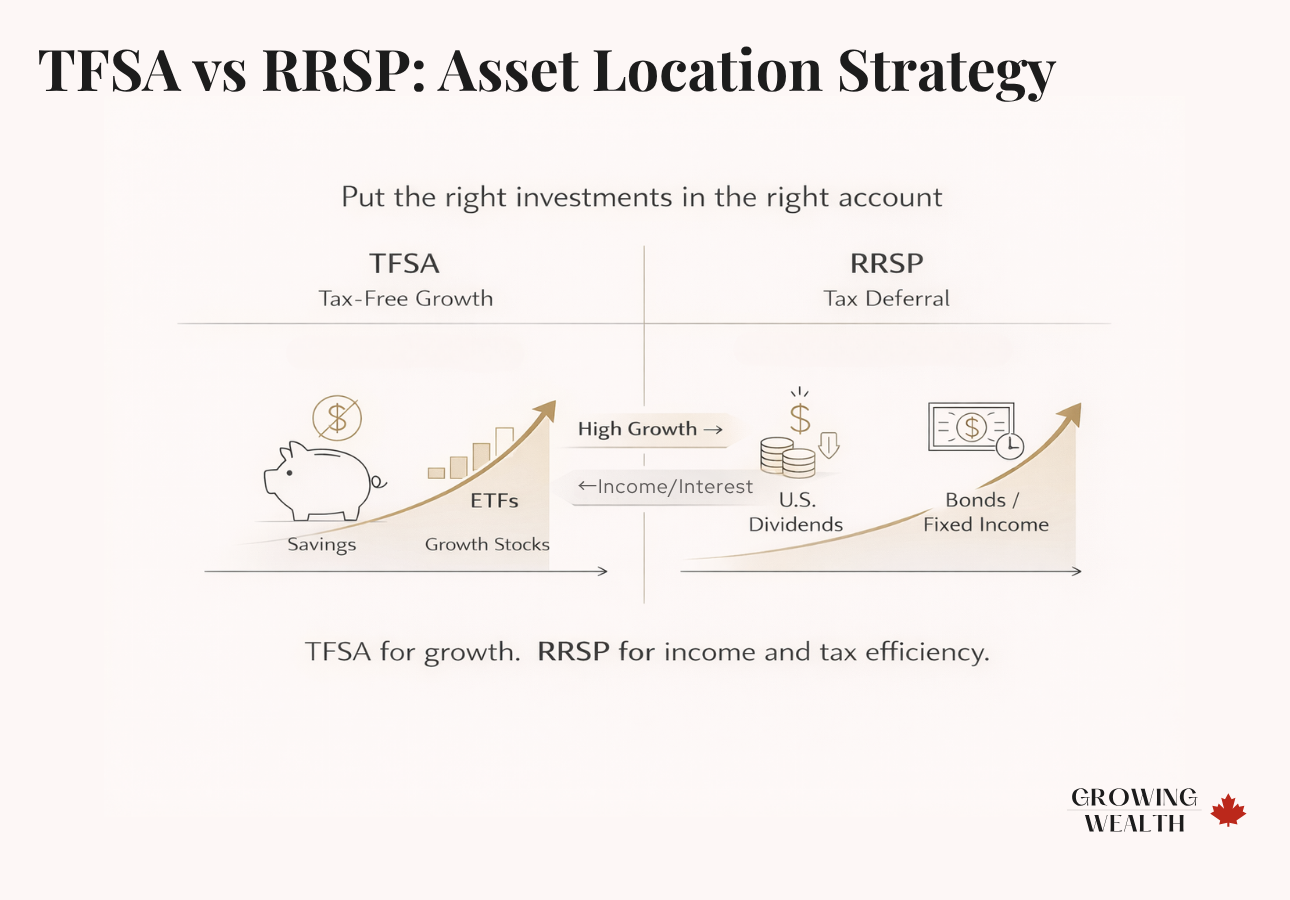
Matching each investment type to the account where it grows most efficiently is the core of asset location strategy.
The TFSA is best used for tax-free growth, while the RRSP is better suited for tax-deferred income and specific tax efficiencies.
For a full breakdown of which investments work best on the RRSP side of that equation, see our guide on what to hold in your RRSP.
If you’re deciding how to balance both, read RRSP vs TFSA in Canada.
If you’re also eligible for an FHSA, it changes the equation — our FHSA vs TFSA vs RRSP comparison shows where it fits alongside both accounts.
Where Your TFSA Fits in a Family Finance System
Your TFSA doesn’t exist in isolation—it’s one part of a broader system.
A strong setup typically includes:
For unexpected expenses.
For short-term goals.
For long-term investing.
For retirement optimization.
The mistake most families make is mixing these roles—using their TFSA for short-term savings and conservative investments, which weakens its effectiveness. Each account should have a clear purpose.
To see how this fits together, revisit A Simple Family Finance System for Canadians.
TFSA Growth vs Savings: Real 10-Year Comparison
Here’s what happens when you use your TFSA differently.
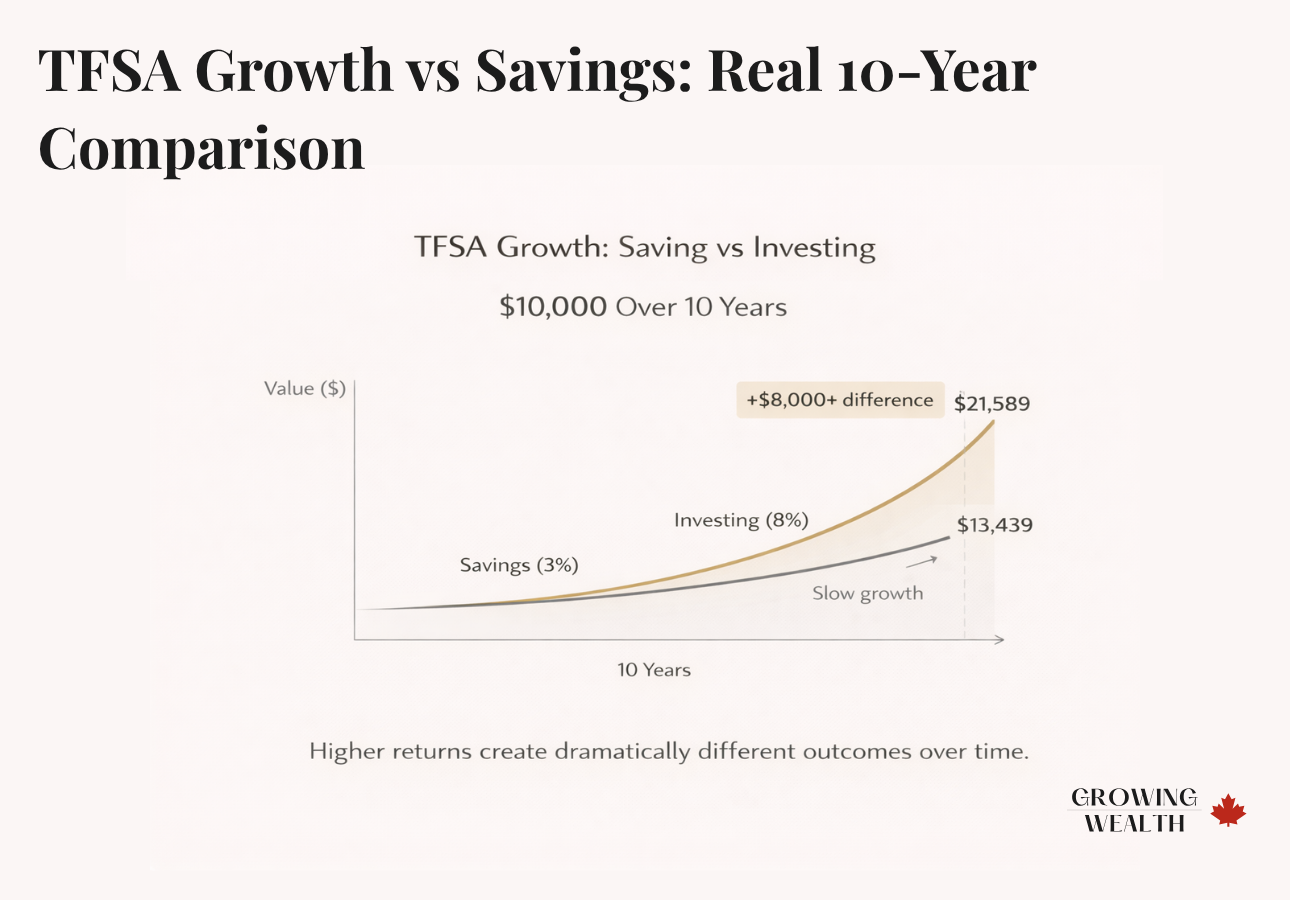
Using your TFSA for growth instead of savings can dramatically increase long-term returns.
| Scenario | Annual Return | Final Value (TFSA) | Tax Owed Outside TFSA | After-Tax Value (Non-TFSA) |
|---|---|---|---|---|
| Savings Account | 3% | $13,439 | ~$1,031 | ~$12,408 |
| Growth Investment | 8% | $21,589 | ~$1,738 | ~$19,851 |
Using your TFSA for savings saves some tax—but produces limited growth. Using it for growth saves more tax and produces significantly higher returns.
The difference is over $8,000 on just $10,000 in 10 years. Over longer periods, that gap becomes much larger.
A Simple TFSA Portfolio (That Actually Works)
You don’t need complexity—you need consistency.
A simple structure is often enough: XEQT or VEQT as your core holding, optionally paired with a small allocation to bonds (like ZAG or VAB) if you need stability.
This gives you diversification, growth, and simplicity without constant management.
Where Lump Sum vs DCA Fits In
Once you know what to hold, the next decision is how to invest your contributions—all at once, or spread out over time.
If you’re unsure which approach fits your situation, compare both strategies in lump sum vs dollar-cost averaging in Canada.
The best approach is the one you can stick with consistently.
Common TFSA Mistakes
The biggest issues aren’t complicated—they’re behavioural.
All of these mistakes reduce long-term results.
The Bottom Line
The TFSA is not just another account—it’s one of the few places in Canada where your investments can grow completely tax-free.
Most people underuse it by focusing on safety instead of growth, and that decision has long-term consequences.
Put your best long-term investments in your TFSA—not your safest ones.

Long-term financial success comes from consistent decisions made at home.
Frequently Asked Questions
High-growth investments like ETFs and global equities are typically the best choice because they benefit most from tax-free compounding.
They can be useful for short-term savings or emergency funds, but they are not ideal for long-term investing.
Yes. While there is a small withholding tax on dividends, the growth potential generally outweighs the cost.
Yes. Losses are possible, and they permanently reduce your contribution room, which is why investment choices matter.
As a rule, the TFSA wins for lower incomes and flexibility, while the RRSP wins at higher incomes because of the tax deduction. If you earn under roughly $50,000, prioritize your TFSA. Above $90,000, prioritize your RRSP first, then fill your TFSA with what’s left.
Start with a diversified ETF portfolio and contribute consistently. If you need guidance, review how to start investing in Canada.
Want to turn what you’ve just learned into lasting results? Read The Power of Financial Habits — the behaviours that determine whether a strong TFSA strategy actually compounds over time.