
Wealthsimple’s Active Trader status has existed quietly for years, but it got substantially more valuable this summer. Since June 2026, the status doesn’t just unlock free phone trades and priority support, it triples the standard transfer match rate from 1% to 3%, turning a minor perk into a bonus worth tens of thousands of dollars on a large account transfer. That change is why the status is suddenly showing up across Canadian investor forums and social feeds, with people trying to work out exactly what it’s worth and whether chasing it makes sense. This guide breaks down the real dollar value of each benefit, how the whole model compares to what other Canadian brokers offer their own active traders, and where the line sits between legitimately qualifying and manufacturing trades you shouldn’t.
This article contains affiliate links. We may earn a commission if you open an account — at no cost to you. We only recommend products we’ve researched and trust.
 INVESTING
In This Article
- What Is Wealthsimple Active Trader Status?
- What You Actually Get
- How It Compares to Other Canadian Brokers
- How to Qualify: The 50-Trade Threshold
- What Counts as an Eligible Trade
- Keeping Your Status: The Grace Month
- The 3% Transfer Match, Explained
- The Legitimate Shortcut for Big Transfers
- Should You Manufacture Trades to Qualify?
- Who This Is Actually Worth It For
- Frequently Asked Questions
Before the full breakdown, here’s the short version: whether Active Trader status is worth pursuing depends entirely on whether the 50-trade threshold reflects money and activity you were already committing, or activity you’d be creating just to hit a number.
| Your situation | Verdict |
|---|---|
| You already place 50+ trades a month as part of normal investing | Yes — claim it, it costs you nothing extra |
| You trade semi-actively (20–40 trades/month) and could realistically get there | Maybe — only if the trades reflect a real strategy |
| You’re a passive investor considering flipping small positions just to qualify | No — the costs and risks outweigh the benefit |
| You’re transferring $25,000+ and can deploy it across 50 genuine buy orders | Yes — this is the one legitimate shortcut, see below |
What Is Wealthsimple Active Trader Status?
Active Trader is a status Wealthsimple grants automatically once you complete 50 or more eligible trades in a single calendar month. It’s separate from paid tiers like Premium or Generation. If you already hold one of those, Active Trader benefits stack on top rather than replacing anything you have. If you’re still deciding whether Wealthsimple Trade is the right platform in the first place, our full Wealthsimple Trade review covers the account itself in more depth.
It’s earned purely through trading activity, and it’s lost the same way: by not trading enough. What makes Wealthsimple’s version distinctive is what it rewards you with. Because Wealthsimple already charges $0 commission on stock and ETF trades, there’s no commission left to discount. So instead of cutting a per-trade fee the way traditional brokers do, Wealthsimple bundles in perks: a boosted transfer match, free phone trading, priority support, and a lower crypto fee.
What You Actually Get
Active Trader status bundles five benefits, and they apply the moment you cross the threshold. Two of them carry real, calculable dollar value. The rest are worth having but don’t reduce to a number.
| Benefit | What it’s actually worth |
|---|---|
| Boosted transfer match (1% → 3%) | +$500 extra on a $25,000 transfer; up to +$40,000 extra at the $2,000,000 maximum |
| Free Trade Desk phone trades | $45 saved per trade, every time you use it |
| Flat 0.5% crypto fee, $0 spread | Non-Active Traders pay that same 0.5% base fee plus a spread that commonly runs another 1–2%. On a $5,000 crypto order, that’s a real $50–$100 difference, gone entirely with Active Trader status. |
| Priority support | Under 1-minute average phone wait, 4-hour email reply. Not a dollar figure, but real time saved. |
| Early feature access | New trading tools before general release. No dollar value, first-access only. |
The match boost is where the real money is, and it’s also the newest addition: it only took effect June 3, 2026. Before that, Active Trader status was a genuinely minor perk, which is largely why it’s suddenly worth a closer look. It’s also not unique to Wealthsimple; other Canadian brokers reward trading volume too, just with a very different structure.
How It Compares to Other Canadian Brokers
Wealthsimple isn’t the only Canadian brokerage with a trade-volume threshold. TD Direct Investing runs a near-identical concept called Active Trader status, and the comparison is useful because it shows how differently two brokers can reward the same underlying behaviour.
| Broker | Active trader threshold | What changes when you qualify |
|---|---|---|
| Wealthsimple | 50+ trades/month | 3% transfer match (up from 1%), free Trade Desk phone trades, priority support, 0.5% flat crypto fee |
| TD Direct Investing | 150+ trades/quarter, per household (roughly 50/month) | Commission drops from $9.99 to $7.00 per trade, free access to the Advanced Dashboard platform |
| Questrade | No volume-based status | $0 stock and ETF commissions apply to everyone regardless of activity; Questrade Plus ($11.95/month) is a paid subscription, not a loyalty tier |
The trading commitment needed is almost identical between Wealthsimple and TD: both work out to roughly 50 trades a month. But the reward looks completely different because the starting point is different. TD charges $9.99 per trade by default, so its Active Trader tier exists to bring that cost down for people trading often enough that it adds up. Wealthsimple starts at $0, so there’s no fee to cut, which is why its version rewards volume with perks instead. Questrade skips the concept entirely: its commission-free structure already applies to every client, so there’s nothing left to unlock through trading frequency.
Practically, this means Wealthsimple’s Active Trader status is closer to a loyalty bonus than a cost-saving mechanism. If you’re comparing brokers purely on trading costs, Wealthsimple and Questrade are already close to the cheapest options in Canada with or without hitting any threshold. Active Trader status is worth pursuing for the specific perks it unlocks, not because it makes trading itself meaningfully cheaper the way TD’s tier does. For a fuller side-by-side, see our Wealthsimple vs. Questrade comparison. And if you want to weigh all nine major Canadian brokers, not just these two, our best trading platforms in Canada guide covers the full field.
How to Qualify: The 50-Trade Threshold
The bar is 50 or more manually placed buy or sell orders within one calendar month, across a Wealthsimple Trade or Crypto account. Wealthsimple calculates your running trade count overnight, so there can be up to a 24-hour lag between placing a trade and seeing it reflected in your count. Once you cross 50, Active Trader benefits activate automatically. No enrollment step required.
For someone who checks their portfolio weekly and makes the occasional trade, that’s not a small gap to close. It’s a real behavioural shift, and it’s worth being honest with yourself about whether you’d actually sustain it before assuming Active Trader status is within reach.
What Counts as an Eligible Trade
Not every transaction in your account moves you toward the threshold. Wealthsimple draws a clear line between manual trading activity and automated account activity.
| Counts toward your 50 | Doesn’t count |
|---|---|
| Manually placed stock, ETF, and options orders | Automated recurring buys |
| Crypto, precious metals, and futures trades | Round-up or pre-authorized contributions |
| Fractional share orders | Dividend reinvestment (DRIP) |
| Trades placed on your behalf by the Trade Desk | Automated rebalancing |
Multi-leg options trades, like a vertical or calendar spread, count as a single eligible trade rather than one per leg.
Keeping Your Status: The Grace Month
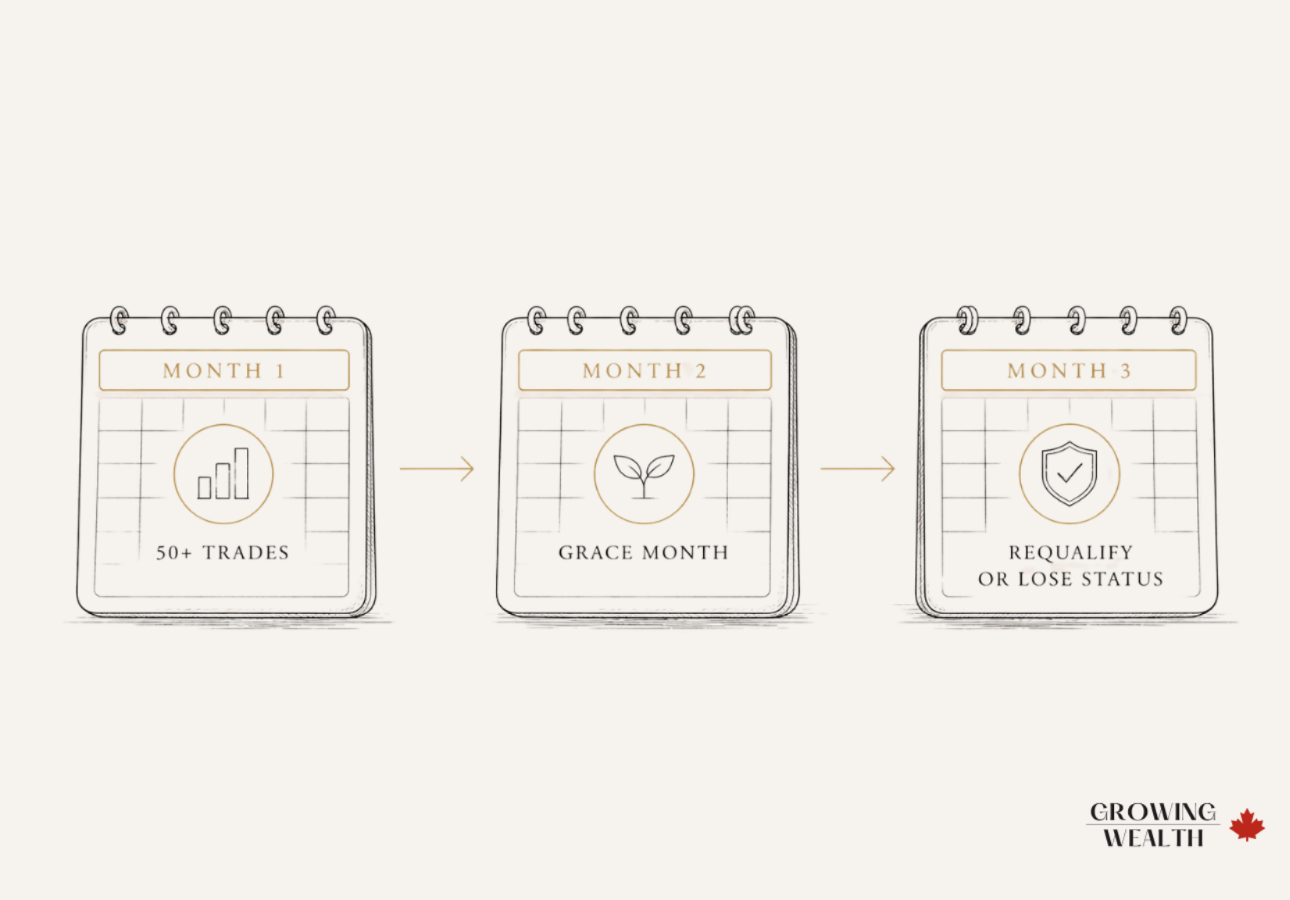
Qualifying is only half the mechanic. The month you hit 50 trades, Wealthsimple grants Active Trader status for that month and the one immediately following it, your grace month. If you don’t hit 50 trades again during the grace month, status lapses at the end of it. If you miss the threshold for two consecutive months, you lose the status outright and have to start over.
Your Active Trader status screen in the app always shows the exact date your current status is valid until, so you can check where you stand rather than guessing.
The 3% Transfer Match, Explained
The transfer match is where the dollar value sits, so it’s worth walking through the full mechanics now that you know what it’s roughly worth. Wealthsimple’s standard transfer match pays 1% on account transfers of $25,000 or more from another institution, paid out as 24 equal monthly installments. If you hold Active Trader status, that rate upgrades to 3%.
$250 on a $25,000 transfer
$750 on a $25,000 transfer
on transfers up to $2,000,000
The rate isn’t locked in at signup. It’s recalculated every month based on whether you held Active Trader status the month before, across the full 24-month payout period.
Installments already paid out at 3% aren’t clawed back if your status later lapses, and the rate climbs straight back to 3% for future payments the next time you requalify.
Promotion terms like transfer minimums and payout structure can change. Confirm the current version on Wealthsimple’s official match page before registering.
If You’re Transferring $25,000+, There’s a Legitimate Shortcut
If you’re already moving $25,000 or more into Wealthsimple to claim the transfer match, you don’t have to manufacture separate trading activity to also hit Active Trader status. You can deploy that same capital as 50 or more individual buy orders instead of one lump purchase: staggering it across several ETFs and stocks, or spreading the buys over multiple days in the month as you build the position. This is functionally the same idea behind dollar-cost averaging, just applied with an eye on the trade count too.
This is a materially different thing from the flip-trading strategy covered below. Each trade is a real, once-only purchase of an investment you’re actually holding, not the same small position bought and sold back and forth with no investment purpose. Fifty buy orders that build a genuine, diversified portfolio out of new capital look nothing like fifty round-trips on $500 of the same ETF.
- 50+ different or staggered buy orders
- Capital you were already transferring in
- Builds an actual diversified position
- Each trade reflects real investment intent
- Same small position bought and sold repeatedly
- No new capital, no real investment purpose
- Portfolio ends up unchanged at month’s end
- Wealthsimple can flag this as designed to game the threshold
Wealthsimple’s revocation clause gives it broad discretion over trades it considers “designed to game or manipulate the qualifying thresholds.” Splitting a real transfer into real purchases is a much stronger position than wash-trading small amounts, but structure it as genuine, reasoned allocation (different holdings, sensible position sizes) rather than 50 identical, arbitrarily-sized orders with no investment logic behind them.
Should You Manufacture Trades to Qualify?
Fifty trades a month is a real bar for anyone who isn’t already an active trader, and it’s tempting to think about closing the gap artificially: buying and selling a small ETF position back and forth dozens of times just to hit the count. Canadian investor forums show plenty of people working through exactly this math.
It doesn’t hold up for three reasons. First, Wealthsimple explicitly reserves the right to revoke Active Trader status, or withhold its benefits entirely, if it determines your activity is designed to game the threshold rather than reflect genuine trading. Second, frequent buying and selling inside a TFSA in particular carries real tax risk: the CRA can treat a TFSA used for high-frequency trading as “carrying on a business,” which strips the account’s tax-free status and taxes the gains as business income instead. See our guide on common TFSA mistakes for more on how this plays out. Third, even setting aside the risk, the time cost of placing 50 low-value trades a month for a bonus you may not keep rarely beats simply investing that time and capital normally.
If your trading is already active for real reasons, none of this applies to you. The distinction Wealthsimple draws, and the one worth drawing for yourself, is between trading that reflects an actual strategy and trades placed purely to hit a number.
- Free 3% match upgrade on qualifying transfers
- Free Trade Desk phone trades, normally $45 each
- Priority phone and email support
- Lower, flat crypto trading fee
- No account fee or minimum balance required
- 50 trades a month is a high bar for most retail investors
- Revocation risk if trades look manufactured
- Frequent trading can trigger CRA scrutiny, especially in a TFSA
- Doesn’t fit a buy-and-hold strategy
- Easy to rack up avoidable tax complexity chasing volume
Who This Is Actually Worth It For
If you’re already running covered calls, managing a larger portfolio actively, or naturally clearing 50 trades a month, Active Trader status is pure upside. You lose nothing by claiming benefits attached to activity you were doing anyway.
Placing 50 small round-trip trades a month to chase a match bonus adds real tax and revocation risk for a payout you might not even keep. A long-term investor is better off leaving the portfolio alone, transferring in normally at the standard 1% match rate, and focusing on what’s actually worth investing in rather than trade volume.
Commission-free trading with no account minimum, useful for active and passive investors alike.
Open a Wealthsimple account →The Bottom Line
Active Trader status is worth having if your trading already gets you there naturally. It’s not worth engineering. Fifty low-value round-trip trades a month to chase a match bonus creates real tax exposure, especially inside a TFSA, and Wealthsimple can revoke the status if it looks manufactured.
If you’re transferring $25,000 or more and already trade actively, register for the match promotion and let the 3% rate apply naturally. If you don’t already trade that often, the standard 1% match on a normal transfer is the better, lower-risk path.
Promotion terms change. Confirm current figures directly with Wealthsimple before registering.Frequently Asked Questions
TD Direct Investing does: 150 or more trades per quarter, roughly the same monthly pace as Wealthsimple’s threshold, drops its standard $9.99 commission to $7.00 per trade and unlocks its Advanced Dashboard platform. Questrade doesn’t have a volume-based status at all since its stock and ETF commissions are already $0 for every client.
You need 50 or more eligible trades within a single calendar month. Wealthsimple calculates your count overnight, so there can be up to a 24-hour lag between placing a trade and seeing it reflected in your total.
Manually placed buy or sell orders for stocks, ETFs, options, crypto, precious metals, or futures, whether you place them yourself or through the Trade Desk. Fractional orders count. Automated or recurring orders, like round-ups or pre-authorized contributions, don’t.
Yes, for one month. Once you qualify, status holds for the qualifying month plus the following calendar month, your grace month. If you don’t requalify by hitting 50 trades again during that grace month, status lapses at the end of it.
Yes. Wealthsimple reserves the right to revoke Active Trader status or withhold its benefits if it determines, at its own discretion, that your trading activity is designed only to hit the threshold rather than reflect genuine trading, for example placing many minimal-value trades.
Yes. Without Active Trader status, a spread applies to crypto market orders. With it, you pay a flat 0.5% fee and no spread on crypto trades, which is a meaningful saving for anyone trading crypto regularly on the platform.
Only if you’re already trading close to that volume for real reasons. Manufacturing 50 low-value trades a month purely for the match adds tax complexity, especially inside a TFSA, and carries a real risk that Wealthsimple revokes the status before you collect the full bonus.
You can trade inside a registered account, but doing it purely to hit a trade count carries risk. The CRA can treat a TFSA used for high-frequency trading as carrying on a business, which strips its tax-free status and taxes the gains as business income instead. Speak with a tax professional before using a registered account this way.
Not sure Active Trader status is even the right goal? Read How to Start Investing in Canada — our full guide to building an investing strategy that doesn’t depend on hitting a trade quota.