
Robo-advisor vs. investing yourself: ten years ago, this wasn’t much of a choice at all. It came down to a trade-off most families made without thinking twice — a robo-advisor was the rational, functional choice: low friction, automatic, diversified from day one. Investing yourself appealed mostly to people who wanted control for its own sake, and were willing to pay for that in time, effort, and trading costs. Function won for most people, because the friction of doing it yourself was real.
That trade-off doesn’t hold anymore. Commission-free trading, fractional shares, and single-ticker all-in-one ETFs have quietly stripped away the friction that used to make DIY investing impractical for a busy household. The functional case for a robo-advisor has weakened. Meanwhile, the emotional case for investing yourself — the control, the confidence, the transparency — was there all along. It just used to cost more than it was worth. Now it doesn’t. This article walks through what changed, what it costs either way, and why the pull toward doing it yourself is now backed by both the numbers and the reasons people actually want to.
This article contains affiliate links. We may earn a commission if you open an account — at no cost to you. We only recommend products we’ve researched and trust.
In This Article
- Robo-Advisor or DIY? The Quick Answer
- What a Robo-Advisor Actually Does
- What Changed: Why DIY Investing Got Easier
- The Real Cost: Robo-Advisor Fees vs. DIY
- Pros and Cons: Robo-Advisor
- Pros and Cons: Investing Yourself
- Robo-Advisor vs. Investing Yourself: Which One Is Right for You
- Where to Open Each Account
- Frequently Asked Questions
Robo-Advisor or DIY? The Quick Answer
Before we get into the fee math and what’s actually changed, here’s the short version. If your situation matches one of the rows below, you likely already know which way you lean — the rest of this article is the “why” behind it.
| If You… | Choose |
|---|---|
| Have never invested and the idea of picking a fund is what’s stopping you | Robo-advisor |
| Know you’ll panic-sell in a downturn without a barrier between you and your account | Robo-advisor |
| Are comfortable buying one ETF and leaving it alone | Invest yourself |
| Have $50,000 or more and haven’t run the fee math | Invest yourself — the dollar gap is real money |
| Want tax-loss harvesting or automatic rebalancing without thinking about it | Robo-advisor |
What a Robo-Advisor Actually Does
A robo-advisor asks you a handful of questions about your goals, time horizon, and risk tolerance, then builds you a diversified portfolio of ETFs based on the answers. From there, it handles the rebalancing, reinvests your dividends, and adjusts as your account drifts from its target mix. Wealthsimple Invest, Questwealth Portfolios, and RBC InvestEase are the platforms most Canadians land on.
It’s worth being clear about what you’re actually paying for, because it isn’t stock-picking skill or a secret strategy. A robo-advisor is buying the same low-cost ETFs you could buy yourself — funds like XEQT or VEQT — and charging you a management fee to automate the process of buying, holding, and rebalancing them. What you’re really buying is distance: someone else making the decisions, so you don’t have to. For a lot of people, that used to be worth the fee purely on convenience. Whether it still is depends on how much you value being the one making the call.
What Changed: Why DIY Investing Got Easier
This is the part most comparisons skip, and it’s the part that actually explains why this decision looks different than it did five years ago.
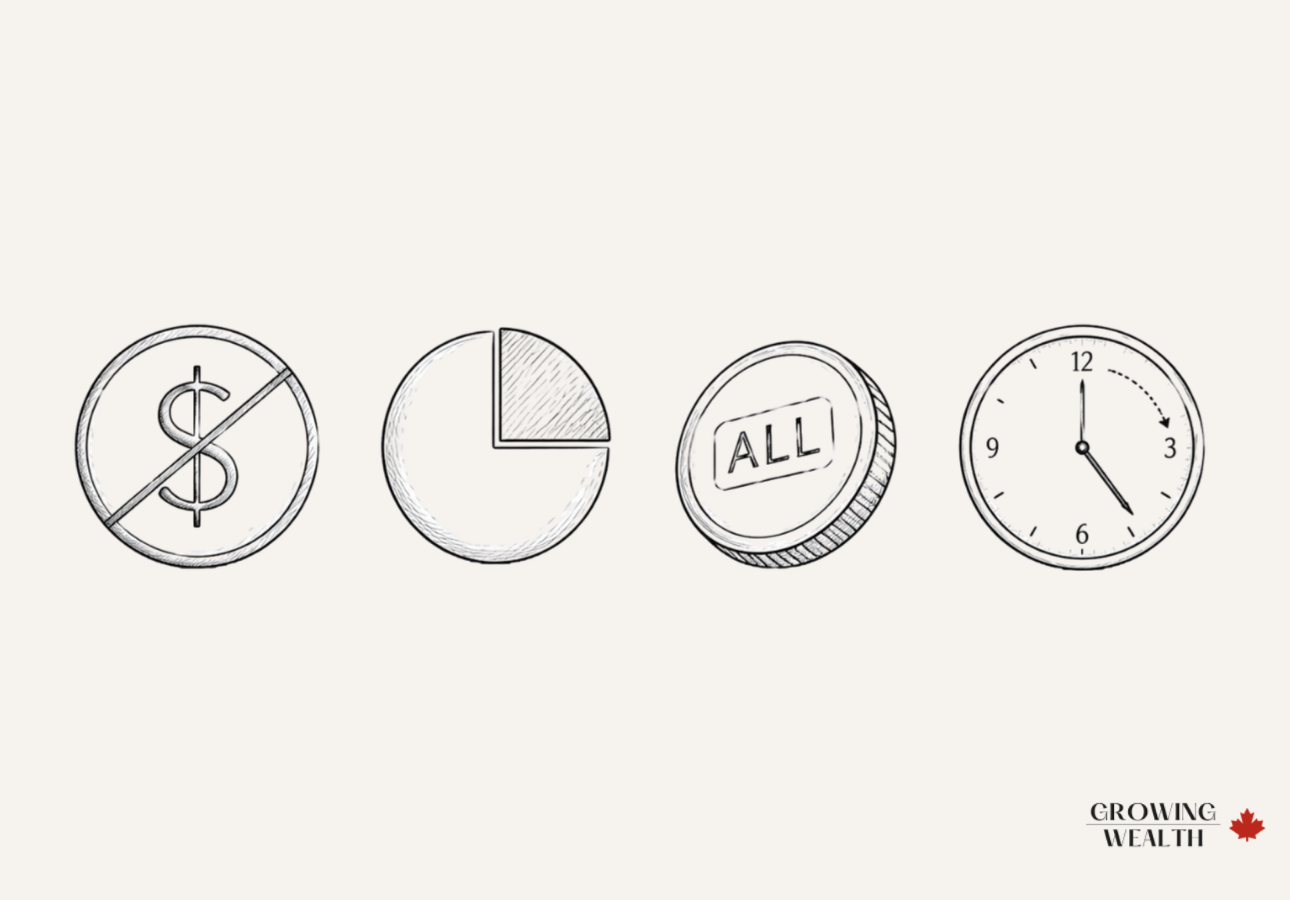
Both Wealthsimple and Questrade now charge $0 per trade on Canadian and US-listed stocks and ETFs. When every trade cost $5 to $10, investing $100 a month meant commissions were quietly eating 5–10% of every contribution. That friction is gone.
You no longer need enough money to buy a whole share of anything. Wealthsimple lets you buy a fraction of a stock or ETF starting at $1, commission-free. If you have $50 to invest this month, you invest exactly $50 — you’re not sitting on leftover cash waiting to afford a full share. That matters whether you’re investing a fixed amount every month or contributing whatever’s left over after bills.
This is the biggest shift. Funds like XEQT, VEQT, VGRO, and XGRO hold a fully diversified global portfolio in one ticker, and rebalance internally on their own. The “pick a dozen ETFs and manually rebalance them” version of DIY investing that used to justify a robo-advisor’s existence isn’t the reality anymore. Buying one all-in-one ETF is the DIY strategy now.
Wealthsimple now offers trading on eligible US-listed securities 24 hours a day, five days a week, on top of regular market hours. The old complaint that DIY investing only worked if you could trade during a 9:30–4:00 window on a weekday no longer holds.
Fractional shares aren’t supported during extended-hours trading specifically — that applies to regular market hours only.
Put together, the functional case for a robo-advisor — the thing that used to make it the obvious choice for a busy parent — has mostly closed. What’s left standing on the robo-advisor side is genuinely being hands-off. What’s left standing on the DIY side is the fee gap, plus something that was true even before any of this changed: some people simply want to be the one holding the reins.
The Real Cost: Robo-Advisor Fees vs. DIY
Here’s the actual math, using current published rates.
A robo-advisor’s all-in cost has two layers: the platform’s management fee, plus the MER on the underlying ETFs it holds. Wealthsimple Invest charges 0.50% at its entry Core tier (0.40% once you cross $100,000), on top of an underlying ETF MER of roughly 0.12–0.25%, for an all-in cost of about 0.62–0.75% at the entry tier. Questwealth is the cheapest robo-advisor option in Canada at 0.20–0.25% management fee.
A self-directed all-in-one ETF like XEQT or VEQT costs only its MER — currently around 0.17–0.20% — with no management fee and no trading commission on Canadian-listed ETFs at Wealthsimple or Questrade.
Over time, that gap compounds along with your investments. Assuming a 7% gross annual return on a $50,000 lump sum held for 20 years: a DIY portfolio in XEQT (net return roughly 6.8% after the 0.20% MER) grows to approximately $186,000. The same $50,000 in a robo-advisor at a 0.65% all-in cost (net return roughly 6.35%) grows to approximately $171,000. That’s a difference of about $15,000 over 20 years, on a single lump-sum investment, with no additional contributions factored in. Add in monthly contributions over that period, and the gap widens further.
Assumptions: 7% gross annual return, fees deducted annually, no additional contributions, no taxes modelled. Actual returns vary and are not guaranteed.
There’s a second thing the dollar figures don’t fully capture: with a self-directed account, you can see exactly what you hold, exactly what you’re being charged, and exactly why your balance moved on a given day. A robo-advisor bundles all of that into one number and one app screen. That’s a fair trade for some households — but it’s a trade, not a free upgrade, and it’s worth being honest with yourself about whether you’re paying for automation or paying to not have to look.
Pros and Cons: Robo-Advisor
- Fully hands-off — you deposit money and the portfolio manages itself
- Automatic rebalancing keeps your risk level where you set it
- Removes the temptation to check in and second-guess your allocation
- Some platforms offer tax-loss harvesting on non-registered accounts
- Far cheaper than a traditional advisor’s 1–2.5% fee
- The fee is real and compounds against you every year you hold the account
- You’re paying an ongoing fee for something that’s now simple to replicate yourself
- Less control — you can’t fine-tune your allocation or choose specific funds
- The convenience advantage that used to justify the fee has shrunk
Pros and Cons: Investing Yourself
- Meaningfully lower cost — MER only, no management fee
- Full control over what you hold and when you buy or sell, and full visibility into exactly what you’re paying for
- Genuinely simple with a single all-in-one ETF: no research, no manual rebalancing
- No real skill barrier left compared to using a robo-advisor
- Managing it yourself tends to build financial confidence that carries over to budgeting and other money decisions
- No automatic tax-loss harvesting
- No built-in barrier between you and a panic-sell decision during a downturn
- Requires the discipline to place the trade and leave it alone
Robo-Advisor vs. Investing Yourself: Which One Is Right for You
If you’ve never invested before and the reason you haven’t started is that the whole process feels intimidating, a robo-advisor is the right first move. Getting money invested today, even at a higher fee, beats sitting in cash while you build confidence. You can always transfer to a self-directed account later — moving registered accounts between institutions as an in-kind transfer doesn’t trigger tax.
If you know yourself well enough to admit you’d sell everything the first time your portfolio drops 15%, the robo-advisor’s structural distance between you and your account is worth paying for, regardless of your portfolio size. That’s a real, legitimate reason to stay — not a fallback for people who “couldn’t figure out” DIY.
If you’re comfortable logging in once a month, buying more of the same ETF, and closing the app, the math favours doing it yourself — especially once your portfolio crosses $50,000, where the dollar gap stops being trivial and starts being a meaningful chunk of your long-term return. And if you’re investing for a child’s education or first home through an RESP or FHSA, doing it yourself gives you something a robo-advisor can’t: the ability to actually show your kid what’s in the account, rather than a balance that just updates on its own. For a lot of families, that’s worth as much as the fee savings.
Where to Open Each Account
Both platforms below are worth a closer look if you want the full breakdown — see our Wealthsimple vs. Questrade comparison for the details on fees, account types, and platform experience. If you want the full field of nine brokers rather than just these two, our best trading platforms in Canada comparison covers them all.
Wealthsimple Invest is the robo-advisor option if you want it fully automated. Wealthsimple Trade is the self-directed option if you’re ready to buy XEQT or VEQT yourself — commission-free, with fractional shares if you’re starting small.
Open a Wealthsimple account →Worth considering if you want the lowest robo-advisor fee in Canada, or if you eventually want a self-directed account with a broader range of account types.
Visit Questrade →The Bottom Line
If you’re not investing at all right now because the decision feels too complicated, stop optimizing and open a robo-advisor account today. The fee is a small price for actually getting started.
But if you’re already comfortable with the idea of investing, the robo-advisor vs. investing yourself decision that used to be a straightforward trade-off — pay for convenience, or do it yourself and deal with the friction — isn’t really a trade-off anymore. The functional reasons to pay someone else have mostly disappeared. What’s left is the reason people wanted to invest themselves all along: control, transparency, and the confidence that comes from knowing exactly what you own and why. Now that it doesn’t cost you much to have both, there’s less reason not to.
Either path beats not investing. The only wrong answer here is staying in cash.Frequently Asked Questions
Yes. Canadian robo-advisors are registered portfolio managers regulated by provincial securities regulators, and client accounts are covered by CIPF (Canadian Investor Protection Fund) for up to $1 million per account category if the firm becomes insolvent. Your investments are held separately from the company’s own assets. You can read more from the Canadian Investment Regulatory Organization.
In a registered account like a TFSA or RRSP, you can request an in-kind transfer to a self-directed brokerage, which moves your existing investments without selling them and doesn’t trigger tax. In a non-registered account, an in-kind transfer also avoids triggering capital gains, since nothing is actually sold.
For someone who wouldn’t otherwise invest, yes — a robo-advisor at around 0.65% all-in is dramatically better than leaving money in cash. For someone already comfortable buying and holding a single ETF, the fee is harder to justify, since you’d be paying for automation you can now replicate yourself in a few minutes a month.
A robo-advisor uses an algorithm to build and manage a low-cost ETF portfolio based on your risk profile, typically for 0.40–0.75% a year all-in. A traditional financial advisor offers personalized advice, financial planning, and ongoing human support, typically for 1–2.5% a year — several times the cost.
No. Fractional shares mean you can buy a partial share of an ETF starting at $1, commission-free at platforms like Wealthsimple. There’s no minimum balance requirement to open a self-directed account or start investing.
Your investments aren’t at risk. Client assets are held separately from the company’s own funds at a custodian institution, and CIPF coverage protects your account up to $1 million per category if the firm fails.
Both hold similar underlying investments and both are far cheaper than a traditional advisor. The robo-advisor adds automatic rebalancing and a small layer of oversight for its fee. An all-in-one ETF like XEQT gives you nearly identical diversification and rebalances internally, at a fraction of the cost, if you’re comfortable placing the trade yourself.
Want to turn what you’ve just learned into a real plan? Read How to Start Investing in Canada — a step-by-step walkthrough of choosing your account, your platform, and your first investment.