
This article contains affiliate links. We may earn a commission if you open an account — at no cost to you. We only recommend products we’ve researched and trust.
Buying a home is one of the biggest financial decisions most Canadian families will ever make. For most households, a mortgage will be the largest debt they carry, and also the foundation of their long-term financial stability.
But many buyers sign mortgage contracts without fully understanding how mortgages actually work in Canada, from down payments and amortization to interest rates, the mortgage stress test, and renewal risk.
This guide explains how Canadian mortgages work step-by-step, including how lenders evaluate borrowers, how payments are structured, and what families should understand before committing to a mortgage.
 HOME BUYING
In This Article
- What Is a Mortgage?
- How Mortgages Work in Canada (Simple Explanation)
- How the Mortgage Process Works in Canada
- Key Mortgage Terms Every Canadian Family Should Understand
- Types of Mortgages in Canada
- Fixed vs Variable Mortgages
- How Mortgage Payments Work
- How Lenders Decide How Much You Can Borrow
- Mortgage Renewal Risk
- Hidden Costs of Owning a Home
- Government Programs for Home Buyers
- Should You Pay Down Your Mortgage or Invest?
- Common Mortgage Mistakes
- Frequently Asked Questions
What Is a Mortgage?
A mortgage is a loan used to purchase real estate.
In Canada, the lender provides funds to buy the property, and the borrower repays the loan over time with interest.
The home itself serves as collateral, meaning the lender can take possession of the property if the borrower fails to repay the loan.
A typical mortgage includes several key components:
The principal is the amount borrowed after the down payment. Each mortgage payment gradually reduces the principal while also covering interest charged by the lender.
For the full home buying journey, from pre-approval through to mortgage renewal, see our complete guide to Canadian home ownership.

How Mortgages Work in Canada (Simple Explanation)
A mortgage in Canada is a loan used to purchase property where the lender provides the funds and the borrower repays the loan with interest over time. The mortgage is secured by the property itself, meaning the lender can take ownership if the borrower fails to repay the loan.
Whether you’re buying your first home or upgrading for a growing family, understanding the mortgage system can help you make better financial decisions and avoid costly mistakes.
How the Mortgage Process Works in Canada
Buying a home with a mortgage generally follows five steps.
Before applying for a mortgage, buyers should estimate how much home they can realistically afford. Our full guide explains this in detail: How Much House Can I Afford in Canada?
Lenders will evaluate:
- Income
- Existing debt
- Credit score
- Down payment
- Monthly obligations
Credit score plays a major role in mortgage approval. If you’re unsure about your score, see What Is a Good Credit Score in Canada? If you’re still building your down payment, see our guide on how to save for a down payment using the FHSA and Home Buyers’ Plan — it covers how much first-time buyers can realistically set aside and in which accounts.
A mortgage pre-approval provides an estimate of how much a lender may be willing to lend. The lender reviews:
- Income documents
- Employment status
- Credit report
- Debt levels
Pre-approvals also typically lock in an interest rate for 90–120 days, protecting buyers if rates rise while they search for a home. For a full walkthrough of the process, including the stress test calculation and what documents to prepare, see our mortgage pre-approval guide.
Once you find a property, you may submit an offer that includes a financing condition. This allows time for the lender to finalize mortgage approval.
The lender will verify:
- Income documents
- Down payment source
- Property appraisal
- Employment stability
If everything meets the lender’s requirements, the mortgage is approved.
On closing day, the mortgage funds are transferred, the property title is registered, and ownership transfers to the buyer. Mortgage payments begin shortly afterward.
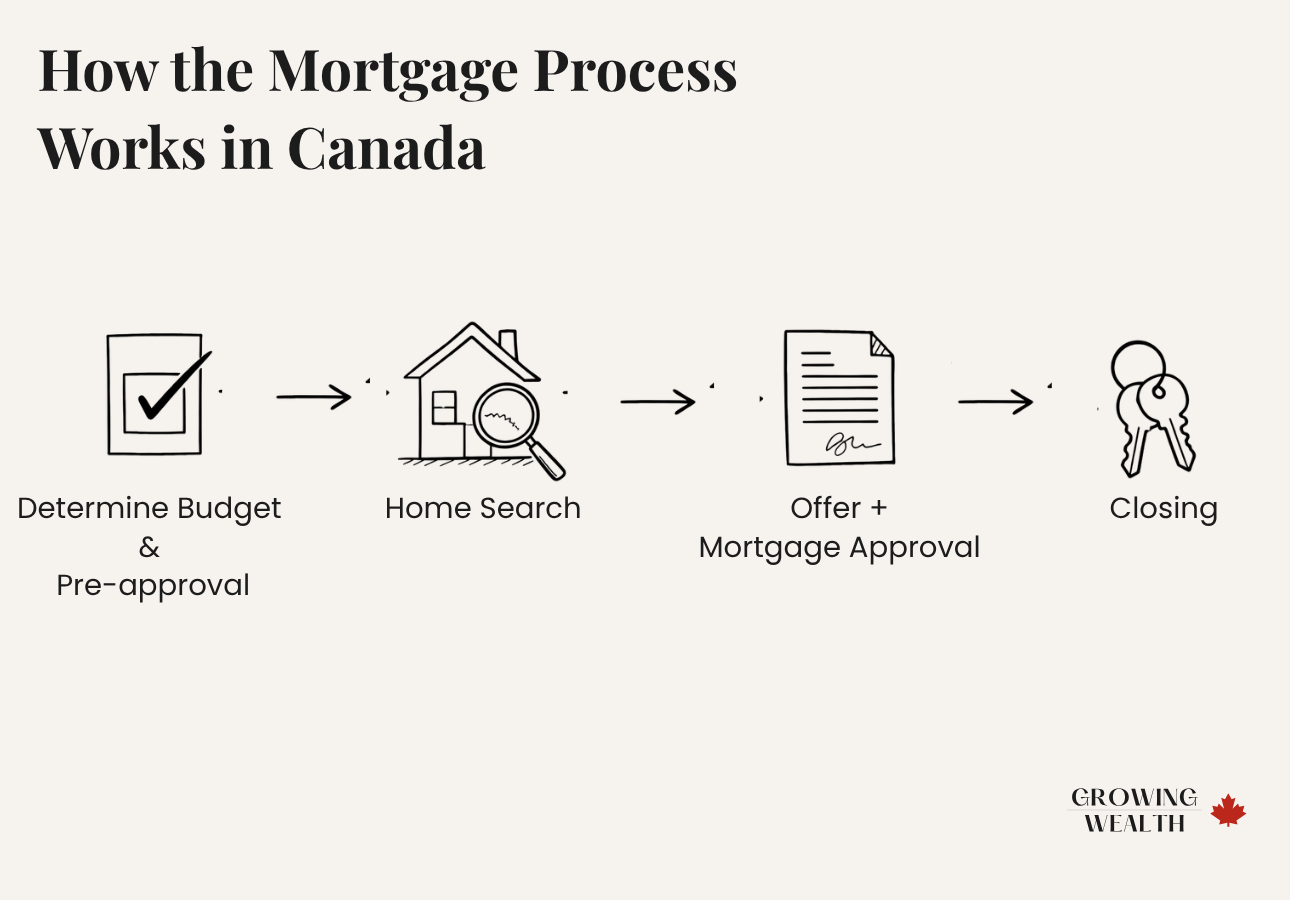
The mortgage process in Canada typically includes determining your budget, getting pre-approved, finding a home, securing approval, and closing.
Key Mortgage Terms Every Canadian Family Should Understand
Understanding mortgage terminology helps prevent confusion during the home-buying process.
Down Payment
The down payment is the portion of the home’s purchase price paid up front.
Minimum down payments in Canada:
| Home Price | Minimum Down Payment |
|---|---|
| Under $500,000 | 5% |
| $500,000–$1,499,999 | 5% on first $500K + 10% on remainder |
| $1.5 million+ | 20% minimum |
Down payments under 20% require mortgage default insurance, and insurance is only available on homes priced under $1.5 million.
Mortgage Insurance (CMHC)
If your down payment is less than 20%, you must obtain mortgage insurance from one of the following:
- CMHC
- Sagen
- Canada Guaranty
Mortgage insurance protects the lender, not the borrower.
Learn more from the Financial Consumer Agency of Canada.
Amortization Period
The amortization period is the total length of time required to fully repay the mortgage.
Most Canadian mortgages use a 25-year amortization. Insured mortgages can qualify for a 30-year amortization if you’re a first-time home buyer on any eligible insured purchase, or if you’re buying a newly constructed home regardless of buyer status.
A longer amortization lowers monthly payments but increases total interest paid.
Mortgage Term
The term is the length of the contract with the lender. Common mortgage terms include:
- 3 years
- 5 years
- 7 years
- 10 years
At the end of the term, the mortgage must be renewed at the current interest rate.
Types of Mortgages in Canada
Several types of mortgages are available depending on the borrower’s needs.
Closed Mortgages
Most Canadian mortgages are closed mortgages. They typically offer lower interest rates but restrict early repayment. Breaking the mortgage early may result in penalties.
Open Mortgages
Open mortgages allow borrowers to repay the loan early without penalty. However, interest rates are usually higher. They are often used when someone plans to sell the home within a short period.
High-Ratio Mortgages
A high-ratio mortgage is a mortgage with less than a 20% down payment. These mortgages require mortgage insurance.
Conventional Mortgages
A conventional mortgage has a down payment of at least 20% and does not require mortgage insurance.
Fixed vs Variable Mortgages
One of the biggest mortgage decisions is choosing between fixed and variable interest rates. See our detailed comparison here: Fixed vs Variable Mortgage in Canada
Fixed-Rate
Rate locked for the entire term
- Interest rate stays the same for the whole term
- Predictable, stable payments
- Protected from rising interest rates
- Often higher penalties if broken early
Variable-Rate
Fluctuates with the Bank of Canada policy rate
- Historically lower average rates
- Lower prepayment penalties
- Payments or interest costs can rise if rates increase
You can see the current interest rate policy on the Bank of Canada website.
How Mortgage Payments Work
Mortgage payments typically include two components:
Early in the mortgage, a large portion of the payment goes toward interest. Over time, more of the payment reduces the principal balance.
Estimated monthly payment
In the early years, most of that payment goes toward interest rather than reducing the loan balance.
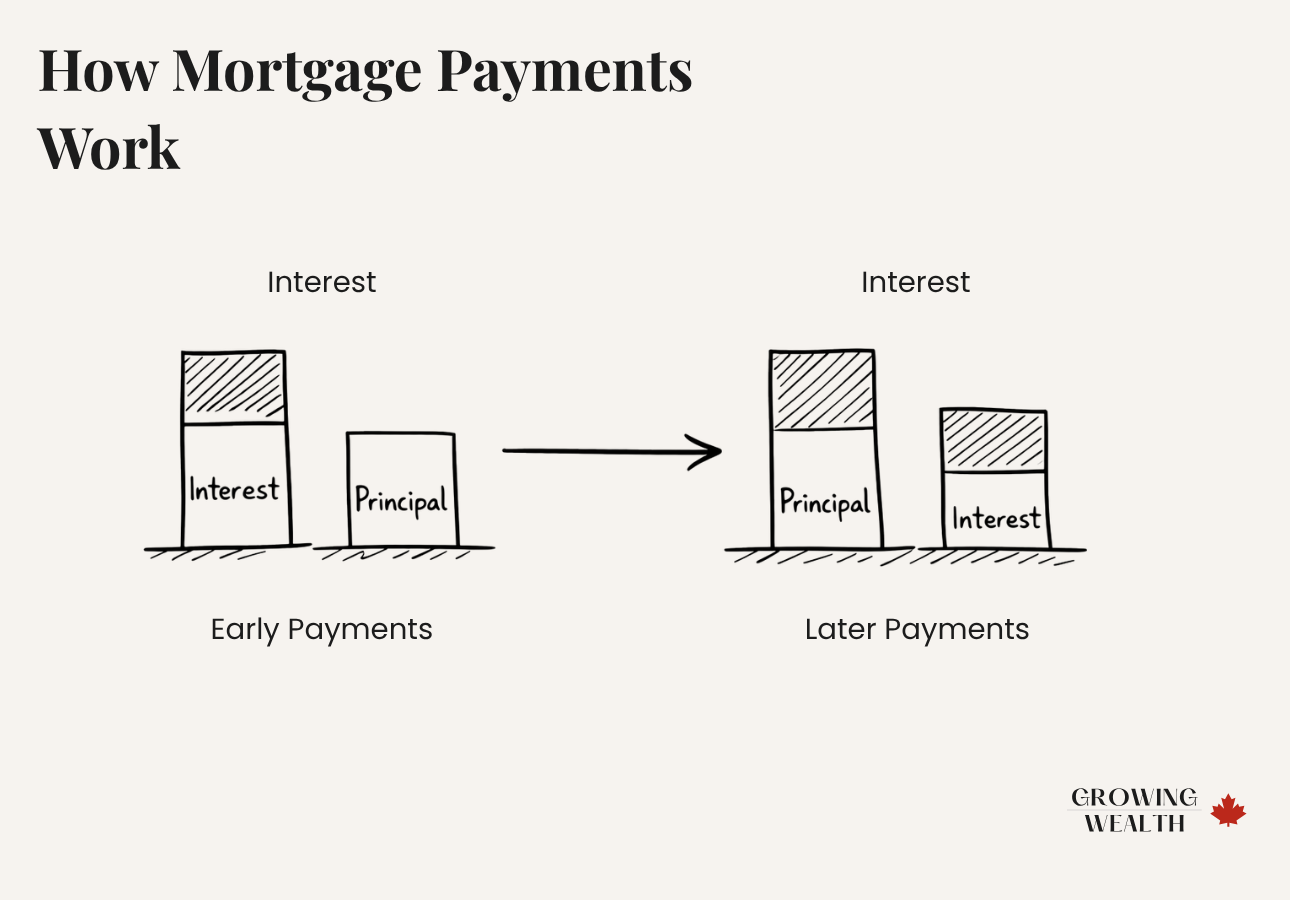
Early mortgage payments go mostly toward interest, while later payments shift more toward paying down the principal.
Borrowers can also choose different payment schedules. Accelerated payments help reduce the amortization and save interest over time:
- Monthly
- Bi-weekly
- Accelerated bi-weekly ★
How Lenders Decide How Much You Can Borrow
Lenders use several factors to determine mortgage approval, including the mortgage stress test. This means qualifying at the higher of:
Whichever number is higher is what you must qualify at.
The stress test ensures borrowers could still afford payments if interest rates rise. More details are available from the Office of the Superintendent of Financial Institutions.
Income
Stable income helps demonstrate the ability to repay the mortgage.
Gross Debt Service
The percentage of income spent on housing costs:
- Mortgage
- Property tax
- Heating
Total Debt Service
The percentage of income spent on all debts:
- Mortgage
- Credit cards
- Car loans
- Student loans
Borrowers with high debt levels may qualify for smaller mortgages.
Mortgage Renewal Risk
Many Canadian mortgages use 5-year terms but 25-year amortizations, meaning borrowers renew their mortgage multiple times. If interest rates rise between renewals, payments can increase significantly.
This renewal risk became very real for many Canadians when interest rates rose sharply after the pandemic. Planning for possible rate changes, and knowing how to negotiate your renewal, helps avoid financial stress later.
Hidden Costs of Owning a Home
Mortgage payments are only one part of the cost of home ownership. Families should also budget for:
The Canada Mortgage and Housing Corporation provides resources on home ownership costs.
Government Programs for Home Buyers
Several programs help Canadians save for a home.
First Home Savings Account
Allows Canadians to save for a first home with tax advantages similar to RRSPs and TFSAs.
Home Buyers’ Plan
Lets eligible first-time buyers withdraw from an RRSP for a home purchase, tax-free, as long as the funds are repaid within 15 years.
Read further on the CRA website.
Should You Pay Down Your Mortgage or Invest?
Many homeowners face the question of whether extra money should go toward the mortgage or investments.
We explore this in detail here: Should You Pay Down Your Mortgage or Invest?
The right choice depends on:
Common Mortgage Mistakes
Just because a lender approves a certain amount doesn’t mean it’s the right financial decision. Housing costs should still leave room for savings and unexpected expenses.
Interest rates change over time. Planning for future rate increases can help avoid payment shock at renewal.
Breaking a mortgage early can result in significant penalties, especially with fixed-rate mortgages. This is important for families who may move within a few years.
The Bottom Line
A mortgage is both a financial tool and a long-term commitment. Understanding how mortgages work in Canada helps families make better housing decisions, avoid common mistakes, and manage long-term financial risk.
For many households, a home will represent both a place to live and a major component of their net worth. Approaching the mortgage process thoughtfully can help families build stability and long-term financial security.
Frequently Asked Questions
Most lenders prefer a credit score of at least 680, although approval may still be possible with lower scores depending on income, down payment, and debt levels. See our guide: What Is a Good Credit Score in Canada?
Minimum down payments depend on the purchase price: 5% for homes under $500,000, 5% on the first $500,000 and 10% on the remainder up to $1,499,999, and 20% for homes $1.5 million or more.
The mortgage stress test ensures borrowers can still afford payments if interest rates rise. Borrowers must qualify at the higher of the contract rate + 2%, or the minimum qualifying rate set by regulators.
Most mortgages use a 25-year amortization, although first-time buyers and buyers of newly constructed homes may qualify for up to 30 years on an insured mortgage.
Yes. Many mortgages allow prepayment privileges, which allow borrowers to reduce the principal faster without penalties. However, breaking the mortgage contract before the term ends may result in penalties.
Want to know what to budget for beyond the mortgage payment itself? Read Closing Costs in Canada: What They Are and How They Affect Your Down Payment — it breaks down every fee due at closing so there are no surprises.