
Finding the best trading platforms in Canada used to come down to one question: which broker charges the least per trade. Four of Canada’s nine major online brokers now charge $0 commission on every stock and ETF trade. The other five — Canada’s Big Five bank brokers — still charge $6.95 to $9.99 per trade on most holdings, though every single one of them also offers a curated list of commission-free ETFs, so “which bank charges what” isn’t a simple yes-or-no either. What actually separates all nine platforms now is what happens after the trade: foreign exchange fees on U.S. stocks, account fee thresholds, and whether your TFSA, RRSP, or FHSA is fully supported without friction. That’s the decision this guide is built around.
This article contains affiliate links. We may earn a commission if you open an account — at no cost to you. We only recommend products we’ve researched and trust.
 Investing
In This Article
- Finding the Best Trading Platforms: What Matters in 2026
- Full Comparison: Fees, Accounts, and Fine Print
- Wealthsimple Trade
- Questrade
- Qtrade
- The Big Bank Brokers: TD, RBC, BMO, CIBC, Scotiabank, National Bank
- TFSA, RRSP, and FHSA Support
- The FX Fee Trap
- Is Your Money Protected?
- Where to Open an Account
- The Bottom Line
- FAQ
Nine brokers is a lot to hold in your head at once, so here’s the short version before the full breakdown below walks through each one.
| If This Sounds Like You | Best Choice |
|---|---|
| Opening your first TFSA, buying and holding Canadian ETFs | Wealthsimple Trade or Questrade |
| Regularly buying U.S. stocks or ETFs | Questrade (lower FX drag over time) |
| Want everything under one banking app | National Bank Direct Brokerage (only bank broker with $0 commissions) — or TD, RBC, BMO, CIBC, Scotiabank if you’re already banking there |
| Want the simplest possible mobile app | Wealthsimple Trade |
| Making frequent small contributions | Wealthsimple Trade or Qtrade (fractional-friendly, $0 minimums) |
Finding the Best Trading Platforms: What Actually Matters in 2026
Most broker comparisons are still built around a question that stopped mattering sometime in the last 18 months: which one charges the least per trade. Wealthsimple Trade, Questrade, Qtrade, and National Bank Direct Brokerage all charge $0 to buy or sell every stock and ETF. The five other bank-owned brokers — TD, RBC, BMO, CIBC, and Scotiabank — still charge a per-trade commission on most holdings, but each one also offers a curated list of commission-free ETFs, so even the “expensive” option isn’t uniformly expensive.
The real decision has moved elsewhere. If you hold any U.S.-listed stocks or ETFs, currency conversion fees can cost more over a decade than any commission ever did. If your broker charges an annual account fee, the threshold to waive it matters more than the fee itself. And if you’re opening a TFSA, RRSP, or FHSA for the first time, not every broker treats registered accounts the same way once you look past the marketing page.
That’s the frame for everything below: fees first, but FX costs and account fit second — because for most Canadian families, those two matter more. Once you’ve settled on a platform, the next decision is what to actually hold inside it — that’s a separate question from which broker to use, and it matters more to your long-term returns.
Full Comparison: Fees, Accounts, and Fine Print
All figures below were verified directly from each broker’s own pricing page. “Commission-free ETFs” means a curated list, not every ETF on the market.
| Broker | Stock/ETF Commission | Account Fee | Best For |
|---|---|---|---|
| Wealthsimple Trade | $0 | $0 | Simplicity, first-time investors |
| Questrade | $0 | $0 | US stocks, DIY control |
| Qtrade | $0 | $0 | Research tools, customer support |
| National Bank Direct Brokerage | $0 | $100/yr (waived above $20K, or 30 and under with 5+ trades/yr) | Bank integration, no commissions |
| CIBC Investor’s Edge | $6.95 ($4.95 active, $0 under 25) | $100/yr (waived above $10K or year one) | Lowest-cost bank broker |
| RBC Direct Investing | $9.95 ($6.95 active, $0 at $250K+ Royal Circle) + 50+ free ETFs | $0 (quarterly fee eliminated in 2026) | RBC customers, Capital Markets research |
| BMO InvestorLine | $9.95 (active trader discounts available) + 100+ free ETFs | $25/quarter (waived under several conditions) | BMO customers, adviceDirect hybrid option |
| Scotia iTRADE | $9.99 ($4.99 active, 150+/quarter) + 200+ free ETFs | $100/yr on RRSP/RRIF (waived at $25K+ or 12+ trades/yr); TFSA/FHSA free | Scotiabank customers, widest free-ETF list |
| TD Direct Investing | $9.99 ($7.00 active) | $25/quarter (waived under several conditions) | Existing TD banking customers |
Wealthsimple Trade — Who It’s For
Best for: first-time investors who want the simplest possible path to opening a TFSA, with no interest in options, forex, or advanced order types.
Wealthsimple Trade remains the easiest way to open a first TFSA or RRSP in Canada. No account minimum, no commissions, and a mobile app that doesn’t require any investing background to use. It also supports fractional shares, so a $50 contribution can go straight into an ETF that trades at $150 a unit instead of sitting uninvested.
The catch is the 1.5% currency conversion fee on U.S.-dollar trades, charged each time you convert CAD to USD and again converting back. For a Canadian-ETF-only portfolio, this never comes up. For anyone buying individual U.S. stocks regularly, it adds up. If Wealthsimple and Questrade are your two finalists, our full Wealthsimple vs Questrade comparison goes deeper on automation, control, and long-term cost.
- $0 minimum to start
- Fractional shares
- Simplest mobile app of the nine
- 1.5% FX fee, both directions
- Limited research and charting tools
- No CFD, forex, or futures access
Questrade — Who It’s For
Best for: DIY investors who hold or plan to hold US stocks regularly, and want more research tools and account control than Wealthsimple offers.
Questrade dropped commissions on both buying and selling stocks and ETFs, closing the gap that used to separate it from Wealthsimple. What Questrade still offers that Wealthsimple doesn’t: true USD-denominated registered accounts, deeper charting and research tools, and access to Norbert’s Gambit for investors who want to manually minimize FX costs on larger conversions.
The trade-off is a steeper interface. Questrade’s platforms (IQ Web, Questrade Edge) are built for people who want more control, which also means more decisions to make when you’re just getting started.
- $0 stock and ETF commissions
- USD-denominated registered accounts
- Stronger research tools
- Steeper learning curve for beginners
- No fractional shares
- Customer service wait times reported during peak hours
Qtrade — Who It’s For
Best for: investors who want $0 commissions but also want a real person on the phone when something goes wrong — a middle ground between Questrade’s DIY depth and Wealthsimple’s simplicity.
Qtrade eliminated commissions on stocks, ETFs, and options in late 2025, and dropped its quarterly account administration fee at the same time. It’s less well-known than Wealthsimple or Questrade, but consistently rates ahead of both on customer support and account-opening speed. For investors who want a broker they can actually reach by phone when something goes wrong, that’s worth factoring in.
- $0 commissions, no admin fee
- Strong customer support ratings
- Solid charting on mobile
- Less brand recognition, smaller user base
- $15/quarter fee on US-registered accounts
The Big Bank Brokers: TD, RBC, BMO, CIBC, Scotiabank, and National Bank
If you already bank with one of the Big Five, opening your brokerage account at the same institution has one real advantage: everything shows up in one login, and moving money between chequing and investing is instant. That convenience isn’t free with most of them — TD, RBC, BMO, and Scotia iTRADE all still charge $9.95 to $9.99 per trade on holdings outside their commission-free ETF lists, and CIBC Investor’s Edge, while cheaper at $6.95, still isn’t free.
Every one of the five now offsets that with a curated commission-free ETF list, so the actual cost depends on what you’re buying:
| Bank | Standard Commission | Commission-Free ETFs |
|---|---|---|
| Scotia iTRADE | $9.99 ($4.99 active) | 200+ |
| BMO InvestorLine | $9.95 | 100+ |
| RBC Direct Investing | $9.95 ($6.95 active) | 50+ |
| TD Direct Investing | $9.99 ($7.00 active) | Select TD Easy Trade list |
| CIBC Investor’s Edge | $6.95 ($4.95 active, $0 under 25) | Included in flat rate |
If your portfolio fits entirely inside one of those free lists, the per-trade commission never comes up. Buy anything outside it — an individual stock, or an ETF not on the list — and you’re back to paying $6.95 to $9.99 a trade.
National Bank Direct Brokerage is the one exception that avoids this trade-off entirely. It’s the only bank-owned broker with $0 commissions on every Canadian and U.S. stock and ETF, no curated list required — making it the legitimate choice for someone who wants bank-level integration without paying a premium for it. The other five make more sense if you specifically value in-branch support, a bundled research offering like RBC Capital Markets or BMO’s adviceDirect, or simply already have significant assets there that offset the fees.
TFSA, RRSP, and FHSA Support
All nine brokers in this comparison support TFSA, RRSP, and FHSA accounts — that part is no longer a differentiator. Where they actually diverge is what happens once you want to hold U.S. dollars inside those accounts, particularly the FHSA.
Questrade, Qtrade, and the six bank-owned brokers all support native USD balances inside a registered account, meaning a U.S.-listed ETF or stock can be bought without triggering a conversion each time. Wealthsimple only offers this through its paid Plus or Generation tier — on the free tier, every U.S. trade inside your TFSA, RRSP, or FHSA converts through the standard 1.5% spread. For a Canadian-ETF-only portfolio, this changes nothing. For anyone planning to hold U.S.-listed ETFs like VTI or individual U.S. stocks inside a registered account long-term, it’s worth factoring in before you pick a platform, not after.
Contribution room only starts accruing the year you open the account, not retroactively. If you’re eligible and haven’t opened an FHSA yet, the broker decision matters less than simply opening the account before year-end.
The FX Fee Trap: Where the Real Cost Differences Live in 2026
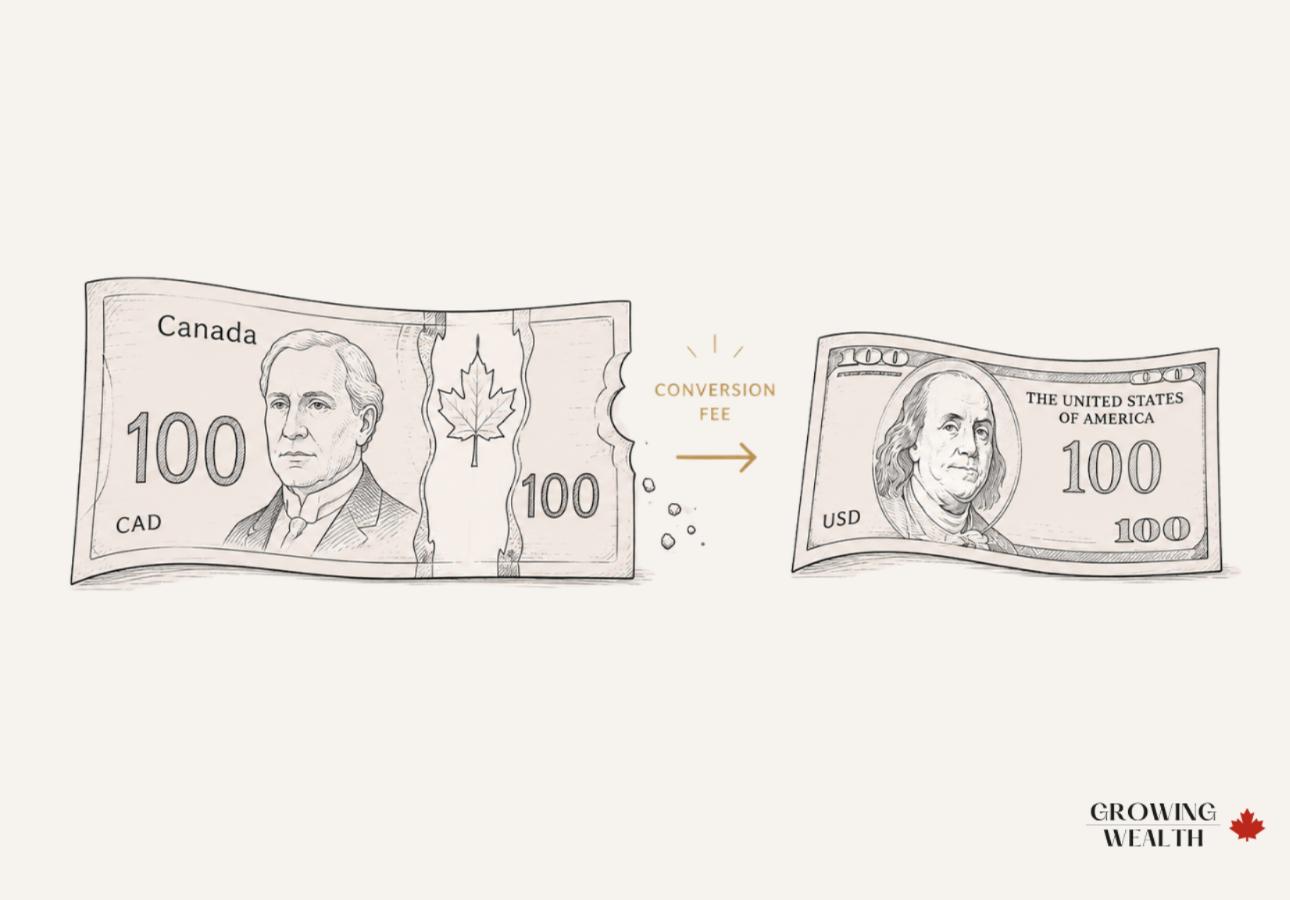
Here’s the calculation most comparison articles skip. Say you invest $10,000 CAD into a U.S.-listed ETF once a year, at a 1.5% FX fee — the rate Wealthsimple charges, and roughly in line with what most of the big bank brokers charge.
Questrade and Qtrade both offer meaningfully lower effective FX costs, particularly for investors willing to use Norbert’s Gambit, a manual workaround that converts currency by buying an interlisted stock in CAD and immediately selling the same shares in USD (or vice versa), rather than paying the broker’s posted conversion rate. It takes a few extra steps and a day or two of settlement time, but it typically cuts the effective conversion cost to well under 0.5%, versus the 1.5% most brokers charge outright. For a buy-and-hold Canadian ETF portfolio, none of this matters. For anyone building meaningful US equity exposure, it’s the single biggest lever in this whole comparison.
Is Your Money Protected? CIRO and CIPF Explained
All nine brokers in this comparison are members of CIRO (the Canadian Investment Regulatory Organization), which replaced IIROC in 2023. CIRO membership means each broker is also covered by CIPF (the Canadian Investor Protection Fund), which protects up to $1 million per account category — general accounts, RRSPs, and TFSAs are each covered separately — if the brokerage itself becomes insolvent.
- Missing shares or cash if your broker becomes insolvent
- Up to $1 million, per account category (TFSA, RRSP, and general accounts each covered separately)
- Automatic — no signup needed
- A drop in the market value of your holdings
- Losses from your own investment decisions
- Brokers that aren’t CIRO members — always confirm in CIPF’s directory
CIPF is not the same as CDIC — CDIC covers deposits at banks, CIPF covers investments at brokerages. It’s free, automatic, and doesn’t require you to sign up separately, but it’s worth confirming your specific broker is listed in CIPF’s member directory before you open an account, since membership claims on a website aren’t always accurate.
Where to Open an Account
The simplest way to open a first TFSA and start investing with no minimum balance and no commissions.
Open a Wealthsimple account →Lower long-term FX costs and stronger research tools for investors who want more control over their portfolio.
Open a Questrade account →The same $0 commissions as Wealthsimple and Questrade, with customer support that consistently rates ahead of both.
Open a Qtrade account →The Bottom Line
If you’re opening your first TFSA and plan to buy and hold Canadian ETFs, Wealthsimple Trade or Questrade both do the job at $0 commission — pick Wealthsimple if you want the simplest possible app, Questrade if you’re comfortable with slightly more interface for slightly more control.
If U.S. stocks are a real part of your strategy, the FX fee is worth more of your attention than the commission ever was. Questrade’s lower conversion costs will outweigh Wealthsimple’s simplicity within a few years of regular US contributions.
Skip the bank-owned brokers unless you specifically want everything under one login — and if you do, National Bank Direct Brokerage is the only one of the six that doesn’t charge you extra for that convenience.
Whichever broker you choose, the account type you put it in matters more than the platform. Confirm your TFSA/RRSP/FHSA priority before you open anything — and if you’re not sure how much to actually contribute once it’s open, this guide breaks down realistic monthly targets.Frequently Asked Questions
Wealthsimple Trade is generally easier for a true beginner — the app has fewer screens, no advanced order types to learn, and fractional shares mean any dollar amount can be invested immediately. Questrade is still beginner-friendly, but its extra tools and account options mean a slightly longer learning curve.
Yes, as long as your broker is a CIRO member, which all nine brokers in this article are. The Canadian Investor Protection Fund covers up to $1 million per account category if the brokerage becomes insolvent and your holdings are missing. It does not cover losses from a drop in market value.
Wealthsimple Trade, Questrade, Qtrade, and National Bank Direct Brokerage all charge $0 commission on every stock and ETF trade. The five other big bank brokers charge $6.95 to $9.99 per trade, but each also offers a list of commission-free ETFs, so “cheapest” now depends on exactly what you’re buying, not just which broker you pick.
Yes, all nine brokers covered here support TFSA and RRSP accounts, and all support the FHSA too. Coverage details like USD-denominated registered accounts vary by broker, so check that specific feature if it matters to your strategy.
Wealthsimple Trade, Questrade, Qtrade, and National Bank Direct Brokerage all have no minimum balance requirement to open an account. Some bank-owned brokers may have practical minimums tied to avoiding account fees, but none require a minimum simply to open.
Yes. Moving your account to a new broker is done through an in-kind transfer, and most brokers reimburse transfer-out fees charged by your old broker, often up to $150, when you move a meaningful balance to them. Your investments move over as-is rather than being sold and rebought.
An online broker like the nine covered here is self-directed: you choose what to buy and when. A robo-advisor builds and rebalances a portfolio for you automatically for a small management fee. Several brokers, including Wealthsimple and Questrade, offer both a self-directed platform and a separate robo-advisor product.
Questrade is generally the strongest choice for regular US stock investing, thanks to lower effective FX conversion costs and support for USD-denominated registered accounts. Wealthsimple works fine for occasional US purchases, but its 1.5% conversion fee compounds if US trading is a regular part of your strategy.
Haven’t opened your first investing account yet? Read How to Start Investing in Canada — a full step-by-step system covering account selection, platform choice, and what to actually hold once you’re set up.