
 HOME BUYING
The mortgage renewal vs refinance decision looks like a formality most years: the bank sends a letter, you sign it, you move on. But for the more than one million Canadians whose mortgages come up for renewal in 2026, it’s a bigger decision than usual. Renewing means accepting a new rate on your existing loan. Refinancing means breaking your current contract, often to pull out equity or restructure your debt, and it usually comes with a penalty. Confusing the two, or defaulting to whichever one your lender mentions first, can cost you thousands.
This article contains affiliate links. We may earn a commission if you open an account — at no cost to you. We only recommend products we’ve researched and trust.
In This Article
| Renew | Refinance | |
|---|---|---|
| When it happens | At the end of your term | Any time during your term |
| What changes | Rate and term only | Loan amount, amortization, lender, or terms |
| Cost | Free (assuming no lender switch fees) | Usually a prepayment penalty, plus legal/appraisal fees |
| Best for | You’re happy with your loan structure and just need a new rate | You need cash or want to significantly restructure |
| Approval required | Minimal — largely automatic | Yes — full re-qualification |
If your only goal is a better rate and you’re not touching your loan structure, wait for renewal and shop around. If you need access to equity, want to consolidate high-interest debt, or your current mortgage no longer fits your life, refinancing can be worth the penalty, but only after you’ve run the math below.
Mortgage Renewal vs Refinance: What’s Actually the Difference?
Renewal and refinance solve different problems, and mixing them up is where most homeowners get tripped up. Here’s each one on its own terms:
Happens when your term ends, typically after 1 to 5 years, and you haven’t paid off the loan. You sign a new agreement with a new rate and term. Your amortization and loan balance carry over untouched. You can renew with your existing lender or switch to a new one; either way, it’s treated as a renewal, not a refinance, as long as you’re not increasing the loan amount or restructuring it.
Happens when you break your existing mortgage contract, at any point in your term, to make a substantive change: increasing the loan amount to access equity, extending the amortization to lower payments, changing who’s on title, or switching lenders mid-term for reasons beyond just chasing a rate. Because you’re ending the contract early, it usually triggers a prepayment penalty.
The distinction matters because renewal is close to friction-free. Refinancing is a full re-application: new credit check, new income verification, new appraisal in many cases.
Read our full breakdown of how mortgages work in Canada if you want the fundamentals before diving into this decision.
The Renewal Timeline: What to Expect and When to Act
If your lender is federally regulated, they’re required to send you a renewal statement at least 21 days before your term ends, according to the Financial Consumer Agency of Canada. That statement includes your remaining balance, the proposed new rate, and term options. If they don’t plan to renew you, they also have to tell you 21 days out.
The problem: 21 days is not enough time to properly shop the market. Start looking 3 to 4 months before your renewal date. Rate holds from competing lenders are typically valid for 90 to 120 days, so locking one in early protects you if rates rise before your actual renewal, while still letting you take a lower rate if one becomes available.
Your renewal checklist
- Confirm your exact renewal date and remaining balance
- Start rate shopping 3 to 4 months ahead, not 21 days ahead
- Lock in a rate hold with at least one competing lender
- Request your current lender’s best offer in writing, not just the standard renewal letter
- Compare total cost, not just the headline rate, including any switch or discharge fees
You are never obligated to accept your current lender’s renewal offer, and you’re never obligated to stay with them. Switching lenders at renewal is treated the same as renewing, not refinancing, so it doesn’t trigger a penalty in most cases, though there may be discharge or legal fees to switch. If you’re weighing a rate type change at the same time, our fixed vs. variable mortgage guide breaks down how to think about that alongside your renewal.
When Renewal Is the Right Call
Renewal makes sense when:
- You’re satisfied with your current loan amount and amortization
- You don’t need to access home equity
- Your main goal is simply getting a competitive rate
- You’re within a few months of your term ending anyway, since the penalty math to refinance early rarely works in your favour this close to renewal
If this is you, the only real work is shopping your renewal properly instead of accepting the first offer, which is often not your lender’s best rate. See our full mortgage renewal strategy guide for a step-by-step negotiation approach.
When Refinancing Makes Sense
Refinancing is worth considering when:
- You need to access equity. Home renovations, a down payment for a second property, or a major expense you’d otherwise finance at a much higher rate
- You’re consolidating high-interest debt. Credit card debt at 20%+ interest rolled into a mortgage at 4% can meaningfully lower your monthly obligations, though it also means turning unsecured debt into debt secured against your home
- Rates have dropped significantly since you locked in, and the interest savings over your remaining term outweigh the penalty
- You need to change your amortization to lower payments during a temporary income disruption
Refinancing is not something to do casually. It resets your mortgage clock in some cases, extends the time you’re paying interest, and involves real transaction costs. If equity access is your main goal, it’s worth reading pay down your mortgage or invest first to make sure refinancing is actually the better lever to pull.
The Cost of Breaking Your Mortgage: How Penalties Actually Work
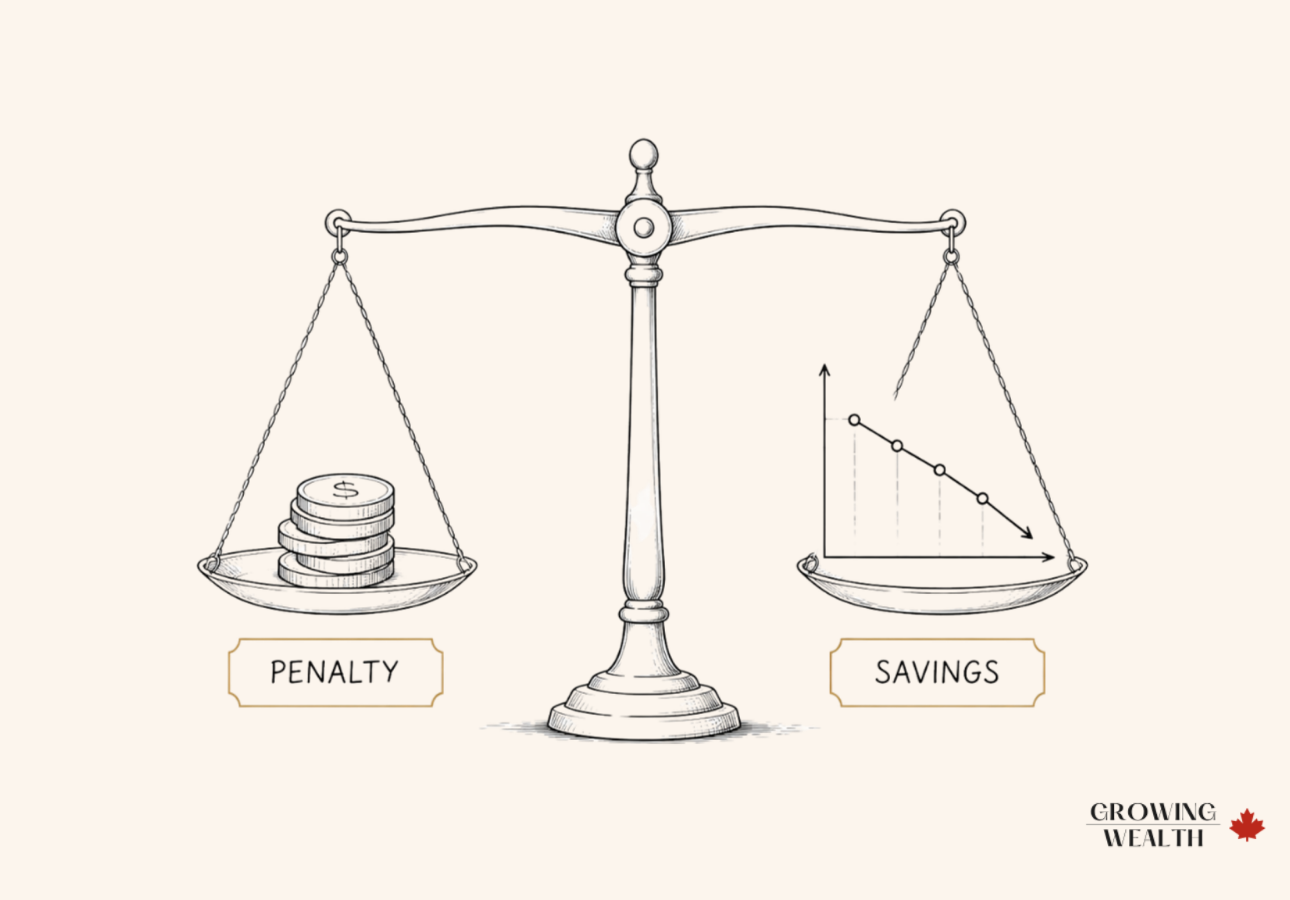
This is the part most articles gloss over, and it’s the part that decides whether refinancing is worth it. Your penalty formula depends entirely on which type of rate you have:
The penalty is simple: three months’ interest on the remaining balance. That’s it — no additional formula to worry about.
The penalty is whichever of these two is greater:
IRD compares your current rate to what the lender could get lending that money today, for your remaining term — and it almost always wins, growing larger the more your rate exceeds current market rates.
Say you have $400,000 remaining on a 5-year fixed mortgage at 5.5%, with 2 years left in your term, and current 2-year fixed rates are around 4.2%.
- Rate differential 5.5% − 4.2% = 1.3%
- Estimated IRD penalty $400,000 × 1.3% × 2 years ≈ $10,400*
- Interest saved over 2 years ≈ $10,400
- In this case, the penalty roughly offsets the savings
*Simplified estimate. Actual lender IRD formulas vary and are typically higher than this calculation. Always request your exact penalty quote from your lender before deciding.
Refinancing starts to make sense when the rate gap is wider, more time remains in the term, or the refinance is also solving a second problem, like debt consolidation or needed equity access, at the same time.
The 2026 Renewal Wave: Why This Year Is Different
More than a million Canadian mortgages are renewing in 2026, largely a wave of pandemic-era purchases hitting their first or second renewal. Roughly a third of Canadian mortgage holders are expected to see higher payments by the end of the year, with fixed-rate renewers seeing average increases around 20%.
The rate environment is also unusually split right now: 5-year fixed rates sit close to 3.9-4%, while 5-year variable rates are closer to 3.25-3.45%. That gap is wider than it’s been in years, largely because fixed rates track government bond yields, which have risen on geopolitical and trade uncertainty, while variable rates track the Bank of Canada’s overnight rate, which has held steady. If you’re renewing this year, that spread is worth factoring into your decision alongside renew-vs-refinance. If you haven’t already sized up what you can comfortably carry, our how much house can I afford guide walks through that math.
Pros and Cons
- No penalty, minimal paperwork, fast
- Full flexibility to shop and switch lenders without cost
- Doesn’t let you access equity or restructure the loan
- Easy to passively accept a non-competitive rate if you don’t shop around
- Access to home equity for renovations, investments, or debt consolidation
- Can lower monthly payments by extending amortization
- Prepayment penalty, which can run into the thousands
- Full re-qualification with new credit and income checks, plus legal, appraisal, and discharge fees
The Bottom Line
If you’re within a few months of your renewal date and your only goal is a better rate, wait and shop your renewal, don’t refinance early.
If you’re mid-term and need equity or want to consolidate high-interest debt, refinancing can pay for itself, but only after your lender gives you an exact penalty quote and you run the actual math, not an estimate.
Never take your lender’s first renewal offer or their in-house refinance pitch at face value. Both are starting points for negotiation, not final numbers.Frequently Asked Questions
Yes. Refinancing can happen at any point during your term, unlike renewal, which only happens at term end. Refinancing before your term ends will almost always trigger a prepayment penalty.
Refinancing involves a hard credit check as part of re-qualification, which can cause a small, temporary dip in your credit score. This is different from renewal, which typically doesn’t require a new credit check if you stay with your existing lender.
Yes. Switching lenders at renewal, rather than mid-term, is treated the same as a standard renewal and doesn’t trigger a prepayment penalty in most cases, though you may pay smaller fees like a discharge fee from your old lender.
Federally regulated lenders must send a renewal statement at least 21 days before your term ends. In practice, you should start shopping 3 to 4 months ahead to properly compare rates.
It depends on the offer. Your current lender may offer retention perks, but a new lender competing for your business often has more room to negotiate. Get quotes from both before deciding.
A blend-and-extend keeps your current lender and blends your existing rate with a new rate for an extended term, often without a full penalty. It’s a middle option worth asking your lender about if you want a lower rate without a full refinance.
Not necessarily. It depends on how your current rate compares to today’s rates. Many homeowners renewing from pandemic-era low rates are seeing increases, but if you locked in more recently at a higher rate, you may see your payment stay flat or decrease.
Yes. This is one of the changes that requires a refinance rather than a renewal, since it’s a substantive change to the mortgage contract, not just a rate reset.
Want the full picture of how mortgages work in Canada, from first purchase through renewal? Read Canadian Home Ownership: From First-Time Buyer to Mortgage Renewal — it ties together everything from pre-approval to paying off your home.