
For many Canadian families, one financial question keeps coming up:
Should you pay down your mortgage faster or invest the money instead?
On the surface, paying off your mortgage seems like the safest option. It reduces debt, lowers interest costs, and provides peace of mind.
But investing has the potential to grow your wealth significantly over time.
The challenge is that the “right” answer depends on several factors — including your mortgage rate, investment returns, taxes, and long-term financial goals.
In this guide, we’ll walk through:
- The math behind paying down your mortgage vs investing
- How taxes affect the decision in Canada
- When paying down your mortgage makes sense
- When investing is usually the better choice
- How compounding changes the outcome
If you’re building a long-term financial plan, this decision should fit into a broader strategy. Our guide to The Family Finance System for Canadians explains how Canadian households can structure saving, investing, and debt repayment together.
Should You Pay Down Your Mortgage or Invest in Canada?
For most Canadian families:
- Investing usually builds more long-term wealth if investment returns exceed mortgage interest rates.
- Paying down your mortgage provides a guaranteed return equal to your mortgage rate.
- A balanced strategy — investing while making occasional mortgage prepayments — often works best.
The right decision depends on:
- mortgage interest rates
- available TFSA or RRSP contribution room
- investment time horizon
- personal risk tolerance
Understanding these factors is essential before deciding whether to pay down your mortgage or invest.
The Core Question: Guaranteed Returns vs Market Returns
The fundamental difference between these two strategies is simple.
Paying down your mortgage provides a guaranteed return.
Investing provides uncertain but potentially higher returns.
Mortgage payoff = guaranteed return
Every extra dollar you put toward your mortgage reduces the interest you will pay.
If your mortgage rate is 5%, paying down your mortgage effectively gives you a risk-free 5% return.
Investing = market returns
Historically, diversified stock portfolios have returned roughly 7–10% annually over long periods.
Data from the Bank of Canada shows that equities have historically outperformed borrowing costs over long time horizons.
However, investment returns are not guaranteed. Markets fluctuate, and short-term losses are possible.
That uncertainty is the trade-off for higher long-term growth potential.
The Role of Compounding in This Decision
One of the biggest differences between investing and paying down your mortgage is how compounding works.
When you invest, your money can grow through compound returns — meaning you earn returns on previous returns.
For example:
- Invest $10,000
- Earn 7% annually
After one year:
$10,000 → $10,700
In the second year, the 7% return applies to $10,700, not the original $10,000.
Over time, this creates exponential growth.
Paying down your mortgage works differently.
When you make extra mortgage payments, you reduce the amount of interest charged on the remaining loan balance. This saves money, but the savings do not compound the same way investment returns do.
Instead of exponential growth, mortgage payoff produces steady interest savings over time.
This difference in compounding is one reason investing often produces greater wealth over long periods — especially when investment returns exceed mortgage rates.
A Simple Example: Mortgage vs Investing
Let’s compare two simplified scenarios.
Assume:
- Mortgage rate: 5%
- Investment return: 7%
- Extra money available: $500 per month
Option 1: Pay down the mortgage
Option 2: Invest the money
Adding $500 per month toward your mortgage saves interest and shortens the loan term.
Over time, this reduces the total interest paid on the mortgage.
Investing $500 per month with a 7% return could grow significantly over time.
After 25 years, monthly investments could grow to roughly:
$380,000+
The key difference is compounding. Investment returns compound year after year, while mortgage payoff simply reduces interest costs.
How Compounding Changes the Outcome (After Taxes)
Consider two ways to use $10,000.
Option 1: Pay down the mortgage
Mortgage rate: 5%
Paying down $10,000 saves about $500 per year in interest.
Because mortgage interest in Canada is not tax deductible, this is equivalent to earning a guaranteed 5% after-tax return.
Over 25 years, this payment might save roughly:
$12,500 in interest
Option 2: Invest the money
Invest $10,000 with an average 7% annual return.
After 25 years:
$10,000 → about $54,000 before taxes
The after-tax outcome depends on the account used.
If invested inside a TFSA
Investment growth is tax-free.
Final value after 25 years:
≈ $54,000
If invested inside an RRSP
RRSP investments grow tax-deferred but withdrawals are taxable.
If taxed at 30% in retirement:
$54,000 → about $37,800 after tax
If invested in a taxable account
Taxes reduce compounding because dividends and capital gains are taxed.
Effective returns may fall to 5–6% after tax, producing roughly:
$34,000–$43,000
Mortgage Paydown vs Investing: Key Differences
| Factor | Paying Down Mortgage | Investing |
|---|---|---|
| Return type | Guaranteed | Market-based |
| Growth pattern | Interest savings | Compound growth |
| Risk level | Very low | Moderate |
| Liquidity | Low | Higher |
| Tax advantages | None | TFSA / RRSP |
| Long-term wealth potential | Moderate | Often higher |
Mortgage vs Investing: The Break-Even Rule
A useful way to evaluate the decision is to calculate the break-even investment return.
The break-even return is the investment return required to match the guaranteed return from paying down your mortgage.
Because mortgage interest is not tax-deductible in Canada, the break-even return roughly equals your mortgage rate.
However, taxes may reduce investment returns depending on the account used.
Break-Even Investment Returns
| Mortgage Rate | Return Needed (TFSA) | Return Needed (Taxable Account) |
|---|---|---|
| 3% | 3% | ~4–5% |
| 4% | 4% | ~5–6% |
| 5% | 5% | ~6–7% |
| 6% | 6% | ~7–8% |
| 7% | 7% | ~8–9% |
When Paying Down Your Mortgage Makes Sense
Despite the potential benefits of investing, there are situations where paying down your mortgage may be the better choice.
1. Your mortgage rate is high
If mortgage rates approach 6–7%, the guaranteed return from paying down debt becomes very competitive.
2. You’re approaching retirement
Entering retirement with a paid-off home reduces required monthly income.
3. You value financial certainty
Some households prefer eliminating debt rather than accepting investment risk.
Should You Pay Off Your Mortgage Early in Canada?
Many Canadian homeowners ask a similar question:
Should I pay off my mortgage early?
Paying off your mortgage early can:
- reduce total interest costs
- eliminate monthly payments sooner
- provide financial security in retirement
However, accelerating mortgage payments also means tying up money in home equity rather than allowing it to grow through investments.
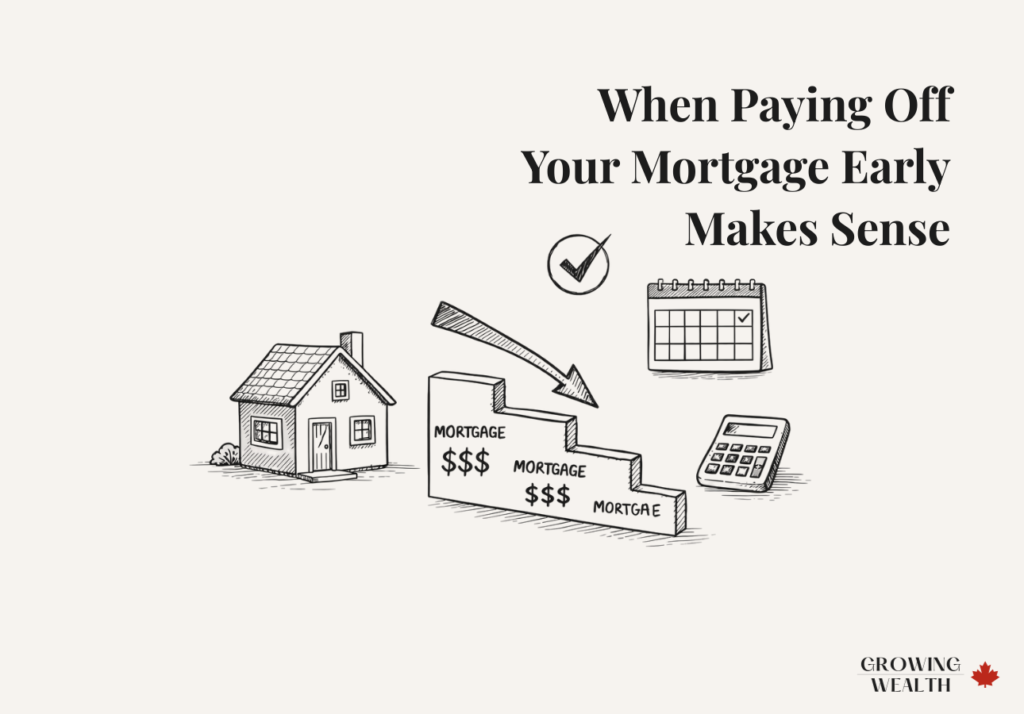
When Paying Off Your Mortgage Early Makes Sense
Paying off a mortgage early can be beneficial when:
- your mortgage rate is high
- you are close to retirement
- you have already maximized TFSA and RRSP contributions
- you prefer financial certainty over investment risk
When Investing May Be the Better Option
Paying off a mortgage early can be beneficial when:
- your mortgage rate is relatively low
- you still have TFSA contribution room
- you have a long investment horizon
- you are comfortable with market volatility
In these situations, the power of compound investment growth can significantly increase long-term wealth.
A Balanced Strategy Many Canadians Use
Many households combine both approaches.
A common framework looks like this:
- Maximize TFSA contributions
- Invest consistently for long-term growth
- Make occasional mortgage prepayments
This approach allows families to benefit from compound investment growth while steadily reducing debt risk.
What About Using Your Tax Refund?
Tax refunds often create the same decision.
Should you invest the refund or use it to pay down your mortgage?
If you’re deciding what to do with extra cash, such as a tax refund, the same framework applies. In our upcoming guide, “What Should You Do With Your Tax Refund?”, we walk through how Canadians can allocate their refunds among debt repayment, investing, and savings.
How Mortgage Renewal Changes the Decision
Many Canadians reassess this strategy during mortgage renewal.
If interest rates rise significantly, paying down the mortgage may become more attractive.
For example:
If a mortgage renews from 2% to 5.5%, the guaranteed return from paying down debt increases dramatically.
Guidance from the Canada Mortgage and Housing Corporation can help homeowners understand mortgage repayment options.
Final Thoughts
Deciding whether to pay down your mortgage or invest is one of the most common financial questions Canadian homeowners face.
The best choice depends on:
- mortgage interest rates
- tax-advantaged investment accounts
- time horizon
- risk tolerance
In many cases, the most effective approach is a combination of investing and gradual mortgage repayment.
Investing allows families to benefit from long-term compound growth, while mortgage payments steadily reduce debt and interest costs.
If you want a practical framework for organizing savings, debt, and investing together, read our guide to The Family Finance System for Canadians.
Frequently Asked Questions
Is it better to pay off your mortgage or invest in Canada?
If expected investment returns exceed mortgage interest rates, investing may build greater long-term wealth. However, paying off a mortgage provides a guaranteed return and reduces financial risk.
Should I max my TFSA before paying down my mortgage?
In many cases, yes. TFSA investment growth is tax-free, making it one of the most powerful investment tools available to Canadians.
Does paying off a mortgage early save money?
Yes. Extra mortgage payments reduce total interest paid and shorten the mortgage term.
Can I do both?
Many Canadians choose a hybrid strategy — investing regularly while making occasional mortgage prepayments.
Affiliate Disclosure
💡 GrowingWealth.ca is supported by readers. Some of the links in this article are affiliate links, which means we may earn a small commission if you open an account or make a purchase — at no extra cost to you. We only recommend products and services we personally use, trust, or believe provide genuine value to Canadians. Our reviews and comparisons are always independent and objective.