

Unlocking Family Savings with the TFSA in 2026
Every family has different goals. Some want to build a safety net for unexpected expenses, others are saving for their children’s future, and many are simply looking for smarter ways to grow money without giving more back to the government in taxes.
That’s where the Tax-Free Savings Account (TFSA) comes in. Since it was introduced in 2009, the TFSA has become one of Canada’s most popular and flexible financial tools—and for good reason. It’s not just a “savings account.” It’s a versatile investment vehicle that allows your money to grow tax-free, no matter what you’re saving for.
In 2026, contribution limits are higher than ever, and families across Canada are using TFSAs to reach milestones faster—whether that’s buying a home, funding kids’ activities, planning for retirement, or simply having peace of mind with an emergency fund.
This guide will walk you through everything Canadian families need to know about TFSAs in 2026: how they work, why they matter, practical strategies, and which providers are best for your family’s goals.
What Is a TFSA? (Clear Definitions & Overview)
A Tax-Free Savings Account (TFSA) is a registered account that lets Canadians grow investments tax-free. You don’t get a tax deduction when you contribute (like with an RRSP), but any income earned—whether from interest, dividends, or capital gains—is completely tax-free, even when withdrawn.
Key TFSA Facts in 2026:
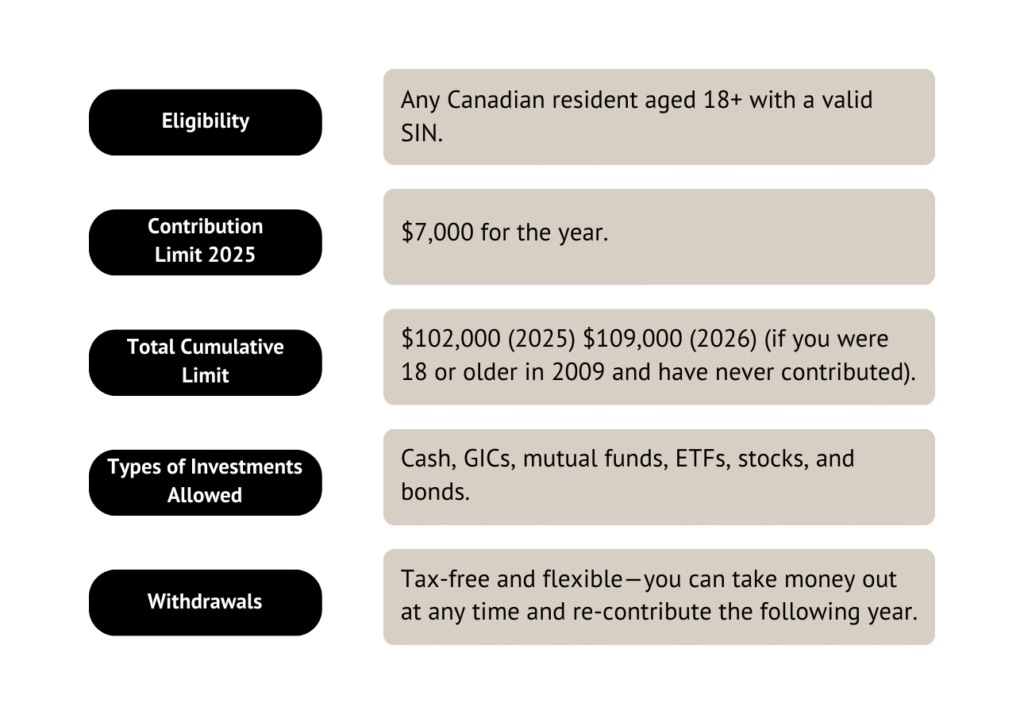
Think of it as a basket: you can hold many different investments inside your TFSA basket, and all the growth is sheltered from taxes.
Why TFSAs Matter for Families
For families juggling day-to-day expenses and long-term goals, flexibility is key. The TFSA is one of the most versatile accounts in Canada, making it ideal for:
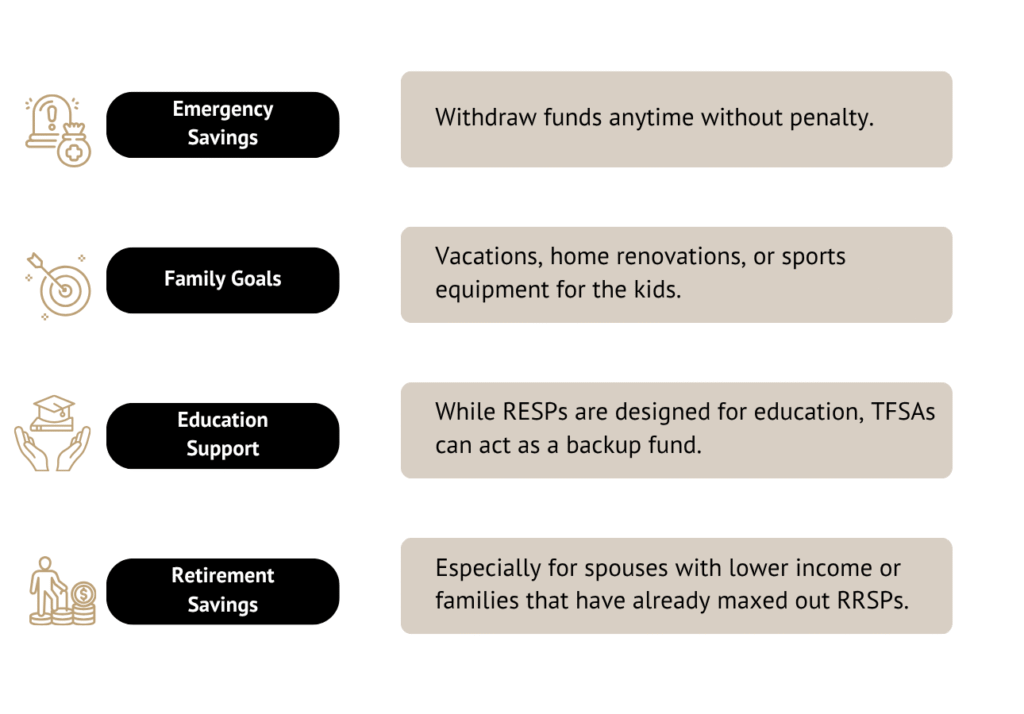
Unlike RESPs or RRSPs, there are no restrictions on how you use TFSA withdrawals. That flexibility makes it one of the most family-friendly accounts available.
TFSAs vs. Other Accounts (Comparison & Context)
To understand where TFSAs fit in your family’s financial plan, it helps to compare them with other registered accounts.
| Account | Tax on Contributions | Tax on Withdrawals | Best Use Cases | Contribution Limit 2025 & 2026 |
| TFSA | No deduction | Tax-free | Emergency fund, family goals, long-term investing | $7,000/year ($102,000 (2025), $109,000 (2026) lifetime max if never contributed) |
| RRSP | Deductible | Taxed as income | Retirement savings, high earners | 18% of income (max $32,490 in 2025 and $33,810 in 2026) |
| FHSA | Deductible | Tax-free if used for home | First-time home buyers | $8,000/year (max $40,000) |
| RESP | No deduction | Taxed to student (usually low rate) | Education savings for kids | $5,000/year per child ($50,000 lifetime) |
Click the links above for our companion article on each account type.
Key takeaway:
- TFSA = flexibility + tax-free growth.
- RRSP = retirement tax planning.
- FHSA = home savings.
- RESP = education savings.
Most families benefit from using TFSAs alongside these other accounts.
Pros & Cons of TFSAs

- Tax-free growth: No tax on gains, interest, or withdrawals.
- Flexibility: Use funds for any purpose.
- Re-contribution: Amounts withdrawn are added back to your room the next year.
- Wide investment options: From safe GICs to growth-focused ETFs.
- No impact on benefits: Withdrawals don’t affect federal benefits like CCB or OAS.

- Contribution limits: Lower than RRSPs; may not be enough for retirement on its own.
- Over-contribution penalties: 1% per month on the excess amount.
- Temptation to spend: Easy withdrawals can undermine long-term goals if discipline is weak.
- No tax deduction: Contributions don’t reduce taxable income.
Real-Life Examples: How Families Use TFSAs

Strategies & Best Practices for Families
Best TFSA Providers in Canada (2026 Options)
Not all TFSAs are created equal. The best account depends on whether your family wants high interest, low fees, or wide investment choices.
| Provider | Best For | Features | 2026 Highlights |
| Wealthsimple | Beginner investors | Commission-free trading, robo-advisor | Easy to use, no account minimum |
| Neo Financial | High-interest savings | Up to 1.75%+ interest on TFSA savings account | Great for emergency funds |
| Tangerine | Everyday banking families | No fees, decent savings rates | Easy link with chequing |
| Questrade | DIY investors | Low-cost ETF trading | Strong choice for long-term growth |
| RBC, TD, CIBC, BMO, Scotiabank | Full-service banking | Wide investment options, advice access | Best if you want everything in one place |
Quick Tips
- If you want growth → consider Questrade or Wealthsimple.
- If you want savings security → choose EQ Bank or Wealthsimple.
- If you want one-stop banking → stick with a Big Five bank.
Building Your Family’s Future with a TFSA
In 2026, Canadian families face real challenges—higher costs, uncertain markets, and competing priorities. The TFSA remains one of the most flexible and powerful tools for saving and investing. Whether you’re building an emergency fund, saving for your children’s future, or creating financial security for retirement, a TFSA can help you grow wealth tax-free while keeping full control of your money.
The key is consistency: even small monthly contributions add up, and the tax-free growth is invaluable over time.
👉 Ready to open your TFSA? Consider starting with low-fee options like Wealthsimple, which is a great all-around option
👉Need help choosing between Registered Accounts? Download our free Registered Accounts Comparison Guide—a clear breakdown for Canadian families.
💡 Want to turn what you’ve just learned into lasting results?
Read our cornerstone guide — The Power of Financial Habits: How to Build Lasting Wealth — and learn how small, consistent actions create real financial freedom.
Affiliate Disclosure
💡 GrowingWealth.ca is supported by readers. Some of the links in this article are affiliate links, which means we may earn a small commission if you open an account or make a purchase — at no extra cost to you. We only recommend products and services we personally use, trust, or believe provide genuine value to Canadians. Our reviews and comparisons are always independent and objective.