
The Big Question for Canadian Families
Every year, Canadians are reminded about one of the smartest financial moves they can make: contributing to registered accounts like the RRSP (Registered Retirement Savings Plan) and TFSA (Tax-Free Savings Account).
Both accounts come with powerful tax benefits, but they work differently—and knowing which one to prioritize can mean thousands of extra dollars in your pocket over time.
With our financial life becoming more complex, many Canadian families are asking:
👉 RRSP or TFSA: What’s better for me?
This guide will give you a clear, beginner-friendly breakdown, practical examples, and strategies to help you make the best choice for your household.
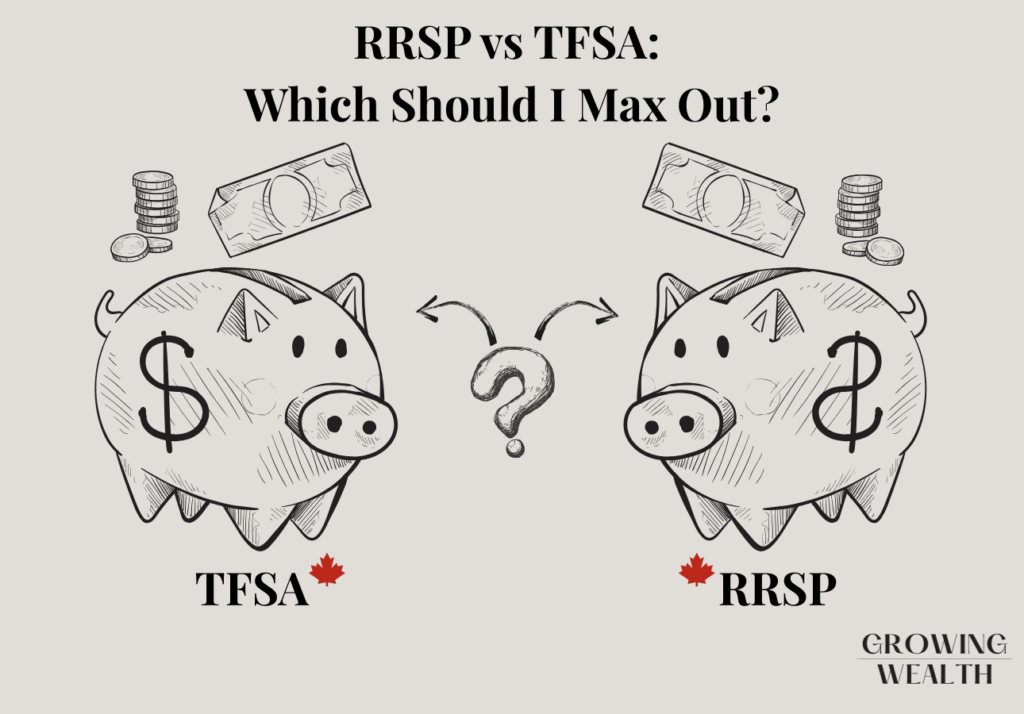
The RRSP is designed primarily for retirement savings.
- Contribution limit: 18% of last year’s earned income, up to $32,490 in 2025 (up to $33,810 in 2026) (plus unused room from previous years).
- Tax treatment: Contributions are tax-deductible, lowering your taxable income today. Investments inside grow tax-free, but withdrawals are taxed later as income.
- Best use case: When your income is higher now than it will be in retirement.
Think of an RRSP like a tax deferral bucket: you get a tax break today, but you’ll pay tax later when you pull the money out.
What is a TFSA? (Tax-Free Savings Account)
The TFSA is much more flexible.
- Contribution limit: $7,000 in 2025 and $7,000 in 2026. Since 2009, total room adds up to $102,000 (2025) and $109,000 (2026) if you were 18+ at the start.
- Tax treatment: Contributions are not deductible, but growth and withdrawals are completely tax-free.
- Best use case: Flexible savings goals, like buying a car, building a house down payment, or supplementing retirement.
Think of a TFSA like a greenhouse: whatever you plant inside grows tax-free, and when you harvest, you don’t share it with the CRA.
RRSP vs TFSA: Key Differences
| Feature | RRSP | TFSA |
| Contribution Limit | 18% of prior years’ earned income max $32,490 in 2025 max $33,810 in 2026 | $7,000 in 2025 (lifetime $102,000+) $7,000 in 2026 (lifetime $109,000+) |
| Contribution Room | Builds with earned income, unused carries forward | Fixed annual amount, unused carries forward |
| Tax on Contributions | Deductible (reduces taxable income today) | Not deductible |
| Tax on Growth | Tax-deferred | Tax-free |
| Tax on Withdrawals | Taxed as income | Withdraw anytime, no tax |
| Best for | Retirement savings, high earners | All-purpose savings, lower earners, flexible goals |
| Impact on Benefits | Withdrawals may reduce OAS/GIS eligibility | Withdrawals don’t affect government benefits |
| Age Limit | Must convert to RRIF at age 71 | No age limit (18+) |

RRSP Pros
- Contributions lower taxable income
- Bigger limits for high earners
- Ideal for long-term retirement planning
- Programs like Home Buyers’ Plan (HBP) and Lifelong Learning Plan let you use your savings to buy a first home or go back to school
RRSP Cons
- Withdrawals are fully taxed
- Must collapse by age 71
- Not flexible for short-term goals
TFSA Pros
- Withdraw anytime, tax-free
- Growth is never taxed
- Doesn’t affect benefits like OAS
- Great for emergencies or near-term goals
TFSA Cons
- Lower annual contribution limit
- No immediate tax deduction
- Easy to accidentally over-contribute (penalties apply)
Which Should You Max Out First?
The right choice depends on your income level, tax bracket, and financial goals.
- High income now, lower in retirement → RRSP first
Example: Sarah earns $100,000 today. She contributes $15,000 to her RRSP, saving about $5,000 in taxes immediately. In retirement, she expects to withdraw at a much lower rate, paying less tax overall. - Lower income now, higher expected later → TFSA first
Example: Mark earns $40,000 today. Contributing to an RRSP doesn’t save him much tax now, but putting money into a TFSA means all his future growth and withdrawals are tax-free. - Need flexibility → TFSA first
Example: A family saving for a down payment can invest in a TFSA, knowing they can withdraw tax-free when the time comes.
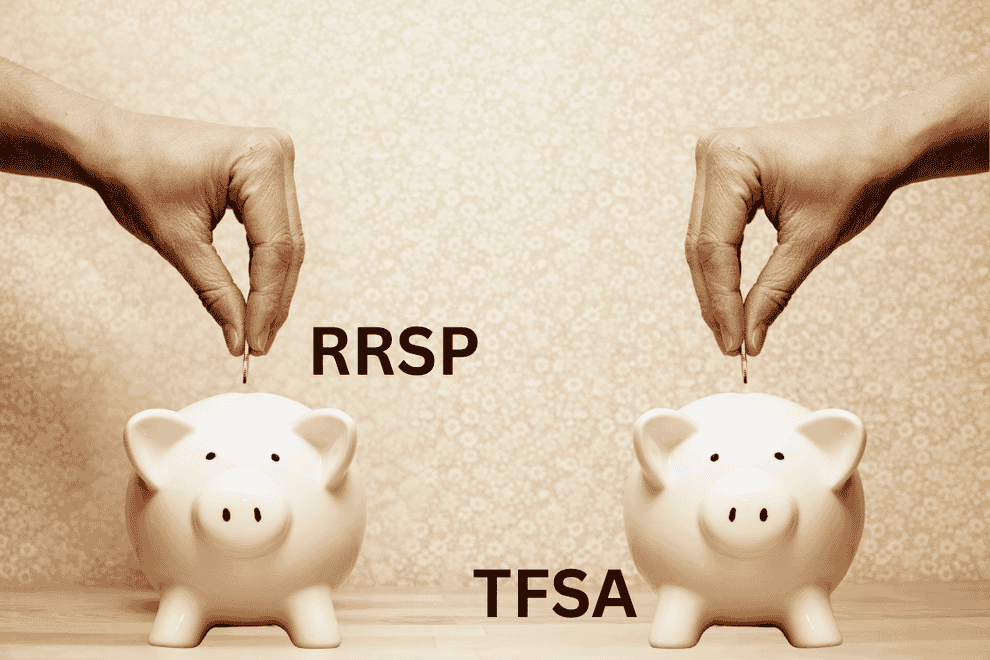
Practical Scenarios for Canadian Families
- Young Family with Moderate Income
- Household income: $80,000 combined
- Goal: Save for a house in 3 years
- Best option: TFSA (flexibility and no tax on withdrawal)
- Mid-Career Couple with High Income
- Household income: $200,000 combined
- Goal: Retirement planning
- Best option: RRSP (big tax deductions today, reinvest refund into TFSA)
- Parents Savings for Emergencies + Retirement
- Household income: $120,000 combined
- Goal: Build emergency fund + long-term nest egg
- Best option: Use both – TFSA for emergencies, RRSP for retirement.
Strategies & Best Practices
- Double Dip Refunds: Contribute to an RRSP, then use your tax refund to top up your TFSA.
- Automate Savings: Set up monthly contributions so you don’t have to think about it.
- Avoid Over-Contributions: Check your CRA MyAccount to track your room.
- Think Long-Term: RRSP is retirement-focused, TFSA is flexible—use each where it fits best.
- Use Both Accounts Together: The most powerful strategy is often a mix, not either/or.
Best Options for RRSP and TFSA in Canada
If you’re ready to invest, here are some of the most popular and beginner-friendly platforms in Canada:
- Wealthsimple
- $0 account minimum
- Easy app and web platform
- RRSP, TFSA, RESP all available
- Best for: all around investing or saving
- Questrade
- Best for: DIY investors
- Low trading fees
- Wide account options (RRSP, TFSA, RESP)
- EQ Bank
- Best for: Registered Savings connected to your daily banking DIY investors
- Guaranteed Savings (GIC’s and High-Interest Savings)
- Wide account options (RRSP, TFSA, RESP)
For most families looking for simplicity and great value, Wealthsimple is an excellent starting point.
👉Want more like this? Sign up for our newsletter to get more content like this delivered straight to your inbox
💡 Want to turn what you’ve just learned into lasting results?
Read our cornerstone guide — The Power of Financial Habits: How to Build Lasting Wealth — and learn how small, consistent actions create real financial freedom.
Affiliate Disclosure
💡 GrowingWealth.ca is supported by readers. Some of the links in this article are affiliate links, which means we may earn a small commission if you open an account or make a purchase — at no extra cost to you. We only recommend products and services we personally use, trust, or believe provide genuine value to Canadians. Our reviews and comparisons are always independent and objective.