

Setting Your Kids Up for Success
Every Canadian parent dreams of giving their children the best possible start in life—and that includes higher education. But tuition costs are climbing every year, and it can feel overwhelming to figure out how to pay for university, college, or even trade school.
That’s where Registered Education Savings Plans (RESPs) in Canada (2026) come in.
An RESP isn’t just a savings account—it’s a government-supported program designed to make post-secondary education more affordable. With generous grants, tax-free growth, and flexible options, RESPs can help turn small monthly contributions into a big financial boost when your child is ready for school.
This comprehensive 2026 guide will break down what RESPs are, why they matter, how they compare to other accounts, the pros and cons, strategies to maximize benefits, the best RESP providers in Canada, and provincial bonuses your family may qualify for.
What Is an RESP? (Overview)
A Registered Education Savings Plan (RESP) is a special investment account that helps families save for a child’s future education.
How It Works
- Contributions: Parents, grandparents, or anyone else can contribute up to $50,000 lifetime per child.
- Government Grants: The federal government matches part of those contributions through the Canada Education Savings Grant (CESG) and other programs.
- Tax-Free Growth: Money inside the RESP grows tax-free until it’s withdrawn.
- Withdrawals: When the child enters post-secondary, money is paid out as:
– Educational Assistance Payments (EAPs) = grants + growth (taxable in the student’s hands, usually very low or no tax).
– Contributions = returned tax-free to whoever contributed.
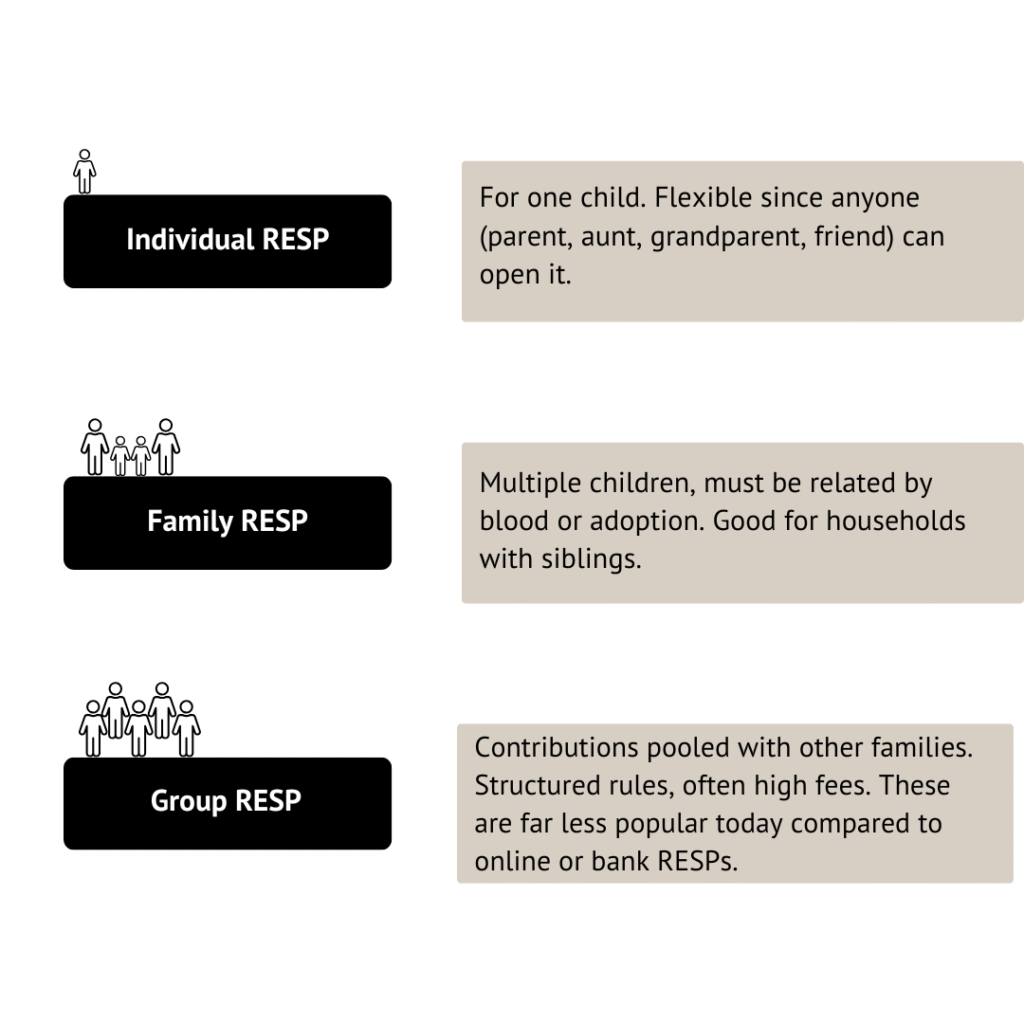
Types of RESPs
Why RESPs Matter for Families in 2026
Education is one of the biggest investments parents make. According to Statistics Canada, the average undergraduate tuition in Canada is over $7,000 per year. Add in books, supplies, transportation, and living costs, and the total can easily exceed $20,000 per year.
For a four-year degree, you’re looking at $80,000+. Without a plan, many students graduate with tens of thousands in student loan debt.
Why Families Should Care
- Free Money – The CESG gives you 20% back on contributions (up to $500 per year, per child). That’s a guaranteed return you can’t find elsewhere.
- Less Debt for Kids – RESP savings mean fewer student loans. Your child starts their adult life with financial freedom.
- Flexibility of Use – Funds can be used for universities, colleges, trade schools, apprenticeships, and even some programs abroad.
- Encourages Saving – Families who use RESPs often save more consistently. Even $25/month adds up over time.
In a world where inflation is squeezing families, an RESP is one of the few financial tools that makes your money go further.
RESPs Compared to Other Accounts
Families often wonder: should I use an RESP, a TFSA, or an RRSP? Here’s the comparison:
| Account | Purpose | Growth | Government Incentives | Withdrawals | Best For |
| RESP | Education savings | Tax-deferred growth | CESG (20% match up to $500/year) + provincial grants | Grants/growth taxable to student; contributions tax-free | Families saving for post-secondary |
| TFSA | General savings | Tax-free growth | None | Tax-free anytime | Flexible savings goals |
| RRSP | Retirement savings | Tax-deferred growth | Tax deduction on contributions | Taxable in retirement | Long-term retirement planning |
Takeaway: If your main goal is education savings, the RESP is unmatched because of the government match. But families often layer accounts—RESP for education, TFSA for flexibility, RRSP for retirement.
Click the links above for our companion article on each account type.
Pros & Cons of RESPs

- Government Grants: Up to $7,200 CESG per child.
- Tax Advantages: Growth inside the RESP isn’t taxed until withdrawal.
- Family-Friendly: Family RESPs let you share funds among siblings.
- Flexible Education Options: Covers apprenticeships, trade schools, and some international studies.

- Contribution Limits: Max $50,000 lifetime per child.
- Grant Limits: CESG capped at $500/year ($1,000 if catching up).
- Education Restriction: If the child doesn’t pursue post-secondary, grants must be returned.
- Complex Rules: Especially for group RESPs or if you have multiple beneficiaries.
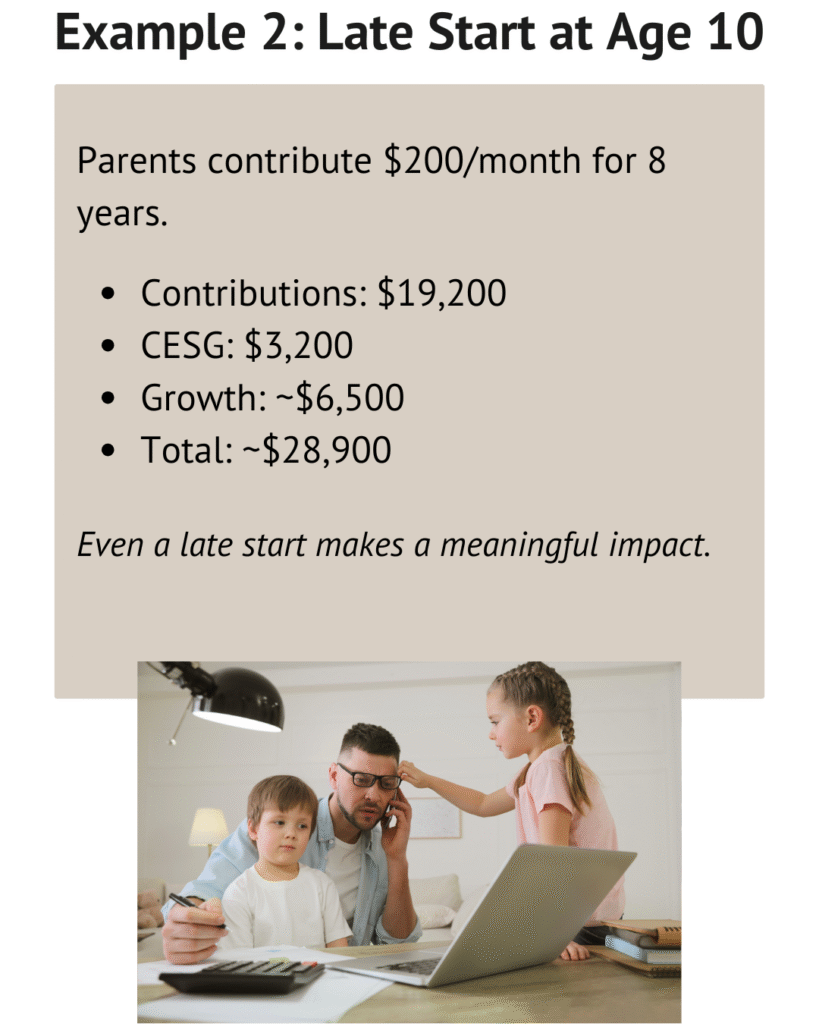
Real-Life Examples


Strategies & Best Practices
Best RESP Providers in Canada (2026)
When choosing a provider, compare fees, investment options, and convenience.
| Provider | Highlights | Best For |
| Wealthsimple | Low fees, automated portfolios, easy online access | Busy parents who want hands-off investing |
| Questrade | DIY investing with ETFs/stocks, lowest trading fees | Parents comfortable managing investments |
| Big 5 Banks (RBC, TD, BMO, CIBC, Scotiabank) | Wide branch access, full-service investing | Families preferring in-person help |
| Knowledge First Financial | RESP-focused, but higher fees | Families wanting structured group RESP |
| EQ Bank / Motive Financial | Online banks with simple RESP savings | Parents wanting no-fee simplicity |
Things to Consider When Choosing a Provider
- Fees: High fees eat into long-term growth.
- Flexibility: Can you invest in ETFs, or is it limited to GICs?
- Convenience: Do you want to manage it yourself or prefer a “set it and forget it” approach?
- Support: Larger banks offer in-person guidance, while online brokers offer digital-only support.
Invest in Your Child’s Future
For Canadian families in 2026, an RESP is one of the smartest financial tools available. With government grants, tax-free growth, and flexible investment options, it turns every dollar you save into a bigger opportunity for your child.
Whether you start small or go all in, the key is consistency. Even $25/month builds a foundation for the future.
👉 Ready to open your RESP? Open your account with a top provider like Wealthsimple and take your first step toward securing your child’s education.
👉Need help choosing between Registered Accounts? Download our free Registered Accounts Comparison Guide—a clear breakdown for Canadian families.
💡 Want to turn what you’ve just learned into lasting results?
Read our cornerstone guide — The Power of Financial Habits: How to Build Lasting Wealth — and learn how small, consistent actions create real financial freedom.
Affiliate Disclosure
💡 GrowingWealth.ca is supported by readers. Some of the links in this article are affiliate links, which means we may earn a small commission if you open an account or make a purchase — at no extra cost to you. We only recommend products and services we personally use, trust, or believe provide genuine value to Canadians. Our reviews and comparisons are always independent and objective.